Four Mobile Restaurants Donate Proceeds for Dining Out for Life
Four Mobile restaurants donated a share of a day's food sales to AIDS Alabama South as part of the national Dining Out for Life fundraiser event.
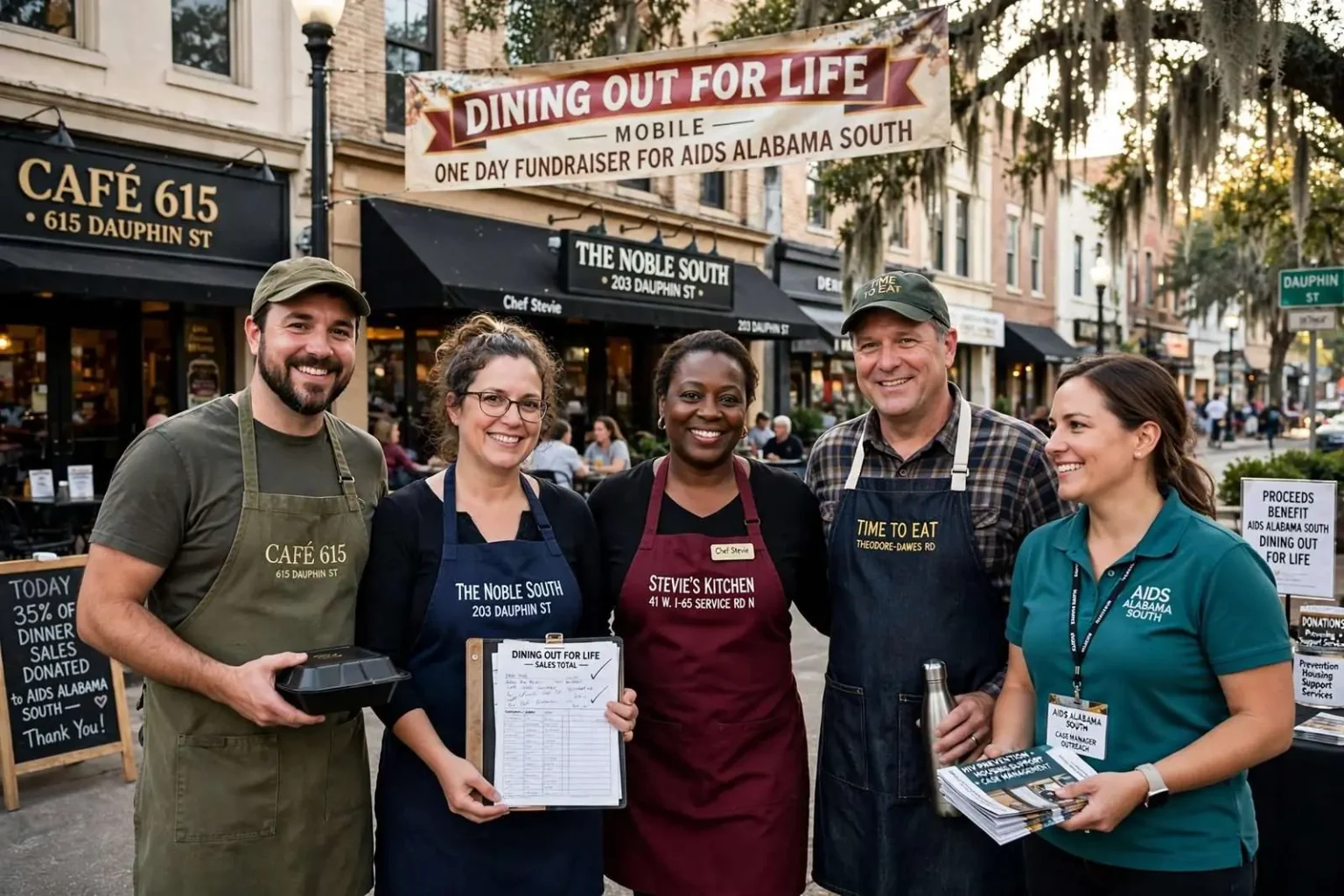
Four Mobile restaurants opened their doors for a good cause this week, joining the national Dining Out for Life campaign by donating a share of a day’s food sales to local HIV and AIDS services. The one-day fundraiser asks participating restaurants to set aside a percentage of either lunch or dinner proceeds — sometimes both — for a local partner organization. In Mobile, that partner was AIDS Alabama South, a nonprofit that provides HIV prevention education, housing assistance and direct services to people living with HIV/AIDS across the region.
The participating establishments spanned the city’s dining map. Café 615, located at 615 Dauphin St. in downtown Mobile, pledged 35 percent of its dinner sales for the day. Just up the street, The Noble South at 203 Dauphin St. committed a quarter of both its lunch and dinner proceeds. Stevie’s Kitchen, situated at 41 W. I-65 Service Road North, donated 35 percent of its lunch sales, while Time to Eat, out on Theodore-Dawes Road, gave 25 percent of dinner revenue for the day.
How the Campaign Works
The structure of the campaign means diners do not need to do anything beyond showing up and ordering a meal as they normally would — the restaurant handles the donation on the back end, making it one of the lowest-friction ways for residents to support a local cause. There are no tickets to buy, no forms to fill out and no special menu to order from; a plate of lunch at Stevie’s Kitchen or dinner at Café 615 becomes a contribution by default.
For restaurants, the appeal is twofold: goodwill in the community and a built-in reason to draw extra foot traffic on a weekday. Managers of participating spots typically see regulars bring friends, and first-time visitors discover a restaurant they return to long after the fundraiser ends. The donation percentage is calculated on food sales for the day, so the restaurant’s contribution grows directly with the size of the crowd it draws.
From Grassroots Beginning to National Reach
Dining Out for Life began decades ago as a grassroots response to the AIDS epidemic and has since grown into an annual event held in cities across North America, with local restaurants and local nonprofits pairing up in each participating market. The model’s simplicity explains its endurance: rather than organizing a gala or a walk, each city’s host organization simply mobilizes the restaurants it already knows, and the public does the rest one meal at a time.
The campaign’s history is rooted in the years when an AIDS diagnosis carried isolation and stigma along with illness, and when community fundraisers were often the difference between services existing and not existing. As treatment transformed the disease, the fundraiser evolved too, shifting toward supporting the housing, case management and prevention work that remain essential. Cities that have participated for decades report that the event also functions as an annual moment of public education, quietly countering stigma by making support for people living with HIV an ordinary act of eating out.
AIDS Alabama South’s Role in the Region
AIDS Alabama South, the beneficiary of this year’s Mobile event, works throughout the region providing case management, housing support and prevention outreach, filling a role that becomes especially important in areas without ready access to specialized HIV care. Its staff connects clients to medical services, helps secure stable housing and runs education programs aimed at stopping new infections — services that stretch across southwest Alabama, where clients may live hours from the nearest major medical center.
Organizers say fundraisers like this one help supplement grant funding and give the organization more flexibility to respond to clients’ immediate needs. Grants and government contracts typically come with restrictions on how dollars can be spent, while community-raised funds can cover the gaps — a rent deposit, a utility bill, transportation to a medical appointment — that determine whether a client’s treatment plan holds together.
Housing assistance in particular has become central to modern HIV services. Stable housing is closely linked to consistent medical care and better health outcomes, and programs that help clients keep or obtain housing are among the most effective tools in the field. Community fundraisers help sustain that work between grant cycles.
Mobile’s Tradition of Restaurant Fundraisers
Restaurant-based charity days have become a recurring feature of Mobile’s civic calendar, offering a way for small and mid-size local eateries to participate in national campaigns without major disruption to their daily operations. A single-day percentage donation requires no special equipment, staffing or menu changes — just a willingness to track sales and hand over a share, along with the publicity effort to bring customers in.
The Dauphin Street corridor, where both Café 615 and The Noble South operate, has long been the center of the city’s dining and nightlife scene, and its restaurants frequently anchor charity events. Spots farther from downtown, like Stevie’s Kitchen near the I-65 service road and Time to Eat on Theodore-Dawes Road, extend the reach of such campaigns into west Mobile neighborhoods, making participation possible for diners across the city rather than only those headed downtown.
A Modest Slice of a National Effort
Mobile’s four participating restaurants represent a modest but meaningful slice of that broader effort, channeling a single day of retail dining directly into services for South Alabama residents affected by HIV. In the accounting of a national campaign, one city’s four restaurants may look small; in the accounting of a local nonprofit’s annual budget, a day’s worth of committed sales from four busy kitchens is anything but.
Organizers of past Dining Out for Life events have said participation tends to grow slowly year over year as more restaurant owners learn about the program and see it as a straightforward way to give back. The low barrier to entry works in the campaign’s favor: an owner who hears from a peer that the day required little extra effort is more likely to sign on the next year, and each additional restaurant multiplies the funds raised without multiplying the organizing burden.
What Diners Can Do Beyond the Event
Residents interested in supporting AIDS Alabama South directly, outside of the annual dining event, can find information about the organization’s services and how to contribute through its social media channels and community outreach events held throughout the year. Direct donations, volunteering and participation in the organization’s other awareness events all extend the impact of the restaurant fundraiser beyond its single day.
The dining event also gives the organization a public platform. Staff and volunteers often use the day to answer questions, hand out prevention information and remind the community that services are available — outreach that reaches an audience the organization might not otherwise meet.
The Week That Was in Mobile Dining
For the four restaurants, the week wrapped with their kitchens returning to normal service and their owners tallying the day’s totals for the donation. For AIDS Alabama South, the proceeds become part of the quiet financial backbone that keeps case managers employed, housing assistance flowing and prevention education running across the region.
And for the diners who filled the tables at Café 615, The Noble South, Stevie’s Kitchen and Time to Eat, the event offered the rare alignment of a good meal and a measurable good deed — the formula that has kept Dining Out for Life alive in cities across North America for decades, and that Mobile’s restaurant community has now made its own.
The Economics of a One-Day Giveback
From a restaurant’s side of the ledger, a 35 percent commitment on a day’s sales is a serious number, which is why participation is often framed as a statement of values rather than a marketing expense. The donation comes off the top before labor, food costs and overhead are considered, meaning the restaurant effectively funds much of the gift from its own margin. Owners who sign up at that level tend to treat the day as a community investment, banking on the goodwill and new customers to balance the ledger over time.
The dining public, meanwhile, effectively leverages its regular spending. A family that eats out on the event day at a participating restaurant channels more than a third of that check — at some locations — to services they might never think to fund otherwise. Fundraising researchers have long noted that such low-effort mechanisms reliably outperform appeals that ask people to do something new; the diner does not change behavior, only destination.
HIV Services in the Deep South
The need for organizations like AIDS Alabama South in the Gulf South is well documented. The region has long carried some of the highest rates of new HIV diagnoses in the country, often paired with rural health care deserts, limited public transit and persistent stigma that keeps people from seeking testing and treatment. Nonprofits in Mobile serve as the connective tissue between clients and a medical system that can be difficult to navigate without help.
Prevention outreach — free testing, education campaigns and linkage to care — is the front end of that work, while housing and case management hold together the long-term side. Each dollar raised through events like Dining Out for Life supports that continuum, which is why the organization and its restaurant partners describe the fundraiser as a community health effort as much as a charity night.