Panera Bread Looked the Part. Then the Roast Beef Arrived.
Our critic called the Asiago roast beef one of the worst sandwiches he had ever eaten, and found the dining room of the Schillinger Road bakery-cafe littered while the staff stood around.
Panera Bread arrived in Mobile as one of a new breed of chain restaurants that seemed, on paper, to have everything: a handsome building, a comfortable interior, a long menu of light meals, breads and pastries, and free Wi-Fi that had made it a natural office for anyone with a laptop and an hour to spend. By the middle of the 2000s the St. Louis-based bakery-cafe chain had spread across the country on exactly that formula, positioning itself somewhere between a fast-food counter and a sit-down restaurant, and Mobile’s westward growth along Airport Boulevard and the Schillinger Road corridor made the area a predictable stop for national chains hunting for new customers. Our anonymous dining correspondent visited the Schillinger Road location in the spring of 2008 to see whether the reality lived up to the formula.
He found the building attractive and the staff pleasant — several young women who appeared to be of late high school or early college age, taking orders and running food with the efficiency the chain trains into its crews. Almost nothing else, however, recommended itself. The decor was handsome in the way that a thousand identical Panera interiors across the country are handsome: warm woods, soft lighting, shelves of displayed bread, a fireplace-style seating area meant to suggest a neighborhood bakery rather than a corporate franchise. For a first-time visitor the impression is genuinely pleasant. The trouble, as this visit made clear, begins when the food arrives.
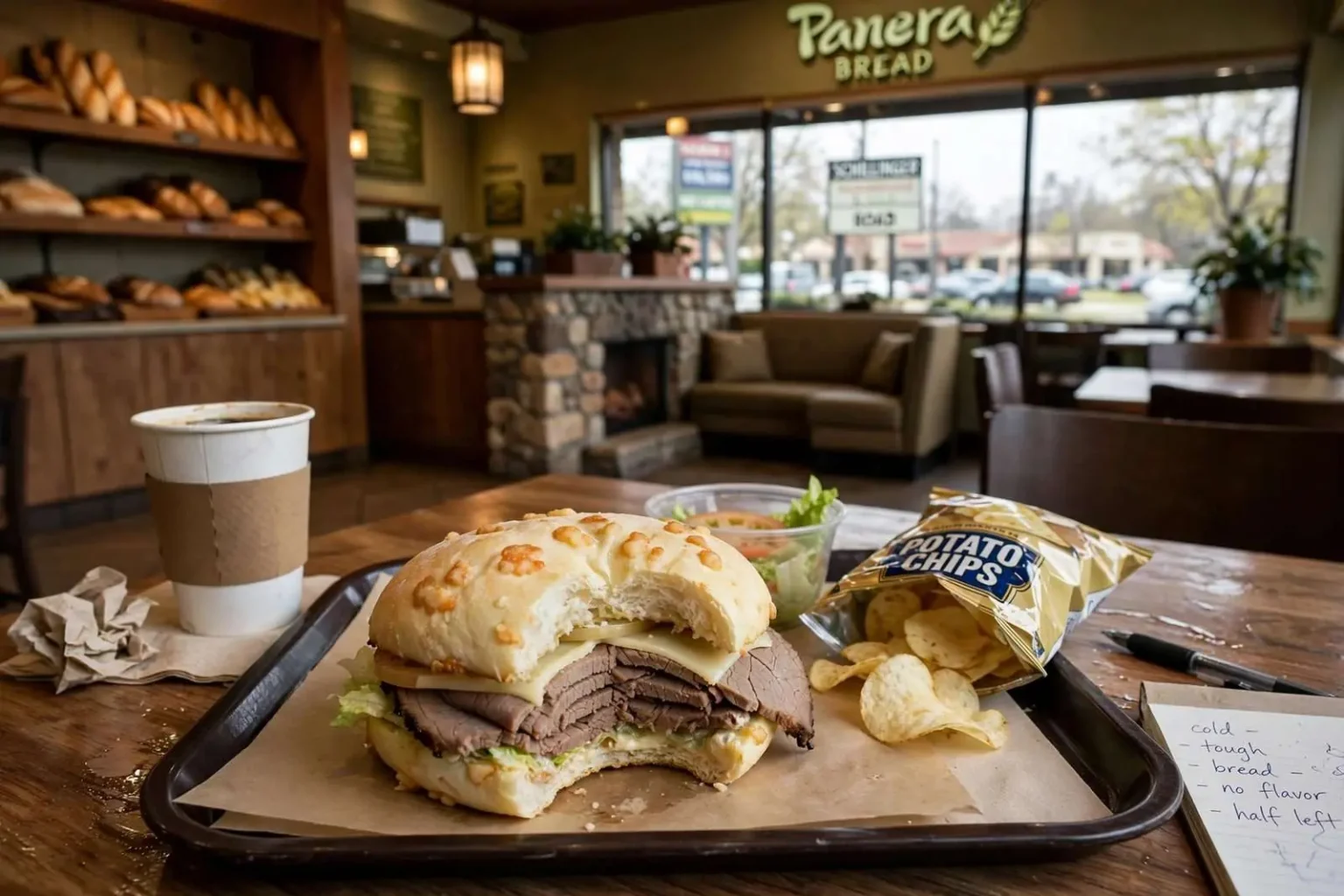
Ordering at the counter, our correspondent chose the Asiago Roast Beef, dressed with lettuce, tomato, cheese and a horseradish sauce, served on an Asiago cheese demi roll. His dining companion took a half Chipotle Chicken Panini with a side salad. Each order came with a bag of potato chips, the chain’s standard accompaniment for guests who do not upgrade to a side of soup, fruit or bread. The ordering process itself was quick and friendly, the food was delivered to the table within minutes, and the tray looked the part — which, on a menu built around visual appeal as much as taste, counts for something.
“My sandwich was, without a doubt, one of the worst roast beef sandwiches I have ever had ….. ever,” he wrote, and then itemized the reasons. The cold beef tasted, to him, as though it had been cooked long before and left in a refrigerator far too long, a complaint that points to the central tension of any chain that par-cooks and chills its proteins at a central facility and finishes them in the store. The cheese was cold and chewy. The lettuce was lettuce — present, but contributing nothing. The tomato slices were too cold and too crisp, and not, in his judgment, from a good tomato; refrigeration robs a tomato of both texture and flavor, and these had clearly been stored well below the temperature at which a tomato remains worth eating.
There was only a hint of the horseradish sauce, which might have been the sandwich’s one chance at distinction. And the bread — at a restaurant whose name is Bread, in a chain that built its reputation on freshly baked loaves displayed behind the counter — was tough and difficult to bite or chew. A diner can forgive a lot at a sandwich shop, but not the bread. The chips, he concluded, were the best item in the basket, which is about as damning a summary as a restaurant review can deliver. Hungry as he was, he could manage only half of the sandwich.
His companion said little about the panini, but a portion of that, too, went into the trash bin on the way to the car. Pressed sandwiches are forgiving territory — warm bread and melted cheese can rescue mediocre fillings — and yet the half Chipotle Chicken Panini did not finish the trip to the parking lot. The side salad drew no comment either way, which in the arithmetic of a two-person lunch is its own quiet verdict. Two orders, two unfinished plates, and a drive home with the hunger neither meal had satisfied.
A pattern, not an off day
This was not our critic’s first disappointment there. On an earlier visit he had ordered the low-fat chicken noodle soup and left much of it in the bowl; it was heavy with sodium, and tasted like it. That is a common trade at fast-casual counters, where soups are held hot for hours and salt is the cheapest way to keep a broth tasting like anything at all. A diner watching his fat intake chooses the soup precisely because it is supposed to be the lighter option, and a bowl that trades fat for a wall of sodium defeats the purpose. The low-fat label, in this case, was doing more work than the kitchen was.
He was more generous about breakfast. The pastries he found quite tasty — not healthy fare, he conceded, but good enough. That tracks with the chain’s origins, because the bakery case, not the sandwich line, is where Panera’s kitchen genuinely earns its name. Croissants, cinnamon rolls, bagels and sweet rolls produced in a high-volume bake-off format will never match a neighborhood bakery’s, but they are consistently better than what the same store does with its cold line, and the morning crowd on Schillinger Road has long seemed to know it. Coffee and a pastry remains the safest order in the building.
The pattern across two visits matters more than any single dish. A bad sandwich can be a bad day — a mis-made batch, a new employee, a delivery problem. A bad sandwich on one visit and a bad soup on another, at the same counter, suggests a systematic gap between what the menu promises and what the store delivers. Chains of this kind live or die on consistency, and consistency is exactly what the stores are engineered to provide. When a store misses on two very different menu items across separate visits, the problem is not the roast beef.
What Panera was trying to be
Some context explains the gap between promise and plate. The chain began in 1987 as St. Louis Bread Company, a sourdough bakery in the St. Louis suburb of Kirkwood, and was acquired in 1993 by the Au Bon Pain company, which took the bakery-cafe concept national under the Panera name through the 1990s and 2000s. The pitch was a third place between home and work: better ingredients than fast food, faster service than a diner, free wireless internet, and a bread counter up front to anchor the brand’s identity. It was, and remains, one of the most successful restaurant concepts of its generation.
The model’s weakness is the same one our correspondent hit. A menu that stretches from sourdough and pastries to paninis, soups, salads and refrigerated proteins demands a supply chain that moves food long distances and holds it cold, then reheats or assembles it quickly at the counter. The bread travels the shortest distance from the oven and shows the least damage. Everything cold in the case — the roast beef, the tomatoes, the cheese — shows the most. A reviewer ordering across the menu will find the seam between the bakery half of the operation and the sandwich half faster than the average customer ever will.
For Mobile, the Schillinger Road store was part of a broader wave. Through the 2000s the city’s growth pushed west and southwest, filling in the corridors around Airport Boulevard, Hillcrest Road and Schillinger Road with exactly the kind of national retail and restaurant tenants that follow rooftops. New subdivisions meant new lunch crowds, and chains like this one were built for them: predictable menus, counter service that turns a table twice in an hour, and a dining room that doubles as an informal office for students and remote workers. The Wi-Fi, as much as the food, was the product.
What it means for local diners
None of this makes the store unusable, and our correspondent’s notes suggest how a regular customer could eat well there. Order from the bakery case and the coffee line, where the operation is strongest. Treat the sandwich line with caution, particularly anything built on cold cuts and refrigerated produce, where the supply chain’s weaknesses show up on the plate. Ask for the horseradish sauce on the side if a sandwich offers it; the dressing is applied so sparingly at the counter that it barely registers, and a diner who controls it controls the only flavor that could lift the plate.
It is also worth remembering what the alternatives looked like in Mobile in 2008. The city’s locally owned lunch counters, meat-and-three plates and Vietnamese restaurants along the Airport Boulevard corridor were serving food made the same morning, in the same building, by people whose names the regulars knew. A chain bakery-cafe competes on predictability and comfort, not on cooking, and against the city’s independents it has to be very good at its own game to justify the trip. On the evidence of two visits, the Schillinger Road store was not.
The Wi-Fi, it should be said, delivered. Free wireless internet was still not universal in Mobile cafes in 2008, and a chain that offered a quiet room, soft chairs and unlimited refills while a customer worked was offering something genuinely useful. Plenty of people spent afternoons there without ever ordering a roast beef sandwich, and for them the store performed exactly as designed. The lesson of the visit is not that the concept fails, but that the menu is wider than the kitchen.
The verdict
Our correspondent’s scoring is best understood as a warning about expectations rather than a call to avoid the brand everywhere. Panera Bread built its name on bread, and when the bread itself is tough and the cold fillings taste of the walk-in, the store has failed at the one thing it advertises first. A handsome building, a friendly crew and reliable Wi-Fi are the furniture of the experience, not the meal.
The reliable plays remain what they have always been at stores like this: pastries in the morning, soup on a cold day with realistic expectations about salt, and coffee as long as the laptop holds out. The Asiago Roast Beef, at least as served on Schillinger Road in the spring of 2008, goes to the back of the line — behind the chips, which our critic ranked as the best thing in the basket, and that is not a compliment any sandwich should have to live with.
For diners along the Schillinger corridor deciding between the chains and the older, independent kitchens farther east, the arithmetic is simple enough. The chain offers the same room, the same Wi-Fi and the same pastries every day of the year, and that consistency has real value. The independent offers a kitchen that is actually cooking. When the sandwich in question tastes of yesterday’s refrigerator, the choice makes itself.