‘Do Ya Want Dat Dressed, Dahlin?’ In Search of a Proper Roast Beef Po-Boy
Dressed, pressed, and messy enough to require a stack of napkins: our critic laid out the rules of a proper roast beef po-boy, then admitted he had yet to find one in Mobile.
“Do ya want dat dressed, dahlin?”
As soon as our anonymous dining correspondent heard those words on the telephone, he knew what was coming. He was placing a to-go order for a roast beef po-boy at a little drive-in restaurant on the north shore, and the question told him he had called the right place.
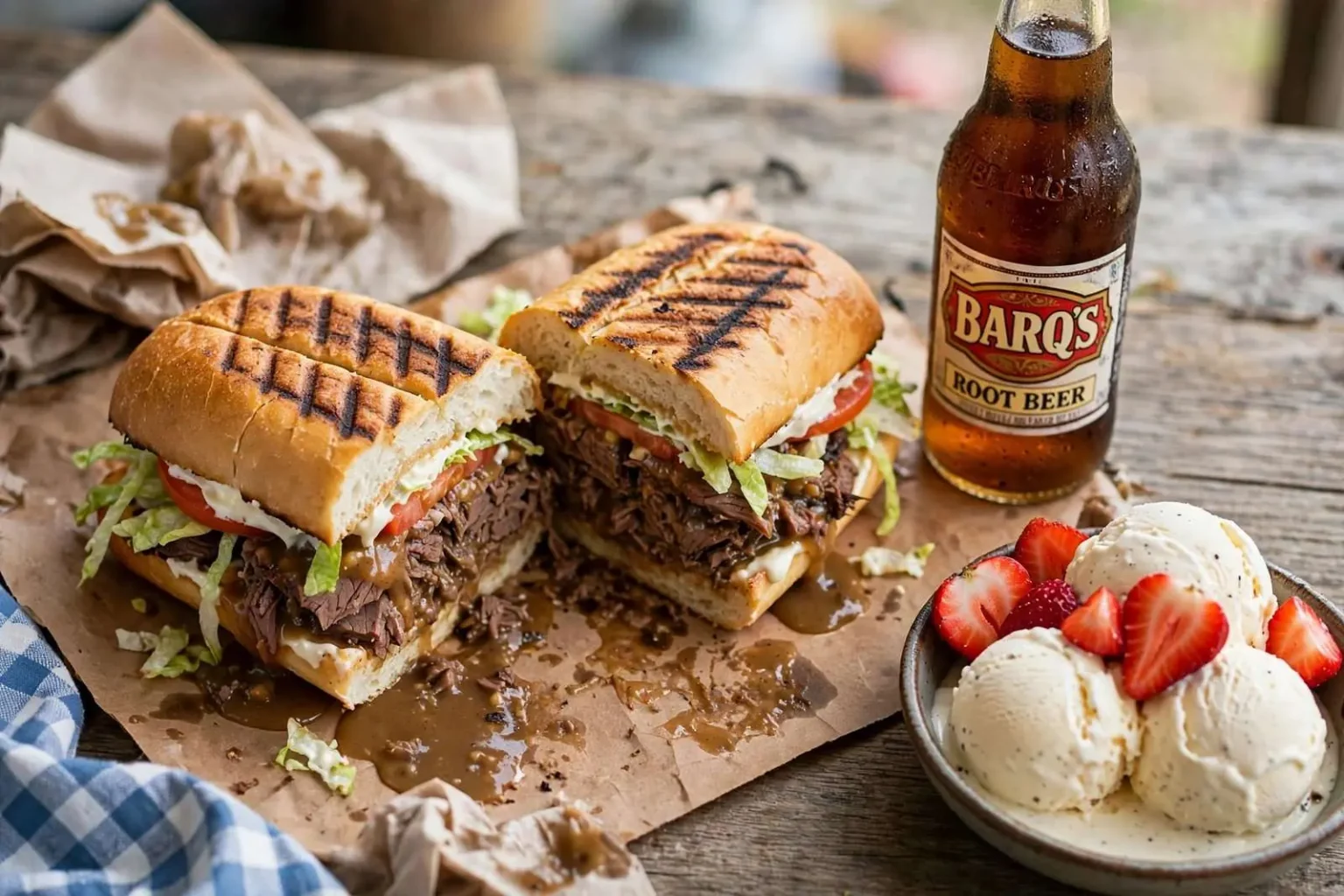
He drove down, picked it up, carried it back to his father’s house and washed it down with a long-neck Barq’s. For dessert: a bowl of Blue Bell vanilla bean ice cream topped with sliced Ponchatoula strawberries. It was, he reported, wonderful.
The afternoon had everything a proper po-boy expedition requires: a drive past the water, a shop that answers its own telephone, a root beer in the bottle and a dessert that depends on the strawberry calendar. Ponchatoula, the Tangipahoa Parish town that bills itself as the strawberry capital of the world, sends its berries into kitchens across the Gulf Coast every spring, and pairing them with a vanilla bean scoop is exactly the sort of instinct that separates a true north shore pilgrimage from a mere lunch run.
Dressed
The occasion prompted a small treatise on the subject, which is worth setting down because the roast beef po-boy is one of those dishes that people order incorrectly for years without ever being told.
Our critic prefers his dressed and pressed. Dressed means lettuce, tomato and a generous slathering of mayonnaise on each side of the sliced French bread — and not just any French bread, but the kind with a crisp crust and a soft inside, never chewy. A true aficionado, he insists, always takes the dressed version over one with, in the local phrase, “nuttin’ on it.”
Some people put cheese on a roast beef po-boy. He does not. The taste of the cheese, he argues, detracts from the taste of the beef.
The anti-cheese position is more controversial than he lets on. Plenty of otherwise reasonable Gulf Coast diners order Swiss on their roast beef, on the theory that it anchors the gravy, and some shops will not ask — the cheese simply arrives. Our critic’s counterargument is purity: the beef and its gravy took hours to build, and melted cheese sits on top of that labor like a tarp on a garden. Readers are free to disagree. He would simply like it noted that he told you so.
The bread itself deserves the attention he gives it. New Orleans French bread — and the north shore bakeries that supply it — is a different creature from the chewy loaves sold in supermarket racks: a shattering crust, an airy crumb, and a shelf life measured in hours rather than days. A po-boy on the right bread is architecture. The same ingredients on the wrong bread is a filling in search of a shell.
Pressed
Pressed is the final stage before the sandwich is served. Once assembled, the po-boy is laid on a po-boy press — picture a very large waffle iron — and heated. The press leaves telltale burn marks on the bread, which is how you know it has been done properly.
Failing a press, our critic accepts a standard griddle: lay the sandwich down, press it to the grill with a heavy metal spatula, turn it, press the other side.
The pressing is not cosmetic. Heat and light pressure weld the dressed bread to the filling, melt the mayonnaise into the crust and set the gravy so the first bite arrives warm and coherent rather than sliding apart. It is the difference between a sandwich that was built and a sandwich that was finished, and our critic regards any shop that skips it as having stopped one step short of the plate.
Debris and napkins
Most people, he observed, judge a roast beef po-boy by the number of napkins required to finish it. The gravy should soak into the bread but not through the bread — a distinction with a real margin of error, and the reason a good one is a messy proposition.
Then there is debris. Gravy does not always contain it, but when it does, it is a sign of a roast so tender that little chunks of meat have broken loose and invaded the gravy. Those chunks are the debris, and they are the mark of a kitchen that cooked the roast long enough and did not hurry it.
Debris, in other words, cannot be faked. A kitchen can slice a lean roast thin and ladle it with gravy, and the result will photograph well, but the gravy will be a sauce poured over meat rather than a broth that meat dissolved into. The distinction is time. Debris is what patience looks like on a plate.
As for the most unhealthy version he has ever eaten, he had no hesitation: a French fry po-boy drenched in debris gravy. Delicious, he wrote, but too much of an artery clogger to consume on a regular basis.
The French fry po-boy occupies its own corner of the tradition. Born of the same Depression-era instinct that stretched cheap roast beef over bread, the fry version — gravy-soaked potatoes on French bread — survives in a handful of south Louisiana shops as a side dish that refused to stay in its lane. As a main course it is what our critic calls an annual event, like a blood drive with better intentions.
Where, exactly?
And where did he find this particular sandwich? Here our critic declined to answer, on the grounds that naming the little drive-in on the north shore would pose too much of a threat to his anonymity — a reviewer’s occupational hazard, and one that leaves the reader with a description and no address.
What he was willing to say is that the search continues closer to home. Mobile has excellent seafood, respectable Creole cooking and no shortage of French bread. But a truly good roast beef po-boy — dressed, pressed, gravy soaking into the crumb, debris in the gravy, napkins piling up — had eluded him.
That gap is strange on its face. Mobile sits ninety minutes from the cradle of the po-boy, shares its French bread supply routes, and has consumed the sandwich at every Carnival parade and crawfish boil for a century. Yet the roast beef version, which demands a simmered roast and a slow-built gravy maintained all day, is precisely the menu item that a fast-moving kitchen is tempted to shortcut. Anyone can put roast beef on a roll. The debris gravy is where the commitment shows.
“I’m sure it is there somewhere,” he wrote of Mobile. “I just haven’t found it yet. Any suggestions?”
He is taking answers. The criteria are published above, and they are not negotiable: dressed, pressed, debris in the gravy, napkins on the table. Readers who know of a shop on the Gulf Coast that meets the standard are invited to say so, with the understanding that our correspondent will verify every claim personally, in strict anonymity, and at his own expense — and that the Barq’s must be in a bottle.
Our restaurant critic dined at his own expense, remained anonymous to the staff, and reviewed only restaurants he visits in the ordinary course of life.
Until the Mobile question is settled, the north shore drive-in will keep its place in the legend: the shop where the telephone is answered with a question that tells you everything — that the sandwich will be dressed, that it will be pressed, and that whoever is asking, dahlin, already knows what a proper po-boy is.
There is history behind the vocabulary, too. The po-boy itself traces to the New Orleans streetcar strike of 1929, when the Martin brothers’ sandwich shop fed the “poor boys” on the picket lines, and the dressed-or-not shorthand spread across south Louisiana as the sandwich did. “Dressed” — lettuce, tomato, mayonnaise, and on the roast beef, gravy built in — became the default order of anyone raised within a day’s drive of the city, and the phrase has outlived every attempt to Anglicize it. Our correspondent’s telephone exchange, a century on, proves the vocabulary traveled intact across the lake and the state line.
The drive-in format matters to the story as well. Some of the region’s most dependable po-boys come not from sit-down restaurants but from window-service shops where the menu is short, the roast has been simmering since morning and the same hands have built the same sandwich for years. A short menu is its own credential: a kitchen that does four things has no room to do any of them badly, and a drive-in that sells out its roast beef by mid-afternoon is making a statement no advertisement can buy.
As for the long-neck Barq’s, the pairing is closer to law than preference across the Gulf Coast. The root beer was born in Biloxi, aged in Mobile, and bottled across south Louisiana for generations — a hometown product for exactly the territory our critic covers. Served cold in glass, cut with the salt of a hot, gravy-soaked sandwich, it completes the meal the way iced tea never quite does. The Blue Bell and Ponchatoula strawberries are the epilogue, and a fitting one: three regional products, no imports, all within an hour’s drive of the table where the expedition ended.