The Captain’s Table: A Fine Place for Politics, a Poor One for Lunch
A burned roux, a jambalaya that resembled microwaved rice and greasy fried green tomatoes left our critic doing something he almost never does: leaving food on the plate.
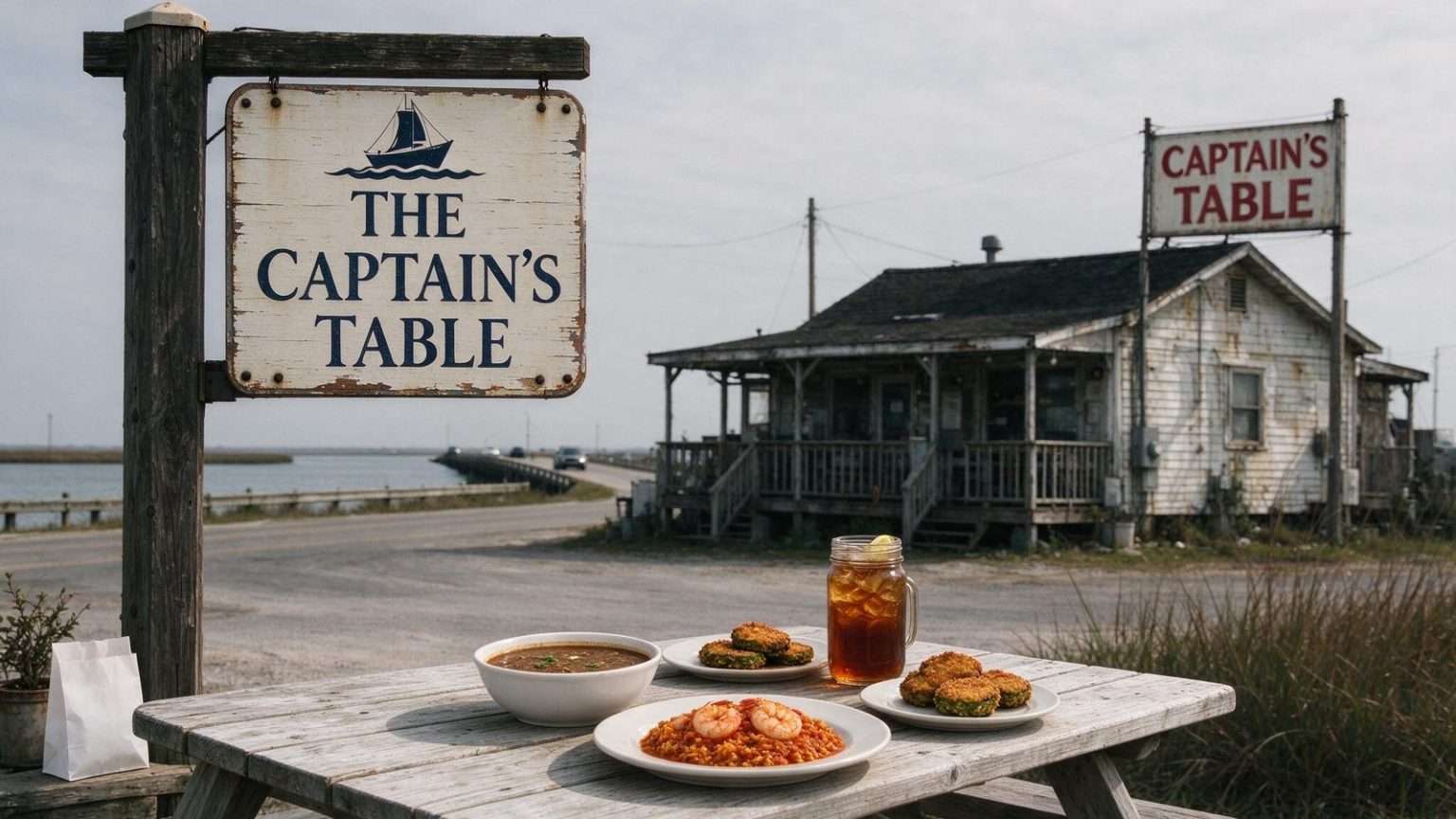
Our anonymous dining correspondent did something at the Captain’s Table on the Causeway that he says he almost never does. He left food on his plate. It had nothing to do with the size of the portions.
The Causeway — the low road across the head of Mobile Bay, lined with seafood houses and long a neutral ground where Mobile and Baldwin County business gets done over lunch — is a place our critic visits often, and grades harshly. This visit, in the spring of 2008, did not go well.
The stretch of U.S. 90 crossing the bay delta has hosted restaurants for generations, and the Captain’s Table has held a place among them as a fixture of the political lunch circuit. County commissioners, legislators, developers and lawyers have long used its tables the way earlier generations used downtown hotel dining rooms: as common ground where the two counties that share the bay can meet halfway, literally and figuratively. A restaurant’s survival in that company does not depend on its kitchen alone.
Working through the gumbos
He had been running a systematic survey of area gumbos, and ordered the Captain’s Table version as part of it. Rather than pay à la carte prices he found steep — $5.95 a cup, $9.95 a bowl — he ordered the lunch special of shrimp jambalaya, which came with a cup of gumbo included.
The gumbo was mediocre, he wrote, and probably the least satisfying he had tried since a disappointing bowl at Ed’s some time back. He did not finish it, because, as he put it, “it just wasn’t good.” It was obvious to him that the chef had slightly burned the roux — the flour-and-fat foundation of the dish, which cannot be rescued once it has gone bitter.
Roux is unforgiving chemistry. Cooked slowly over low heat, flour and oil darken to the copper color that gives a proper gumbo its depth; a minute too long in the pot and the entire batch turns acrid, with nothing to be done but start again. On the Gulf Coast, where gumbo is a measuring stick of a kitchen’s seriousness, a burned roux is the kind of error a regular diner can taste immediately — and forgive rarely.
The comparison confirmed a judgment he had made earlier: Bluegill remains the best gumbo on the Causeway. He promised readers verdicts on Ed’s and Felix’s in due course, keeping his survey of the causeway’s kitchens alive for future installments.
The jambalaya, so called
“The jambalaya had the consistency and taste of something other than jambalaya,” our critic wrote. He was not sure what the dish ought to be called, but jambalaya was not a good description of it. There were a nice number of shrimp in it, and that was the end of the compliments.
The color, the consistency, the taste and the presentation all disappointed him. His impression, he said, was of a bowl of seasoned sticky rice that had been heated in a microwave, with bland shrimp inserted into the mix afterward. That, too, went back to the kitchen unfinished.
Jambalaya, done as the Cajun and Creole traditions intend, is rice cooked in the same pot with the trinity of onions, peppers and celery, the seasonings absorbed as the rice swells in the stock. A dish assembled after the fact — rice reheated and shrimp added on — loses that integration, and the critic’s sticky-rice impression was his way of describing the difference in a single image. It is a lesson about restaurant economics as much as technique: specials are often where kitchens use up what is on hand, and the result shows.
Grease and grits
The fried green tomatoes were tasty, he allowed, but very greasy and visually unappealing. He ate one of the three and could not bring himself to consume more grease. Whatever batter there might once have been, he wrote, had long since been defeated by the hot oil.
Fried green tomatoes rise or fall on the temperature of the oil and the integrity of the coating. Held too cool, or held too long in a warming window, the batter drinks oil instead of sealing it out, and the dish turns heavy before the second bite. Our critic’s verdict — tasty underneath, defeated by grease on top — suggested a kitchen that knew the dish but was not tending it that day.
The grits were the best item on the plate — good consistency, good taste, needing only the traditional pat of butter and a little salt. He enjoyed them, and it says something about the meal that the grits carried it.
The iced tea was acceptable, particularly once the server finally brought some ice. He was not offered flavored tea, an omission he greeted with an audible “Hooray!” — the critic belonging to the school that holds an unadorned glass of strong tea to be the only proper companion to a plate of Gulf seafood, and peach-flavored variations to be an imposition on it.
He skipped dessert, though he noted having had the bread pudding there before and found it okay. Not great. Okay.
The verdict
Our critic’s conclusion was pointed, and it acknowledged what the Captain’s Table has long been in Mobile and Baldwin County life — a place where deals are struck and candidates are sized up over a plate of fried seafood.
“From past experience and today’s experience, I am convinced that the Captain’s Table might be a great place for political contacts,” he wrote. “It is not the place, however, for a hungry man in search of good food.”
The distinction is a real one on the Causeway, where geography does as much work as any menu. A restaurant sitting midway across Mobile Bay can survive for decades on the traffic of people who need a table equidistant from both counties’ courthouses, whatever the kitchen’s condition that day. The Captain’s Table’s luncheon crowd, in that sense, is not always there to eat.
Our restaurant critic dined at his own expense, remained anonymous to the staff, and reviewed only restaurants he visits in the ordinary course of life. The policy is what lets the reviews read like reportage rather than publicity: no comped meals, no warnings to the kitchen, and no special treatment that a paying customer would not receive. It also means the verdicts carry the texture of ordinary experience — the missing ice, the long wait, the unfinished plate.
A critic’s method on the Causeway
The gumbo survey that framed this visit was the critic’s way of comparing kitchens on a level field: one dish, ordered wherever he happened to eat, judged against every other bowl he had tasted that season. Gumbo suits the method. It is common enough to find anywhere on the bay, variable enough to distinguish kitchens sharply, and honest enough that shortcuts announce themselves — a burned roux chief among them.
Running the survey across the causeway’s restaurants also told readers something about the strip as a whole. Bluegill’s perch at the top of the standings came not from a single good bowl but from consistency across visits, while the uneven results elsewhere suggested kitchens whose attention drifted between the dining room and the busier back rooms where the county’s business actually gets transacted.
Why the Causeway matters to both counties
The low road across the head of the bay predates the interstate and the tunnels by generations, and its restaurants grew up serving travelers who crossed the delta by ferry and bridge long before causeways carried four lanes of traffic. When the banks and shipyards of Mobile needed to deal with the farmers and landowners of Baldwin County, the road between them offered the natural meeting place, and the seafood houses along it became the de facto conference centers of the two-county region.
That history explains both the Captain’s Table’s endurance and the critic’s framing. A restaurant whose lunch rush runs on political traffic lives or dies on that traffic, not on passing tourists, and its kitchen answers to a customer base that returns weekly regardless. Reviews of such places measure something different from a beachside tourist spot: not whether the food can lure a first visit, but whether it can sustain a habit.
This visit suggested the kitchen was resting on the habit. A mediocre gumbo, an unrecognizable jambalaya and a plate of greasy tomatoes would be forgivable in a place that had just opened; in a Causeway institution, the critic treated them as evidence that the dining room had learned to depend on the address. The grits, the tea and the memory of an acceptable bread pudding kept the review from being a total loss — and kept the promise of future visits, to Ed’s and Felix’s, on the table.