Baldwin County Schools Weigh Funding Options After Tax Vote Defeat
Baldwin County school leaders held a public listening session on alternative funding ideas after voters rejected new property taxes for schools.
Listening After a Defeat
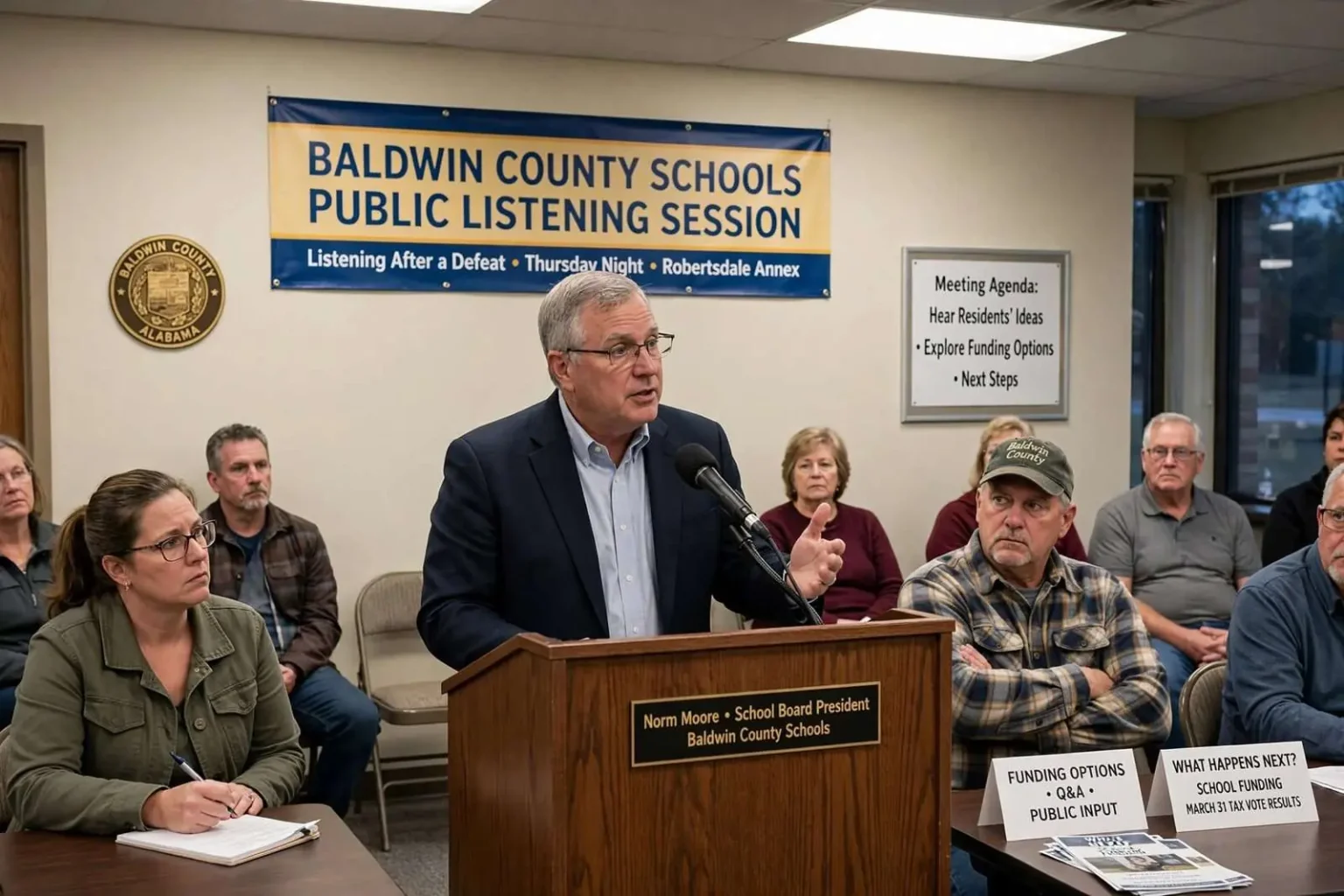
Baldwin County school and county officials gathered Thursday night for a public listening session on the future of school funding, telling residents ahead of time that the focus would be on hearing ideas rather than defending any particular plan. School Board President Norm Moore said the two-hour session, held at the county’s Robertsdale annex, was designed primarily so officials could hear what residents think should happen next after voters soundly rejected new school taxes in a special election held March 31.
“We want to see what ideas the people have out there that might be helpful,” Moore said, adding that county leaders already understand voters don’t want a property tax increase. “Hopefully, someone will come back with an alternative.”
The session was an acknowledgment of an uncomfortable reality: the district’s needs did not disappear with the election, and no one — not the board, not the county commission, not the voters who rejected the taxes — has yet produced a workable alternative. Officials chose to start by asking rather than telling, a posture shaped by the lopsided result at the polls.
What Voters Rejected
The rejected measures included two new millage requests, of 5 and 3 mills, that were defeated in every precinct across Baldwin County except one near the Spanish Fort Fire Department. That funding was intended to support a 10-year, $50 million expansion plan meant to address both short-term overcrowding and longer-term facility needs across the fast-growing district.
The geography of the defeat was as notable as its size. A countywide tax proposal losing in all but a single precinct sends an unambiguous signal, and school officials have been careful not to read the result as anything but a verdict on new taxes. The one precinct that voted yes sits in Spanish Fort, but even there the margin offered little comfort to supporters of the plan.
Voters also rejected a renewal of 4 existing mills, a decision that could strip millions of dollars from the school system’s budget within the next couple of years if a workaround isn’t found. Unlike the new mills, the renewal mills are money the district already receives and has built into its operating baseline — which is why their rejection set off the search for a legal mechanism to preserve the revenue without going back to the ballot.
Ideas From the Public — and Their Limits
Since the election, various funding ideas have circulated among residents on social media and elsewhere, though Moore said most fall outside what the school system or county actually has authority to implement. The listening session was in part a chance to test those ideas against the legal realities, with officials explaining which levers local government can actually pull.
One frequently mentioned option, a state lottery, isn’t something local officials can create on their own, Moore noted, since it would require action at the state level. He also pointed out that a lottery proposal currently being discussed in Montgomery is aimed at funding Medicaid, not school construction, unlike lottery-funded scholarship programs used in some other states. Even if Alabama ultimately adopts a lottery, under the version being debated the proceeds would flow to healthcare rather than classrooms.
Other suggestions, such as a local lodging tax, likewise fall outside the school board’s own authority, requiring action by the Legislature or by other bodies that levy such taxes. The pattern behind the limits is familiar to anyone who follows Alabama school finance: school boards and county commissions can only ask voters for property tax millage, and nearly every other revenue idea runs through Montgomery.
That constraint is precisely what made the March 31 defeat so consequential. Property tax millage is the one funding tool Baldwin County’s schools control directly, and voters just used that tool to say no — to the new mills outright, and to the renewal that keeps existing revenue flowing.
The Growth Problem Beneath the Vote
The expansion plan the millages would have funded was written against the backdrop of Baldwin County’s relentless growth. The county, the largest by area in Alabama, has for years ranked among the fastest-growing counties in the state, with new subdivisions filling in around Daphne, Spanish Fort, Fairhope, Foley, Gulf Shores and Robertsdale. Every roofline is a student, and the district’s enrollment has climbed accordingly, straining schools that in some communities are years past the populations they were built for.
Overcrowding is not a projection in Baldwin County — it is the daily reality in classrooms, cafeteria lines and portable buildings across the district. The 10-year plan was structured to catch up: new construction in the fastest-growing zones, renovations and expansions elsewhere, and longer-term land and facility planning for the growth still expected along the Interstate 10 and Highway 98 corridors.
What Happens to the Renewed Mills
The most immediate question facing officials is the fate of the 4 renewal mills, whose rejection threatens revenue the district already uses. Options under discussion in the weeks since the election have included ways to restructure the request or to find substitute revenue, though each path carries legal or political complications of its own. Officials have not ruled out returning to voters with a differently framed request, but Thursday’s session suggested no appetite to rush back to the ballot.
Under Alabama law, school boards depend heavily on local property tax support to supplement state funding, and districts in fast-growing counties typically lean on local mills for construction and debt service. Baldwin’s voters have historically supported school taxes in earlier eras — the existing mills on the books are the residue of past votes — which is part of why the March result startled so many observers in the district.
The defeat also landed amid a broader debate about how Alabama pays for schools, a system long criticized for its reliance on property taxes that track local wealth and growth. Districts like Baldwin’s, growing quickly, face a cruel arithmetic: growth generates the need and, eventually, the tax base, but new schools must be built years before the new roofs pay for them.
Where the Conversation Goes Next
Thursday’s session was billed as the first step in a longer conversation, and officials promised that more opportunities for public input would follow. Moore’s framing — hear ideas, test them against reality, keep looking for an alternative — will guide the board’s approach in the coming months as it decides whether to revisit the ballot, restructure the request or pursue other channels entirely.
The district’s funding clock, meanwhile, keeps running. Enrollment projections do not pause for election results, and the facilities needs that drove the 10-year plan — overcrowded campuses in the growth corridors, aging buildings elsewhere — accumulate whether or not the money arrives. The listening session produced no new revenue and no new plan, but it gave residents what officials promised: a chance to be heard, and a clear-eyed description of what the district is permitted to do next.
What comes out of that process — a restructured tax request, a scaled-back building program, or some combination not yet on the table — will define Baldwin County’s school debate for years, and Thursday’s crowd of residents, parents and officials got the first look at how the board intends to find out.
How Millages Work — and Why This One Stung
Alabama measures property taxes in mills, with one mill equal to $1 in tax for every $1,000 of assessed value, and residential property is assessed at a fraction of market value under state law. That structure means millage votes are usually modest in their per-homeowner impact but large in their cumulative effect on a school budget, which is exactly how the two Baldwin requests were pitched: a few dollars a year per homeowner, tens of millions for classrooms over a decade.
The renewal mills carried that logic one step further, since they asked voters only to keep money already flowing. Their rejection — alongside the new mills — suggested many voters saw the entire package as a single question about taxes rather than separate choices about new money and existing money. School officials have spent the weeks since trying to separate those ideas in the public’s mind.
The Robertsdale annex, the county complex in the heart of the county’s central corridor, was a deliberate choice for the session — central to the growth areas where school crowding is worst and to the rural communities that voted most heavily against the taxes. Officials said they wanted input from both, since any plan that follows will need support across the county’s geographic and political spread.
For the parents and residents who filled the room, the session offered something the election campaign rarely did: a direct exchange with the officials who will decide what happens next. Whether the ideas that emerged — from new partnerships to phased construction to fresh revenue proposals — can clear the legal and political barriers ahead will become clear in the months before the board must set its next budget.