Jury Weighs Tax Evasion Case Against Mobile County License Commissioner
A federal jury in Mobile began deliberating tax evasion charges against License Commissioner Kim Hastie and her husband John after a three-day trial.
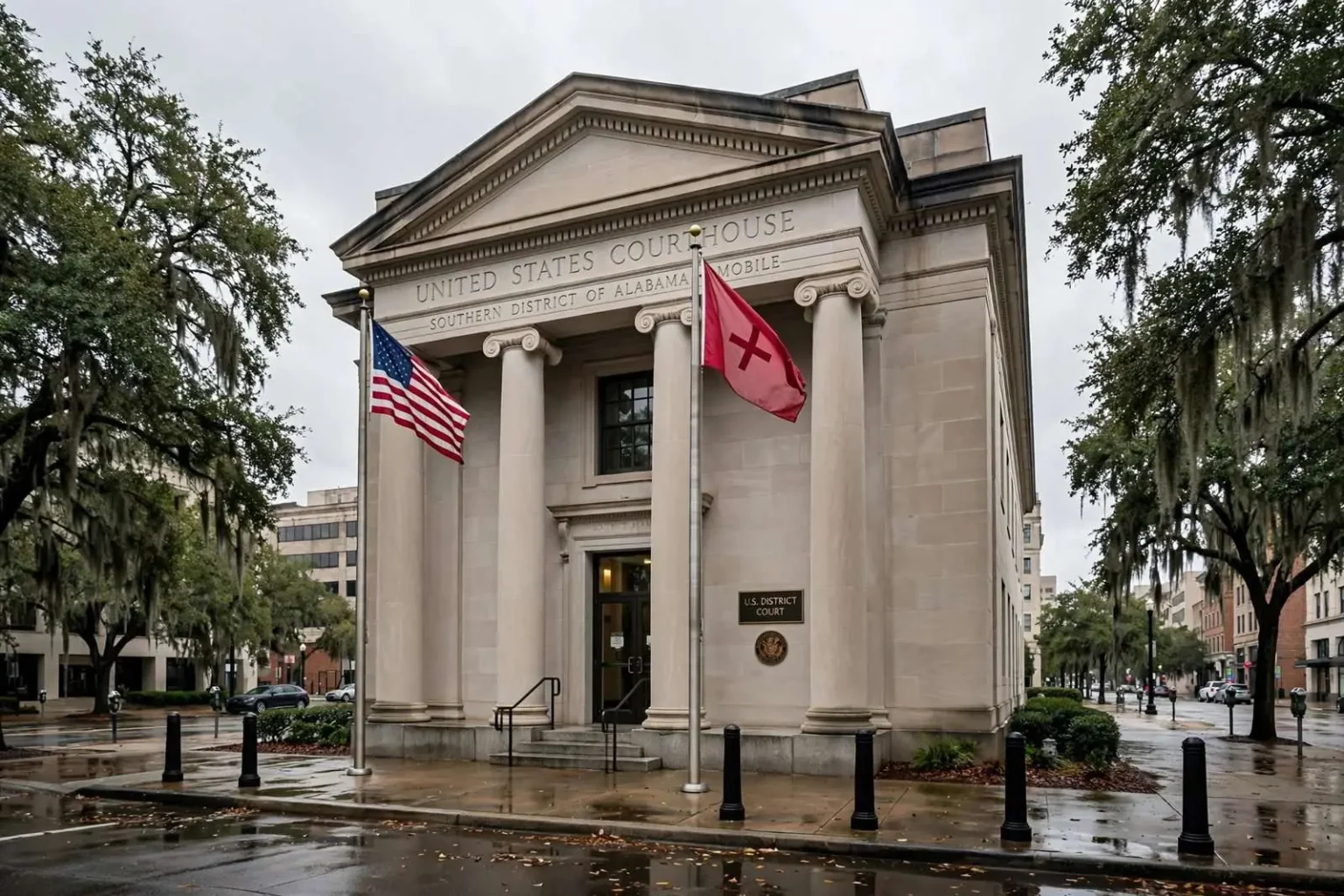
A federal jury in Mobile spent Thursday afternoon weighing tax evasion charges against Mobile County License Commissioner Kimberly Hastie and her husband, John Hastie, following closing arguments that capped a three-day trial in U.S. District Court.
Prosecutors allege the couple conspired to hide roughly $58,600 in income from the Internal Revenue Service, money they say came from John Hastie brokering land deals and performing timber-cutting and land-clearing work between 2009 and January 2015.
According to testimony, the unreported earnings were used to cover shortfalls in the family’s bank accounts.
Court testimony detailed three specific transactions: a $38,400 arrangement in 2009 and a $15,000 deal in 2014, both with the same business associate, plus a $5,232.66 payment in January involving John Hastie’s second cousin.
An accountant testified that the Hasties filed an amended 2009 tax return earlier this year acknowledging the previously unreported income and have since repaid the federal government $13,800.
Despite the repayment, an assistant U.S. attorney told jurors during closing arguments that the county’s top license-collecting official should not be exempt from the same tax obligations she enforces on others, arguing that no one is above the law regardless of position.
Defense attorneys countered that the case reflected government overreach, describing John Hastie as a hardworking outdoorsman rather than someone versed in bookkeeping or finance, and framing the extra land and timber work as an honest side effort to support his family.
Kim Hastie’s attorney argued prosecutors were pursuing taxes that were never legally owed in the first place.
Testimony during the trial’s final morning came from an FBI agent who told jurors that John Hastie’s employer, a Mobile-based marine and timber company, initially failed to produce a subpoenaed contract tied to timber-clearing work performed on property in Baldwin County.
The government’s case, transaction by transaction
The prosecution’s theory of the case was built on a small number of concrete transactions rather than a sprawling pattern. The $38,400 land-deal arrangement in 2009 and the $15,000 deal in 2014, both with the same business associate, bookended the alleged scheme, and the $5,232.66 January payment from John Hastie’s second cousin closed the period at the edge of the indictment. In each instance, prosecutors contend, income reached the Hastie household without ever appearing on the family’s tax filings — money that testimony showed flowing into accounts at moments when the family’s balances needed shoring up.
That timing mattered to the government’s narrative. Assistant U.S. attorneys walked jurors through bank records showing the unreported earnings arriving alongside personal shortfalls, an alignment the prosecution argued was no coincidence. If income is systematically omitted in the periods when a family needs cash, the argument goes, the omission is less likely to be oversight and more likely to be a functioning arrangement — an agreement to treat side earnings as invisible.
The conspiracy charge binds the couple together in the government’s framing: Kim Hastie, the elected official whose signature obligations put her among the county’s most visible tax collectors, and John Hastie, whose outdoor work generated the income at issue. Jurors did not have to find that both handled the paperwork, only that they agreed the money would stay off the returns.
The defense’s counter-story
The defense portrait of John Hastie was deliberately unglamorous: an outdoorsman, not an accountant, doing physical work on the side to keep his family’s finances afloat. Attorneys argued he lacked the sophistication to construct a tax scheme, and that the land brokering and timber-cutting jobs were the kind of informal, cash-based side work common in rural Alabama — work done among relatives and longtime associates, not structured to defeat the IRS.
Kim Hastie’s lawyer pressed a sharper legal point, telling jurors the government was chasing taxes that were never legally owed. If the underlying income was not taxable as the government claimed, or was offset by legitimate deductions and business expenses, then the alleged evasion collapses regardless of what went unreported. It was a challenge aimed at the heart of the IRS’s arithmetic, and one that juries in tax cases must untangle line by line.
The amended return and the $13,800 repayment figured in both narratives. The government treated the late amendment as a tactical correction once the investigation surfaced, not genuine repentance; the defense offered it as evidence of good faith — a family that, once questions arose, put the record straight and paid what it believed it owed. The assistant U.S. attorney’s closing made clear which reading prosecutors favored, reminding jurors that repayment after exposure does not unring the bell, and that the obligation to report is the same for a license commissioner as for anyone else in her county.
The subpoenaed contract and the final witnesses
The trial’s last morning narrowed to the FBI agent’s testimony about John Hastie’s employer. The Mobile-based marine and timber company, prosecutors established, performed timber-clearing work on property in Baldwin County connected to the deals at issue, and a contract documenting that arrangement was central to tracing who was paid and when. When the company initially failed to produce the subpoenaed document, jurors heard, investigators had to press for records that should have been handed over on demand — a friction point the prosecution suggested reflected how loosely the paper trail was kept, and how much of the arrangement lived outside any formal file.
Once obtained, the contract gave prosecutors what they wanted: corroboration tying the timber work to the payments and to the people involved. The second cousin’s January payment, the smallest of the three transactions, took on significance beyond its amount precisely because it sat at the edge of the charged period — evidence, in the government’s telling, that the arrangements were ongoing when the indictment’s clock stopped.
For an accountant’s testimony to anchor the case, the government needed the numbers to be simple, and they were: roughly $58,600 across six years, $38,400 here, $15,000 there, $5,232.66 at the end. Three-day federal tax trials live on that kind of clarity, and both sides spent their closings reciting the same figures with opposite meanings.
Stakes for an elected official on trial
The jury’s task carried weight well beyond the Hastie household. Kim Hastie holds a countywide elected office, one of three commissioners who run the Mobile County License Commission, the agency that issues the driver licenses, tags and titles county residents queue up for every day. A conviction on tax charges would be a career-ending event for an official whose position depends on public trust in her handling of money, and even an acquittal would leave the trial’s testimony — about side income, family accounts, and a subpoena initially ignored — part of the public record of her tenure.
Federal tax crimes carry real prison exposure. Tax evasion and conspiracy to defraud the United States are felonies with multi-year maximum sentences per count, and sentencing guidelines weigh the amount of tax loss, here a modest figure, alongside the defendant’s role and history. The sums in this case — $58,600 hidden, $13,800 repaid — are small by white-collar standards, but the office of the defendant is not, and the prosecutor’s closing line about no one being above the law framed the case as a proposition about equality before the tax code as much as a calculation of dollars.
The jurors began deliberating Thursday afternoon, retiring with the exhibits, the bank records, the amended return and the competing portraits: a couple who hid income, or a couple who worked, spent, and mended their filings when questions came. Their verdict would end a three-day trial and, whatever it said, settle the immediate question — guilty or not guilty — for the elected official who has spent months at the center of Mobile County’s most closely watched federal prosecution.
Deliberations in cases like this one tend to turn on the same few fulcrums. The first is the accounting: whether the government’s figures hold up once deductions and the character of each payment are examined, the question Kim Hastie’s attorney put to jurors directly when he argued the taxes were never legally owed. The second is intent, which in tax prosecutions is everything — the difference between a misdemeanor filing error and felony evasion lives entirely in whether a defendant knew the income had to be reported and chose otherwise. The third is the agreement itself, since the conspiracy charge requires jurors to find that husband and wife shared a plan, not merely a household.
The trial also illustrated how federal investigators build tax cases from the outside in. Rather than starting with the returns, agents traced the work — the land brokering, the timber cutting, the Baldwin County clearing job — and then followed the payments backward to bank accounts, letting the deposits testify about what the filings omitted. The subpoenaed contract from John Hastie’s employer fit that architecture: one document that connected a side job to a side payment to a silent tax return.
Whatever the jury returned, the broader sequence of Hastie-related legal proceedings remained ahead, with additional charges pending in the wider case. Thursday’s deliberation resolved the tax counts; the questions about the license office, the records and the political email operation belong to the larger docket still to come.