Emails to Voters at Center of Mobile License Commissioner’s Federal Case
Court records detail how a Mobile County official's office allegedly funneled taxpayer emails into a 2013 mayoral campaign.
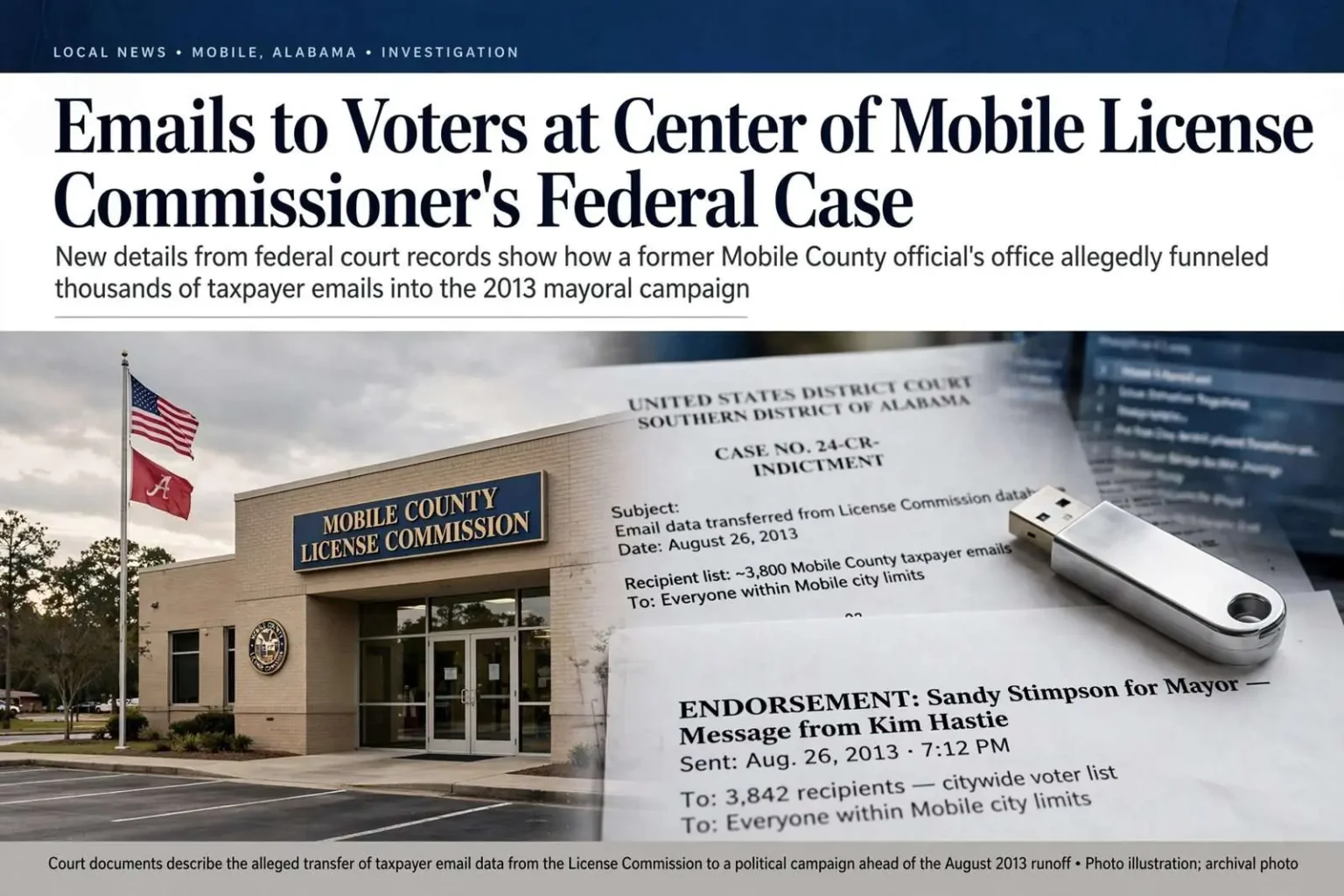
New details from federal court records show how a former Mobile County official’s office allegedly helped funnel thousands of taxpayer email addresses into a 2013 mayoral campaign, an episode now central to a federal fraud case that has drawn attention across South Alabama’s political and legal circles.
According to court records, Mobile County License Commissioner Kim Hastie’s office pulled email addresses of county residents from a government database in the days before the August 2013 mayoral runoff and passed them along to the campaign of Sandy Stimpson, who was challenging incumbent Mayor Sam Jones. The runoff capped a contest that dominated Mobile politics for months, dividing neighborhoods, business leaders and civic organizations across the city as two very different visions of City Hall went before voters.
Court records state that Hastie instructed an employee to email “everyone within Mobile’s city limits” an endorsement statement backing Stimpson. When the employee warned that sending such an email would be improper, Hastie allegedly directed the employee to download the addresses onto a flash drive instead. The employee complied, fearing retaliation, and the list eventually reached Stimpson’s campaign consultants, according to the records.
The day before the election, the Stimpson campaign sent a mass email to the addresses pulled from the county database. The message, titled as a communication from Hastie, featured her endorsement and a photo of her supporting Stimpson’s candidacy. Stimpson went on to defeat Jones with more than 53 percent of the vote, capturing a citywide mandate and ending an era of leadership at Government Street that had begun years earlier.
Inside the Allegations
The sequence described in federal court records is unusually specific. In the final stretch of the 2013 race, Hastie’s office allegedly pulled the email addresses of Mobile County residents from a database maintained for government purposes, assembling a list that included thousands of taxpayers with no connection to the mayoral campaign. The records describe a direct instruction to send an endorsement to “everyone within Mobile’s city limits,” which would have converted a public agency’s communication channels into a vehicle for one candidate’s benefit.
The alleged pivot from sending to downloading is the detail that has drawn particular attention. When the employee flagged that a mass email from a county office would be improper, the instruction changed: instead of transmitting the endorsement, the employee was allegedly told to copy the addresses to a flash drive. That step moved the data outside the government system entirely, and from there it made its way into the hands of campaign consultants, where it was used to reach voters the day before they went to the polls.
Public employees who raise objections in situations like this often face an unenviable choice. The court records describe an employee who complied with the download instruction out of fear of retaliation, a detail that underscores the pressure that can build inside a government office when a directive conflicts with professional judgment. Protections for state and county workers who report improprieties exist precisely for such moments, but they offer limited comfort to a worker weighing a family’s livelihood against an order from the elected official who runs the agency.
The License Commission’s Role in County Life
The Mobile County License Commission is an independent agency that operates outside the day-to-day structure of county government, with its own elected commissioner and staff. Its offices handle a steady stream of everyday transactions: vehicle registrations, license plates, titles and the associated ad valorem taxes and fees that fund schools, roads and municipal budgets across the county. For many residents, a visit to the License Commission is one of the most frequent direct interactions they have with any arm of local government, which makes the integrity of the agency’s data practices a matter of broad public concern.
That data is collected for administrative purposes, not political ones. Residents hand over names, mailing addresses and email addresses when they register vehicles, transact business or update their records, with the reasonable expectation that the information will be used to run the office and communicate about official matters. The allegation that such a database was repurposed for campaign outreach goes to the heart of that expectation, and it is one reason the email episode has remained a live issue in federal court long after the votes were counted.
The Campaign’s Side of the Story
Leaders of the political consulting firm that ran Stimpson’s digital campaign said in interviews that they did not solicit or pay for the license commission’s email list and that volunteers routinely forwarded contact lists to the campaign from a variety of sources. They described an operation built on conventional tools of modern campaigning: volunteer networks, sign-up sheets at events, and outreach that accumulated contacts organically over the course of the race.
They said the campaign’s broader digital operation included contributions from more than 1,700 donors, roughly 100,000 phone calls made on Stimpson’s behalf, and tens of thousands of email addresses collected through other channels. In their telling, the volume and variety of the campaign’s contact-gathering meant that any single list represented a small slice of the overall effort, and they maintained that their work proceeded without knowledge of where every forwarded list originated.
A spokesman for Stimpson said the campaign relied on its outside consultants to run its digital outreach in accordance with the law. That framing placed responsibility for compliance squarely with the professionals hired to manage the campaign’s digital presence, a common arrangement for campaigns that lack in-house legal and technology staff. It also meant that the campaign’s defense rested in part on what its consultants knew, when they knew it, and what steps they took to verify the provenance of the lists they deployed.
How the Episode Resurfaced
The email episode resurfaced after Hastie and her husband were indicted on related federal charges, transforming a controversy that had simmered since the election into a criminal matter with potentially serious consequences. Federal prosecutors treat the misuse of government resources and the movement of that material into a campaign as conduct that can support fraud counts when it deprives the public of honest services or property, and the case has proceeded through the federal court system in the years since.
Cases of this kind unfold slowly. Indictments are followed by motions, discovery disputes and hearings, and the public record grows in increments as filings detail what investigators uncovered. The documents now at the center of the case describe the inner workings of the License Commission during the campaign period with a level of detail rarely seen in local politics, offering residents a window into how decisions moved through the office in the decisive days of the 2013 race.
For Mobile, the stakes extend to the credibility of its institutions. The 2013 election marked a changing of the guard at City Hall, and Stimpson took office promising a more businesslike approach to city government. An episode in which a county official allegedly redirected taxpayer data toward that transition complicates the story of the election for everyone involved, whatever the eventual outcome of the charges.
What It Means for Local Residents
The case carries practical lessons for anyone who transacts business with a government office in Mobile County or elsewhere in Alabama. The contact information residents provide to public agencies is protected by rules against its use for private benefit, and misuse of such data can carry criminal exposure. When an officeholder asks staff to blur the line between official work and political activity, employees have avenues to report the conduct, and courts have shown that the internal record of such requests can become evidence.
For campaign operatives, the episode is a reminder that provenance matters. Receiving a list from a volunteer or a supporter does not insulate a campaign from scrutiny if the list turns out to have been taken from a government database, and consultants who deploy large volumes of voter contact data are expected to understand where that data came from.
For the broader Gulf Coast political community, the case has become a reference point in discussions about ethics reform and the boundaries between public office and political campaigning. Alabama’s ethics framework has been strengthened and refined repeatedly over the past decade, and cases arising from Mobile County’s 2013 election cycle are part of the body of experience that informs how those rules are written, enforced and understood by the officials who must live within them.
The federal case remains a developing story, and the documents filed so far suggest more detail will emerge as it moves forward. What is already clear is that the route from a county database to an election-eve mass email is now a matter of public record, and that the questions it raises about data, power and accountability in local government will outlast the campaign that produced them.