Monroeville Man’s Heart Attack Recovery Tied to Mobile’s Azalea Trail Run
A Monroeville man credits Mobile's Azalea Trail Run with saving his life after a 2000 heart attack, and now helps others cross the finish line each year.
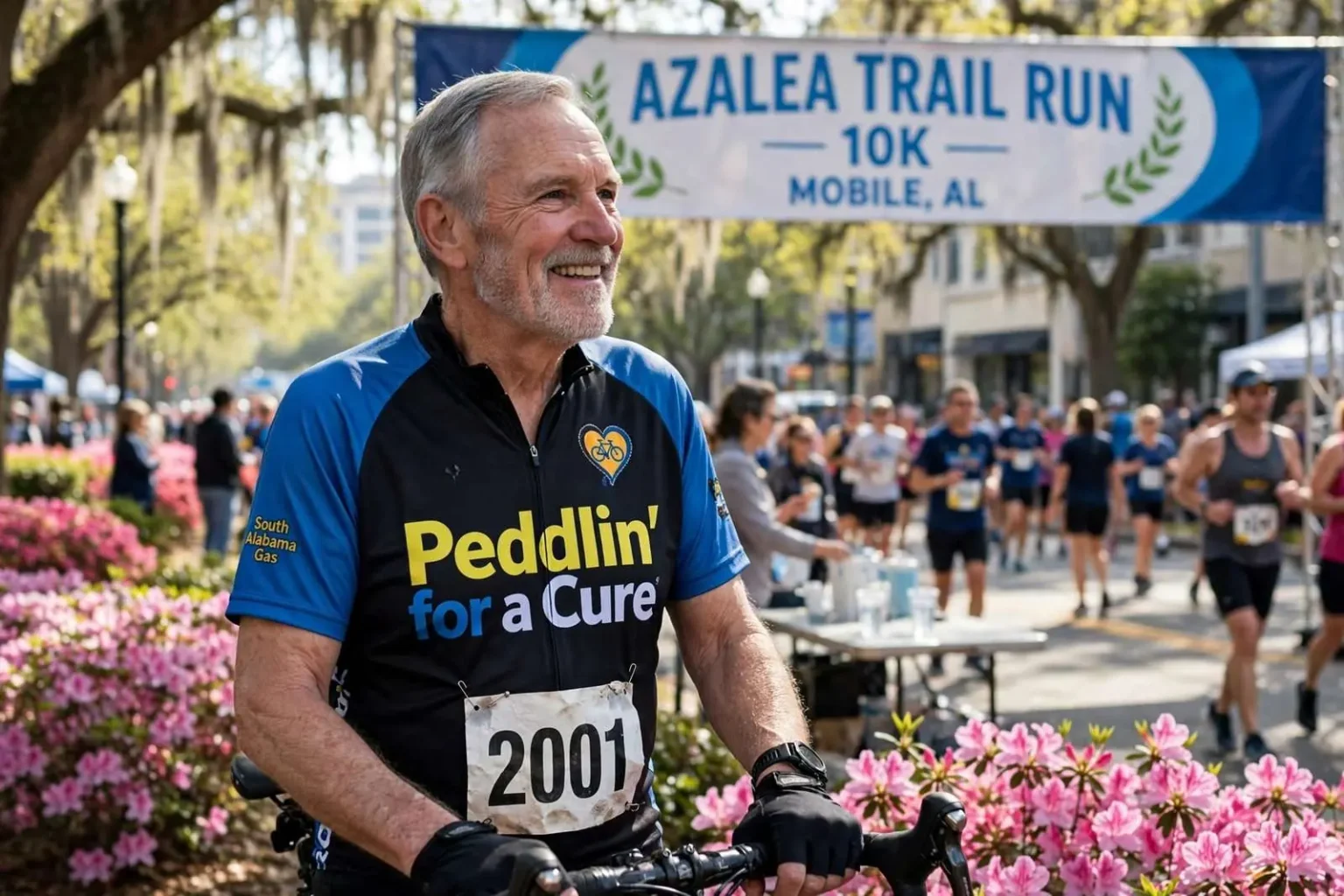
Fifteen years after a heart attack nearly killed him, a Monroeville man says a Mobile road race changed the entire course of his life. Fred Kelley, who now leads the Peddlin’ for a Cure bicycle ride he started in 2004, says none of it would have happened without Mobile’s Azalea Trail Run.
Kelley suffered his heart attack on March 28, 2000, an event that cost him much of his heart function. Doctors told him he had lost nearly all use of his left ventricle, the chamber of the heart responsible for pumping oxygen-rich blood out to the body. For a patient in his situation, the prognosis was sobering, and the easy path would have been to accept a restricted, sedentary life under careful medical watch.
Rather than accept a diminished life, Kelley said he decided to make sweeping changes to his diet and activity level, and he set his sights on the following year’s Azalea Trail Run — an annual 10K held each spring in Mobile. The choice of goal was ambitious to the point of recklessness by any conventional measure: a man months removed from massive heart damage, aiming to run 6.2 miles through the streets of a city an hour and a half from his home.
“I didn’t know what a 10K run was. I didn’t know how far that was. I didn’t care,” Kelley recalled. His lack of familiarity with racing, he suggests, may have been an advantage. Had he understood exactly what a 10K demanded of the body, or how far the distance would feel to someone starting from zero, he might never have signed up at all.
With a friend serving as what he called an “accountability partner,” Kelley began walking, then jogging, steadily cutting out fried foods and white bread in favor of grilled meat and wheat bread. The transformation followed a pattern that cardiac rehabilitation specialists recognize as the most durable kind: gradual increases in activity, paired with realistic substitutions rather than a crash diet, and a companion who made skipping a workout that much harder.
Seventy pounds and one finish line
By the time race day arrived in 2001, he had lost 70 pounds and crossed the finish line in one hour and 24 minutes. For a first-time 10K runner recovering from severe cardiac damage, the time was secondary to the fact of finishing, and Kelley’s account of that morning treats the clock as an afterthought to the act of completion itself.
The Azalea Trail Run, the event Kelley chose as his proving ground, has long been one of the Gulf Coast’s signature road races, drawing serious distance runners and first-timers alike to Mobile each spring. Its reputation as a welcoming event for runners of all abilities made it a fitting stage for a comeback story of the kind Kelley was writing.
After that first race, Kelley returned to Mobile Infirmary, where he had been treated, to share his story with patients facing similar health scares. Walking back into a cardiac ward as a living counterexample — a man whose left ventricle had largely stopped working, now finishing 10Ks — gave him a credibility with frightened patients that no pamphlet or physician’s reassurance could match.
He went on to help organize a company-sponsored team through his employer, South Alabama Gas, that has participated in the run for years as part of a workplace wellness program. What began as one man’s recovery effort grew into an annual tradition that has pulled coworkers off the sidelines and into training, extending the reach of his second chance to colleagues who had never faced a diagnosis of their own.
Workplace wellness programs of that kind have multiplied across the country as employers recognize that healthier employees mean lower insurance costs and fewer absences, but the ones that endure tend to have a person behind them — someone whose story makes participation personal rather than mandatory. Kelley’s team became a fixture of the Azalea Trail Run’s corporate ranks for exactly that reason.
Kelley said one of his most memorable moments from the race came when he slowed his own pace to help a struggling runner finish. About three years ago, he said, he came across a man near the back of the pack who was overheated and exhausted with about a mile left to go. The scene — a runner in visible distress as the field thinned out behind him — is a familiar one to anyone who has run a warm-weather road race, and it is exactly where a race becomes dangerous for someone pushing past their limits.
Kelley encouraged him to walk and jog in short bursts, pole to pole, until the man found his second wind and ran the final stretch into the crowd on his own. The method was pure veteran pragmatism: breaking the remaining distance into small, reachable segments between utility poles, turning a discouraging mile into a series of manageable efforts. It is the same technique Kelley himself had used to climb out of cardiac crisis one workout at a time.
A calling found at the back of the pack
The man later returned with his wife and children to thank Kelley for the encouragement, a gesture that confirmed what the moment on the course had already suggested about why Kelley keeps coming back to the race year after year.
“I kind of figured that was my calling, to help people,” he said. The statement ties together the strands of his post-heart-attack life: the visits to cardiac patients at Mobile Infirmary, the company wellness team, the charity bicycle ride he founded, and the stranger he coached through the final mile of a spring morning in Mobile.
Kelley’s hometown of Monroeville, the Monroe County seat best known as the childhood home of novelist Harper Lee, is a community of modest size where personal reputation travels by word of mouth. In a town like that, a story of survival and reinvention does not stay private for long, and Kelley’s fame as the man who ran himself back to life has spread through the region’s running and cycling circles for years.
The Peddlin’ for a Cure ride he launched in 2004 extended that reputation onto two wheels. Charity bicycle rides have become a staple of fundraising across Alabama, drawing riders of mixed abilities onto marked routes supported by rest stops and volunteers, and Kelley’s event followed the model he knew best: set a demanding but reachable goal, recruit companions, and finish what you start.
Medical science has caught up to what Kelley discovered by instinct. Cardiologists now routinely prescribe supervised exercise for heart failure patients, and research has repeatedly shown that structured physical activity can improve quality of life even for people with severely reduced heart function. His doctors’ warning about his left ventricle was accurate, but his refusal to accept the predicted ceiling on his life anticipated the direction that cardiac rehabilitation would take as a field.
None of which means his approach is a template anyone should copy unsupervised. Kelley’s story works as inspiration precisely because it was extreme — a near-total loss of heart function overcome through relentless, gradually building effort. Patients facing similar diagnoses are generally counseled to begin with medically supervised programs before attempting anything like distance running, and his own account emphasizes the years of patient building between his 2000 heart attack and that first finish line in 2001.
Why the story endures
Fifteen years on, Kelley’s routine of telling his story to heart patients, organizing the ride and returning to Mobile each spring has turned a single medical catastrophe into what amounts to a second career in encouragement. The people who hear him speak at the hospital bed’s side rarely forget the contrast between the statistics on his chart and the man standing in front of them.
The Azalea Trail Run, meanwhile, continues to serve as the stage where such stories play out. Every year, the back of the pack — the section of the field where Kelley found his calling — contains its own heart patients, stroke survivors and first-time finishers grinding out the final miles, and every year the event’s culture of welcoming slow finishers keeps those stories possible.
Kelley’s advice to anyone facing the diagnosis he once received is implicit in everything he has done since: find a partner who will hold you accountable, change what you eat in ways you can live with, set a goal that scares you, and then show up for it one pole, one block, one mile at a time. The heart that nearly failed him in March 2000 has carried him across finish lines, charity rides and hospital visits ever since — proof, he would say, that the worst day of his life became the best thing that ever happened to the people around him.