Worker Injured by Machinery in Ship’s Hull at Alabama State Docks
A dockworker was taken to a Mobile hospital after being pinned against a wall by machinery inside the hull of a ship at the Alabama State Docks.
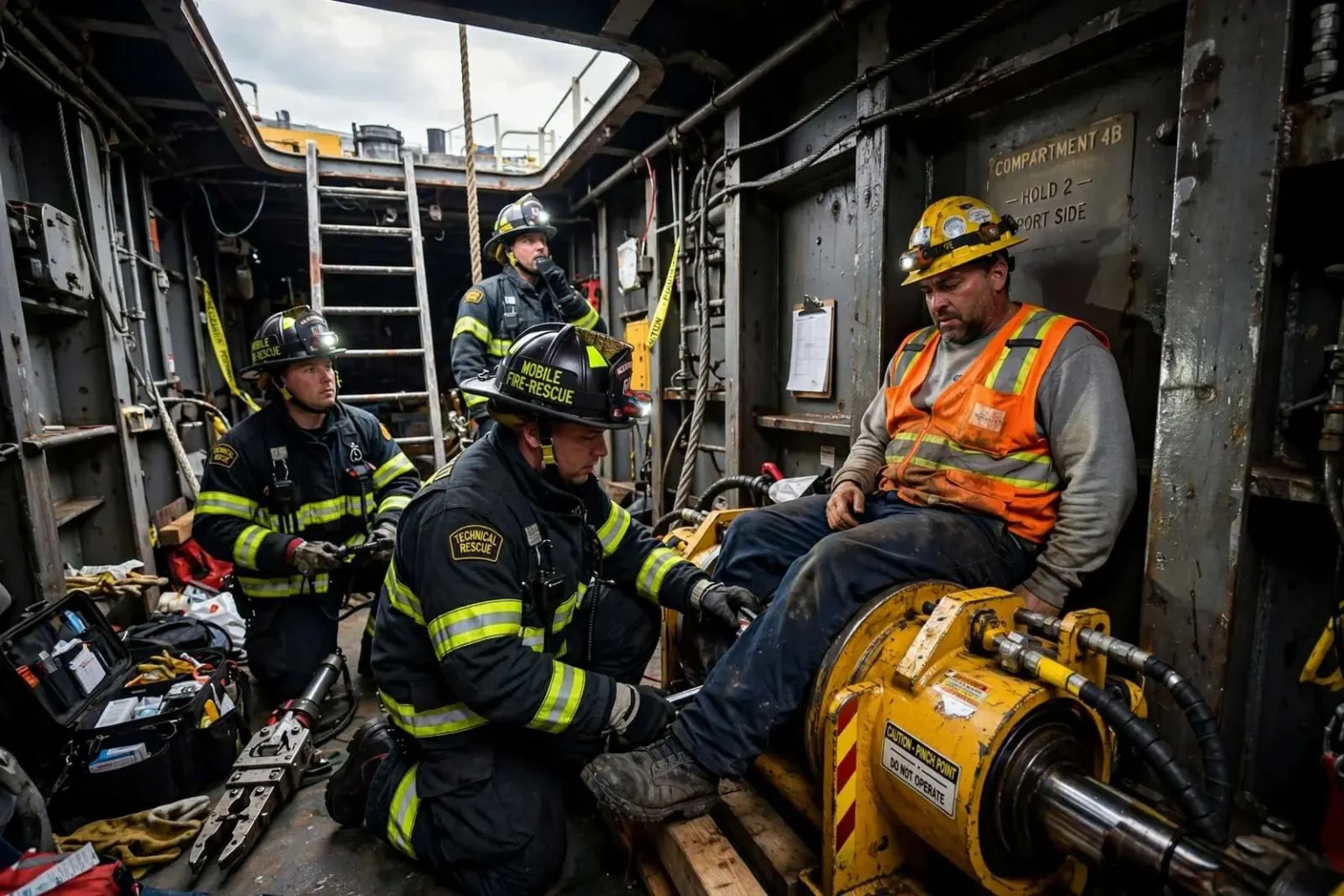
MOBILE, Alabama – A man was taken to a local hospital Sunday morning after being injured by machinery while working inside the hull of a ship docked at the Alabama State Docks, according to Mobile Fire-Rescue.
Emergency crews were dispatched shortly after 9 a.m. following an initial report of a man who had fallen into an opening at pier four of the sprawling port complex. When Mobile Fire-Rescue technical rescue personnel arrived, they determined the man had instead been pinned against a wall by a piece of machinery while working in the ship’s hull.
A Mobile Fire-Rescue spokesman said the worker suffered a hip injury that was not considered serious. He was transported to Mobile Infirmary for treatment.
A Specialized Response at Pier Four
The distinction between the initial report and what crews found illustrates why port calls demand a different kind of firefighting and rescue. A man reported fallen into an opening suggests a rope-rescue or confined-space entry; a worker pinned by machinery calls for stabilization, extrication tools and coordination with the vessel’s crew before anything moves. Mobile Fire-Rescue’s technical rescue team trains for both, and Sunday’s dispatch placed them inside one of the most constrained environments a rescuer can face — the multi-level interior of a cargo ship’s hull, where steel compartments, ladders, hatches and machinery leave little room to work.
Working inside a hull combines the hazards of confined space work — limited entry, restricted airflow, difficult access for stretchers and equipment — with those of an active industrial site, where cranes swing overhead and heavy machinery operates on tight schedules. Rescuers reaching an injured worker in that environment may need to be lowered through hatches, guided by the ship’s crew and the port’s own personnel, and then moved by hand through passages never designed for litters.
That Sunday’s outcome was a hip injury considered not serious, from a call that began as a possible fall into an opening, counted as a good result for everyone involved — the responders, the vessel’s crew and the port’s operations staff who coordinated the response without shutting down the pier’s activity around it.
The Port Behind the Story
The Alabama State Docks, operated by the Alabama State Port Authority, is one of the largest deepwater ports on the Gulf Coast and a major economic engine for the Mobile area, handling everything from bulk cargo to steel and forest products.
The complex stretches for miles along the Mobile River just north of downtown, a working landscape of piers, transit sheds, coal yards and container cranes that ranks among the nation’s busiest by tonnage. Vessels there load and unload the full catalog of Gulf Coast trade: coal and other bulk commodities moving out to the world, containerized freight flowing through the growing container terminal, steel coils, forest products, poultry and project cargo bound for inland job sites. The port’s economic reach extends well beyond its fence line — supporting carriers, warehouses, trucking firms and thousands of jobs across the region — which is why the Port Authority’s operations figure in nearly every conversation about Mobile’s economy.
The facility employs hundreds of longshoremen, stevedores and maintenance workers who regularly perform tasks in and around vessels, cranes and heavy machinery, work that carries inherent physical risk even under normal operating conditions.
Longshore work has always been among the most physically demanding in the region. Crews move cargo in all weather, on schedules set by tides and ships, around equipment that outweighs anything on a highway. Safety programs, union rules and federal maritime regulations have transformed the industry’s injury rates over the decades, but the nature of the work — steel, cables, cargo and machinery in constant motion — keeps port safety officers and emergency responders in steady partnership.
Incidents involving injuries aboard vessels or within port facilities typically trigger a response from Mobile Fire-Rescue’s technical rescue team, which is trained to handle confined-space and industrial accidents that can occur in the tight, multi-level compartments found inside a ship’s hull.
Sunday’s response illustrated the kind of specialized call port-area emergency crews are periodically asked to handle given the scale and complexity of operations at the docks.
Fire-Rescue’s technical rescue capability — shared among specially trained members of the department — covers the spectrum of rescue environments Mobile’s economy produces: high-angle work on bridges and cranes, trench collapses on construction sites, confined-space entries in tanks and hulls, and heavy machinery extrications. Port calls exercise all of those disciplines at once, which is why drills with the Port Authority and vessel crews are a fixture of the department’s training calendar.
What Remained Unknown
It was not immediately clear what type of machinery was involved or what task the injured worker had been performing at the time of the incident. Port officials did not immediately provide additional details about the circumstances surrounding the injury.
That silence is standard in the hours after a workplace injury. Federal maritime law requires the vessel’s operator and the employer to report serious incidents to the U.S. Coast Guard, and depending on the circumstances, investigations may follow from the Coast Guard, the Occupational Safety and Health Administration, or both. Findings — if they are made public — typically arrive weeks or months later, after interviews with the crew and a review of the machinery, work orders and safety records involved.
The docks have long been a focal point of the regional economy, supporting thousands of jobs directly and indirectly across Mobile County, and safety incidents at the facility tend to draw attention given its economic significance to the area.
Sunday’s injury appeared to be an isolated incident rather than part of any broader safety concern at the port, based on the limited information released by emergency officials.
For the port’s workforce, an incident like Sunday’s passes through the close-knit world of Mobile’s maritime labor quickly. Longshore crews are organized by gangs and locals, and men and women who work the same piers week after week know one another’s names — so a teammate carried out of a hull on a stretcher is felt across the roster long before any official report circulates. The speed of the technical rescue response, and the mildness of the injury it produced, will be counted as the system working as designed.
The episode also offered a rare public glimpse of the work that happens below a ship’s deck line. Dockside observers see cranes and containers; the hull’s interior, where Sunday’s injury occurred, is a hidden industrial workplace of frames, stiffeners and compartment bulkheads where maintenance and cargo-securing crews labor out of sight. Injuries there are the ones most dependent on rescue planning, because getting a hurt worker out is often harder than treating him.
Mobile’s growth as a port city keeps that workplace growing too. Recent decades have brought expanded container operations, new terminals along the river and steadily climbing tonnage through the Port Authority’s facilities, adding crews, shifts and machinery to the same piers that have anchored the city’s economy since its founding. Each expansion raises the baseline of activity — and with it the importance of the rescue capability, safety programs and worker training that keep the port’s human costs low.
By Sunday afternoon, the piers had returned to their routine, and the injured worker was recovering at Mobile Infirmary with what officials described as a non-serious hip injury. The machinery, the task and the worker’s name remained undisclosed, as they often do; what the record shows is a specialized team reaching a man inside a ship in time for the story to end in treatment and recovery rather than tragedy — an outcome as routine as it is unheralded on the working waterfront.
Pier four, where the call originated, sits among the Port Authority’s general cargo berths along the riverfront, the section of the complex where breakbulk and project cargo — steel, machinery, bagged goods and oversized pieces that containers cannot hold — moves across the piers on schedules dictated by vessel arrivals. The work there involves gangs of longshoremen coordinating with ship crews, crane operators and checkers, often inside vessels whose holds must be loaded by hand and machine in careful sequence to keep the ship balanced.
Securing cargo inside a hull is among the least visible and most hazardous of those tasks. Workers climb between decks to lash and block heavy pieces so they cannot shift at sea, guiding loads through hatch openings while machinery idles close by. A moment’s misjudgment — a sling that slips, a machine that moves when it shouldn’t — can pin a worker against steel in a compartment where no one can reach him quickly. That is precisely the scenario Sunday’s responders described, and it is why port-area fire crews train for hull rescues the way urban crews train for apartment rescues.
Mobile Infirmary, where the injured man was taken, has long served as one of the primary hospitals for the city’s industrial workforce, its emergency department accustomed to receiving patients from the port, the shipyards and the heavy-construction sites along the river. A hip injury from a machinery pinning that is judged not serious is a strikingly good outcome for the mechanism described; similar incidents in confined hull spaces have historically produced fractures, crush injuries and worse, which is why the response’s speed drew quiet credit from those who reviewed the morning’s radio traffic.
The Port Authority’s own safety apparatus runs alongside the emergency response system. Terminal operations maintain safety officers, incident reporting procedures and coordination protocols with the longshore unions whose members do the work. Federal maritime rules administered by the Coast Guard govern vessel-side conditions, while OSHA-style standards apply to shore-side employment — a dual system that puts responsibility on both the employer and the vessel for the environments workers enter. Sunday’s incident will move through whichever of those channels applies to the man’s job, with the machinery involved examined before it returns to service, as procedure requires after any injury event.
For the broader workforce watching from the next pier over, the morning carried the usual lesson that port veterans pass along without ceremony: the hull is the most dangerous room on the waterfront, and the men who work it come home when preparation, training and a fast rescue team converge — as they did on a Sunday morning at pier four.