Baldwin County weighs school property tax hike to fund $350 million building plan
Baldwin County school leaders pushed an 8-mill property tax increase to raise $28.6 million a year for a $350 million construction plan, set for a March referendum.
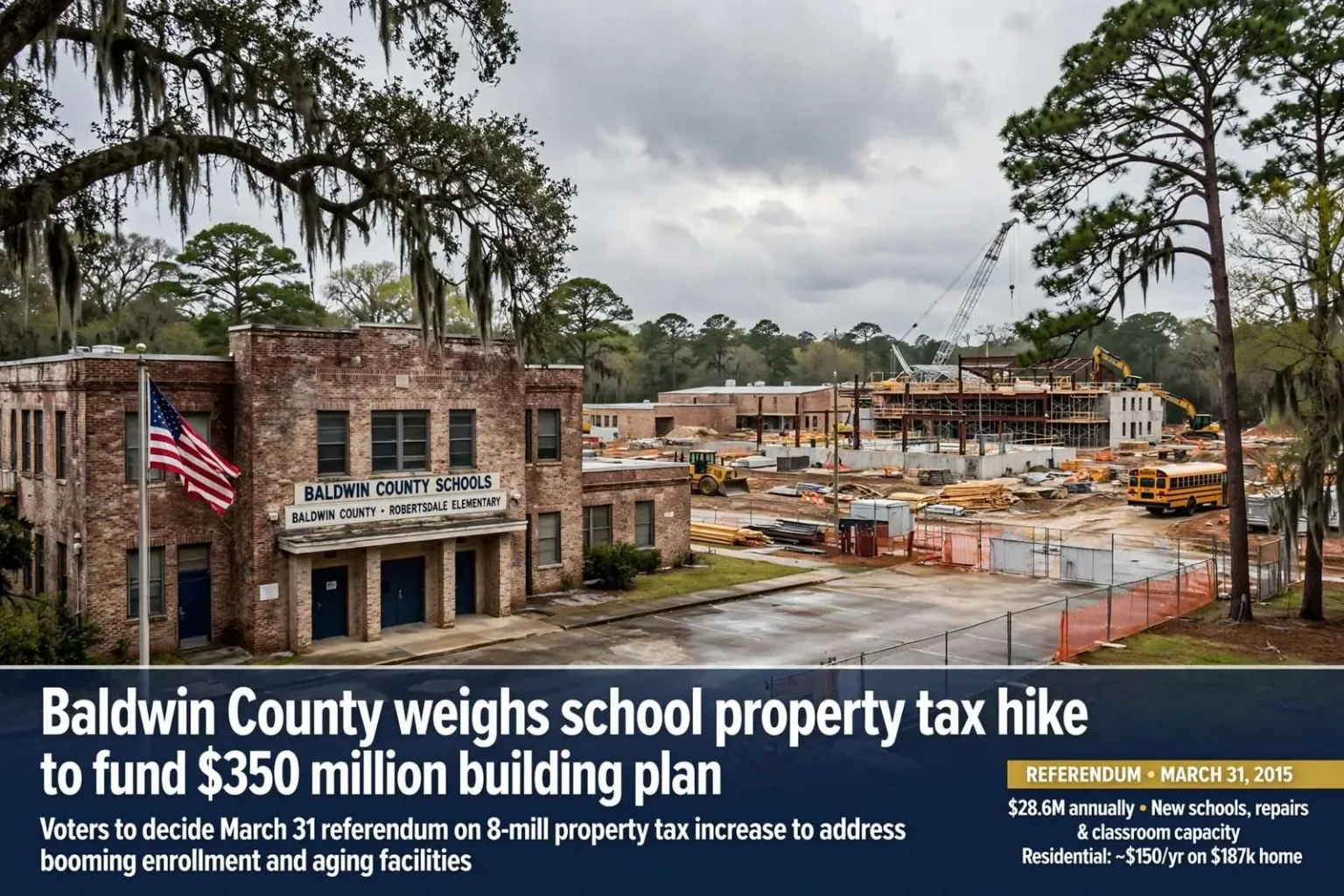
Baldwin County property owners faced a major decision heading into 2015, as school leaders pushed a plan to raise tens of millions of dollars a year through a property tax increase to fund an ambitious building program. The proposal, which required voter approval before it could take effect, set up one of the most consequential local tax questions the county had faced in years, with the outcome tied directly to how quickly the school system could respond to its booming enrollment.
Under the plan, the Baldwin County school system aimed to bring in roughly $28.6 million a year in new revenue to help finance a construction program valued at about $350 million. The money was intended to address growth and aging facilities across one of the fastest-expanding school districts in the region, a system stretched across a county that runs from the Mississippi state line down to the beaches of Gulf Shores and Orange Beach.
County school officials framed the effort as a response to two pressures at once: a steady influx of new families moving into communities along the Eastern Shore and the coastal corridor, and a backlog of campus needs that had accumulated as buildings aged well past the point of routine maintenance. Neither the revenue stream nor the construction program could move forward without the sign-off of the voters who would be paying for it.
The March 31 referendum
The increase could not take effect without voter approval, and a referendum was scheduled for March 31, asking residents to sign off on an 8-mill property tax hike. In practical terms, the request worked out to $8 in additional tax for every $1,000 of assessed property value. Alabama tax watchers noted that the millage structure meant the burden scaled directly with the value of what a person owned, rather than being spread evenly across households.
The mechanics of Alabama property taxation shaped how the debate played out. Under state law, residential property is taxed not on its full appraised value but on an assessed value equal to a fraction of that figure, while commercial property is assessed at a higher share of its appraised value. A mill, the basic unit of property taxation in the state, represents $1 of tax for every $1,000 of assessed value. The 8-mill request therefore translated into a predictable annual cost for any property owner willing to do the arithmetic on a tax bill.
A district stretched across a growing county
Baldwin County is Alabama’s largest county by land area, and its school system mirrors that sprawl. Students attend classes in Bay Minette, the county seat in the north, in the fast-growing Eastern Shore cities of Daphne, Fairhope and Spanish Fort, and in the southern communities of Foley, Robertsdale, Gulf Shores and Orange Beach, among others. Population growth along the coast and the Interstate 10 corridor has outpaced much of the rest of the state for years, and each new subdivision and apartment complex brings additional students into classrooms that in many communities were already filling up.
That growth is precisely what the $350 million building plan was designed to address. New schools, classroom additions and major renovations all figured into the kind of construction program that a revenue stream of $28.6 million a year could support, spread across multiple campuses and phases. Officials argued that waiting would only compound the problem, since construction costs tend to rise over time and portable classrooms offer only a temporary answer to permanent growth.
At the same time, the district faced the ordinary but expensive realities of an older building stock. Roofs, heating and cooling systems, plumbing and electrical infrastructure all carry finite lifespans, and a system with dozens of campuses cannot address those needs out of its day-to-day operating budget without drawing resources away from instruction. The proposal’s backers cast the tax as the only realistic way to fund both categories of need at the scale required.
What it would have meant for homeowners
The impact on any given household depended entirely on the value of the property. For an average home priced at about $187,100, the annual increase would have come to roughly $150. A house appraised at $100,000 would have seen an added tax bill of about $80 a year, while the owner of a $500,000 home would have paid an extra $400 annually under the plan.
Those figures followed directly from the state’s assessment formulas. Because residential property in Alabama is assessed at 10 percent of its appraised value, a $187,100 home carries an assessed value of about $18,710, and 8 mills on that amount produces roughly $150 in additional annual tax. The same arithmetic produced the $80 figure for a $100,000 house and the $400 figure for a $500,000 one, which is why school leaders could present the proposal with a fairly precise menu of costs for homeowners at different price points.
For most working families, supporters argued, the annual cost amounted to a modest sum in exchange for new classrooms, safer buildings and room for the students the county knew were coming. Opponents countered that the increase would land on top of other rising costs and that property owners deserved a harder look at how every dollar of a $350 million program would be spent before committing to decades of higher taxes.
Commercial property owners felt a heavier pinch
Commercial property owners would have felt a heavier pinch under the measure. Because businesses are taxed at twice the residential rate — reflecting the higher 20 percent assessment ratio that Alabama applies to commercial property — a $500,000 commercial property would have carried an additional $800 a year. A larger operation with property valued at $4 million would have owed roughly $6,400 more each year under the plan.
That two-tier structure meant the debate was not simply a matter of homeowners versus the school board. Retailers, restaurants, marinas, contractors and other businesses that line the commercial corridors of Daphne, Foley, Gulf Shores and the county’s other trading centers would have absorbed a disproportionate share of the new revenue, and business owners made their own calculations about whether the cost was justified by the long-term benefit of a stronger school system.
Supporters of the tax pointed out that healthy schools are a selling point for economic development, since companies deciding where to locate weigh the quality of the local workforce and school system heavily. Opponents in the business community responded that Alabama already competes for investment in part on its low property taxes, and that eroding that advantage, even modestly, carried risks of its own. Both arguments were expected to feature in the weeks of campaigning ahead of the March 31 vote.
Second homes and part-time owners
One point school officials stressed was that the tax would apply to anyone owning property in Baldwin County, not only to full-time residents. That distinction mattered in a coastal county with a large number of second homes, rental properties and seasonal owners along the beaches and bays. A condominium owner in Orange Beach or a beach house owner in Gulf Shores who votes and pays taxes elsewhere would still have seen the increase on any Baldwin County property, whether or not children in the household ever set foot in a county school.
The same rule applied to out-of-state owners, investors holding rental property and owners of vacant land across the county’s northern farmland and southern coastal plain. In a county where a substantial share of the property base is tied to tourism and seasonal use, the revenue potential of a countywide millage is larger than the resident population alone would suggest — and so, correspondingly, is the pool of people asked to pay it.
Estimating the cost before the vote
To help residents understand the potential cost, the school system pointed voters toward tools that let property owners plug in an appraised value and estimate their own share of the proposed increase. The calculators allowed a homeowner with a $200,000 house, a shop owner on a main street or a farmer in the northern end of the county to see a personalized estimate rather than working through the millage math by hand.
Officials hoped that giving voters a concrete number before March 31 would cut through speculation and make the decision a straightforward cost-benefit question for each household: whether the annual increase was worth the classrooms, renovations and capacity the $350 million program promised to deliver.
How the debate shaped up
Supporters framed the measure as a necessary investment in classrooms, arguing that continued population growth demanded new schools and upgrades and that the county could not reasonably ask its existing buildings to absorb another decade of arrivals. They pointed to the district’s standing as one of the fastest-expanding school systems in the region and argued that a community’s schools are inseparable from its property values, its ability to attract employers and its overall quality of life.
Opponents, as with most tax questions, weighed the price against their household budgets. Some questioned whether the full $350 million program was the right starting point, others whether property owners rather than other revenue sources should carry the cost, and still others whether the district could accomplish more with the funding it already had. The countywide reach of the tax — extending to second homes and businesses as well as family residences — guaranteed that both the affordability argument and the growth argument would be heard from every corner of the county, from Bay Minette to the beachfront.
Local tax referendums in Alabama require careful campaigns precisely because the state’s property tax structure makes every mill count for something visible on an annual bill. School officials spent the weeks before the vote explaining the district’s needs campus by campus, while critics organized their own case for a no vote. The outcome would determine whether the system’s building plans moved forward on the $28.6 million annual stream or whether leaders returned to the drawing board in search of a different path.
What the vote meant for the county’s future
With the referendum set for the end of March, the debate over how to pay for Baldwin County’s growing student population moved squarely into the hands of the voters who would ultimately decide the district’s financial course. A yes vote would have set in motion one of the larger school construction programs in coastal Alabama, with new revenue flowing as soon as the tax took effect and projects following as quickly as planning and bidding allowed.
A no vote, by contrast, would have left the district to manage its growth and its aging buildings with existing resources, forcing harder choices about which needs waited and which could not. Either way, the March 31 election stood as a measure of how the county weighed its obligations to the next generation of students against the annual cost of paying for them — a question that coastal Alabama communities, with their rapid growth and their reliance on property owners of every description, were likely to confront again regardless of the outcome.
For the families whose children filled the county’s classrooms, for the businesses that depend on a steady supply of graduates, and for the property owners whose tax bills would carry the cost, the weeks leading up to the referendum offered a clear-eyed look at what growth costs and who pays for it. The school system’s case, its opponents’ objections, and the plain arithmetic of 8 mills on every $1,000 of assessed value were all laid out for the public in advance of a single day of voting that would settle the question.