University of South Alabama Mobile
Mobile Arts Council Names Honorees for 11th Annual Greater Mobile Arts Awards
The Mobile Arts Council announced the recipients of its 11th annual Greater Mobile Arts Awards, honoring individuals, groups and businesses for their contributions to the region's cultural life at an August ceremony.
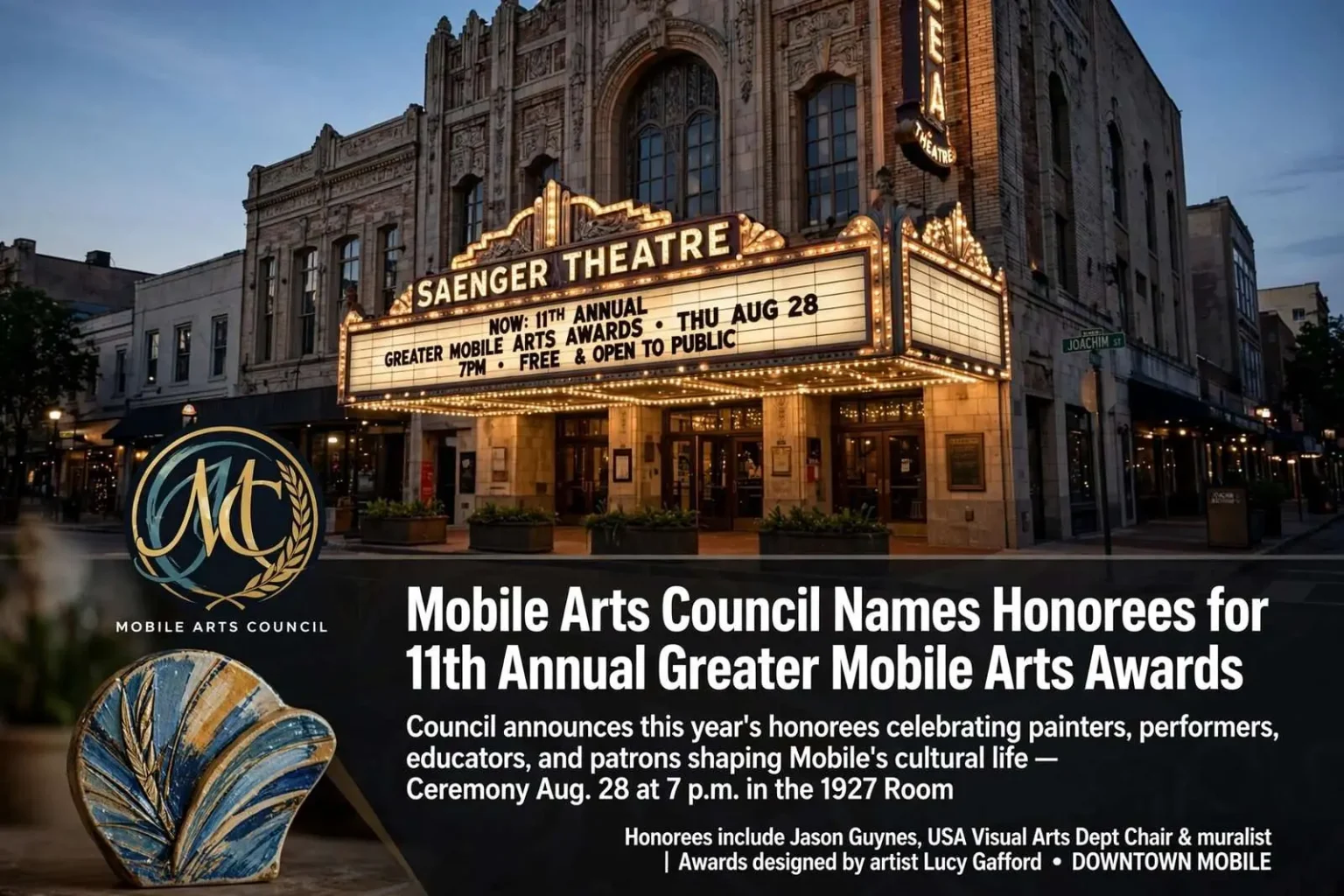
The Mobile Arts Council has announced the recipients of its 11th annual Greater Mobile Arts Awards, recognizing the individuals, groups and businesses that have helped shape the cultural life of the region. The council unveiled the honorees on a Tuesday, setting the stage for a late-summer celebration of the area’s artistic community. Eleven years into its run, the program has become one of the most visible ways the city honors the painters, performers, teachers, and patrons whose work often unfolds far from the public eye.
The awards will be presented at a ceremony on Thursday, Aug. 28, at 7 p.m. in the 1927 Room at the Saenger Theatre, with a reception honoring the recipients to follow immediately afterward. The event is free and open to the public, a deliberate choice that lets the wider community share in a night usually reserved for the honorees themselves and their families. Attendees will find the historic theater’s Joachim Street location in the middle of downtown’s entertainment district, an area whose own revival has been intertwined with the growth of the local arts scene.
The Greater Mobile Arts Awards exist to acknowledge the important contributions that artists, organizations and supporters make to the community’s cultural fabric. Each year the honors spotlight a cross-section of the local arts scene, from working artists to the businesses and institutions that sustain creative work in the Mobile area. The mix is intentional: an arts community needs audiences and patrons as much as it needs creators, and the awards treat both as worthy of recognition.
Honoring a painter and teacher
Among the honorees is Jason Guynes, who chairs the visual arts department at the University of South Alabama. Guynes painted the mural on the inside of the Moulton Bell Tower, a visible example of the kind of public artwork the awards seek to celebrate. The tower, a landmark on the university campus, turns an everyday passageway into a gallery that thousands of students and visitors encounter without ever buying a ticket.
His recognition reflects both his own artistic work and his role in shaping the next generation of artists through his teaching. As department chair, Guynes oversees a program that trains students in painting, printmaking, graphic design and art history, sending graduates into classrooms, agencies, and studios across the Gulf Coast. Awards like this one, arts leaders note, also raise the profile of university arts programs in a city whose cultural identity has historically leaned on music and Mardi Gras. For students, seeing their professor honored by the wider community is a lesson in itself about the place an artist can hold in civic life.
Public art occupies a particular place in Mobile’s landscape, from murals downtown to sculptures in its parks, and the awards’ attention to it underscores how much of the city’s art is encountered informally. Honoring the artist behind the Moulton Bell Tower mural is, in effect, honoring the everyday experience of the thousands who walk past it.
An award made by an artist
In keeping with a longstanding tradition, the awards themselves are works of art. Each year the council commissions a different local artist to create the pieces given to recipients, turning the honors into original objects rather than standard trophies. This year’s awards were created by painter and printmaker Lucy Gafford, herself a previous recipient of a Greater Mobile Arts Award.
That practice, having past honorees craft the awards for future ones, ties each year’s ceremony to those that came before and keeps the recognition rooted in the local creative community it celebrates. A Gafford award carries the mark of a working Mobile artist, and each year’s pieces differ from the last because the maker differs. For recipients, the object is both a trophy and a piece of local art history in miniature.
The tradition also functions as a small but steady stream of commissions for local artists, one more way the council channels support into the community it serves. In a market where original work can be a hard sell, an annual guaranteed commission carries real value for the artists selected.
A hub for the arts
The Mobile Arts Council is a private nonprofit organization that serves as an umbrella for arts and cultural groups across the Greater Mobile area. It draws financial support from a range of public and private sources, including the city of Mobile, the Mobile County Commission, the Alabama State Council on the Arts, the National Endowment for the Arts, and local corporations, businesses and individuals.
That mix of backing reflects the council’s role as a connector within the region’s cultural life, channeling support to organizations and artists and helping coordinate the broader arts community. Funding from the city and the county commission places the council alongside libraries and parks as a recipient of local government support for cultural life, while the state arts council and the National Endowment for the Arts connect Mobile’s organizations to funding pipelines that reach from Montgomery to Washington. The layering of local, state, federal, and private dollars is also a safeguard: when one source tightens, the others cushion the programs that depend on steady support.
The umbrella role matters in a region where museums, theater companies, dance troupes, galleries, and music organizations often compete for the same audiences, donors, and grant dollars. By providing shared marketing, gallery space, and administrative support, the council gives smaller groups capacities they could rarely maintain on their own.
The annual awards are among its most visible efforts, offering public recognition to those whose work might otherwise go uncelebrated. Behind each honoree stand rehearsals in borrowed rooms, classrooms after hours, and unpaid hours of planning that keep the region’s cultural calendar full. The awards are designed to make that labor visible, if only for a night.
The Saenger as a stage for the honors
For the honorees, the August ceremony at the Saenger Theatre promised a moment in the spotlight in one of downtown Mobile’s most storied venues. The Saenger opened in 1927 as a grand movie palace and has since survived storms, closures, and renovations to remain one of the city’s premier stages for touring acts and local productions alike. Its 1927 Room, named for the theater’s opening year, gives the ceremony a setting that matches the awards’ own blend of history and living artistry. Few rooms in the city pair gilded-era atmosphere with working-event practicality as well, which is why the council returns to it year after year.
Hosting the ceremony downtown also ties the event to the district’s broader revival, where galleries, restaurants, and the theater itself feed off one another on a busy night. Arts leaders have long argued that cultural investment and downtown vitality move together, and an evening built around the city’s artists illustrates the point in a single block.
For the public, the free event offered a chance to learn about the people and organizations enriching the area’s cultural scene, and to take part in a celebration of the arts that has become an annual tradition. Admission removes the barrier that keeps many residents from attending formal arts events, and the council’s open-door approach to the ceremony reflects its mission of broadening the audience for the arts rather than narrowing it.
The reception that follows the presentations gives honorees, council supporters, and attendees a chance to meet the artists whose work they have followed, a social function that in a city of Mobile’s size carries real weight. Relationships formed at events like this one often lead to the collaborations, commissions, and board memberships that sustain cultural organizations in the years between ceremonies.
Looking toward the ceremony
With the recipients now announced, attention turned to the ceremony itself, where the council would formally present its handcrafted awards and honor another slate of contributors to the Greater Mobile area’s artistic life. The announcement period also serves the practical purpose of building the audience the honorees deserve, letting friends, students, and colleagues clear an August evening to attend.
Eleven years on, the Greater Mobile Arts Awards have settled into their role as the region’s yearly accounting of its own creative health. The honorees change, the commissioned awards change, and the reception crowd shifts with them, but the underlying purpose holds: a city that measures itself by more than economics pauses each August to say, plainly, that its artists matter.
For this year’s class, the honor arrives as both recognition and responsibility, marking them as part of the tradition that future award makers — perhaps someday their own past honorees — will draw on. The doors of the Saenger open at 7 p.m. on Aug. 28, and anyone in the area who cares about the region’s cultural life is invited to be there when the honors are handed over.