University of South Alabama Mobile
Mobile SketchCrawl Heads to USA Campus for a Day of Drawing Oct. 15
The Mobile Arts Council's ninth SketchCrawl comes to the University of South Alabama campus Oct. 15, a free day of drawing open to all.
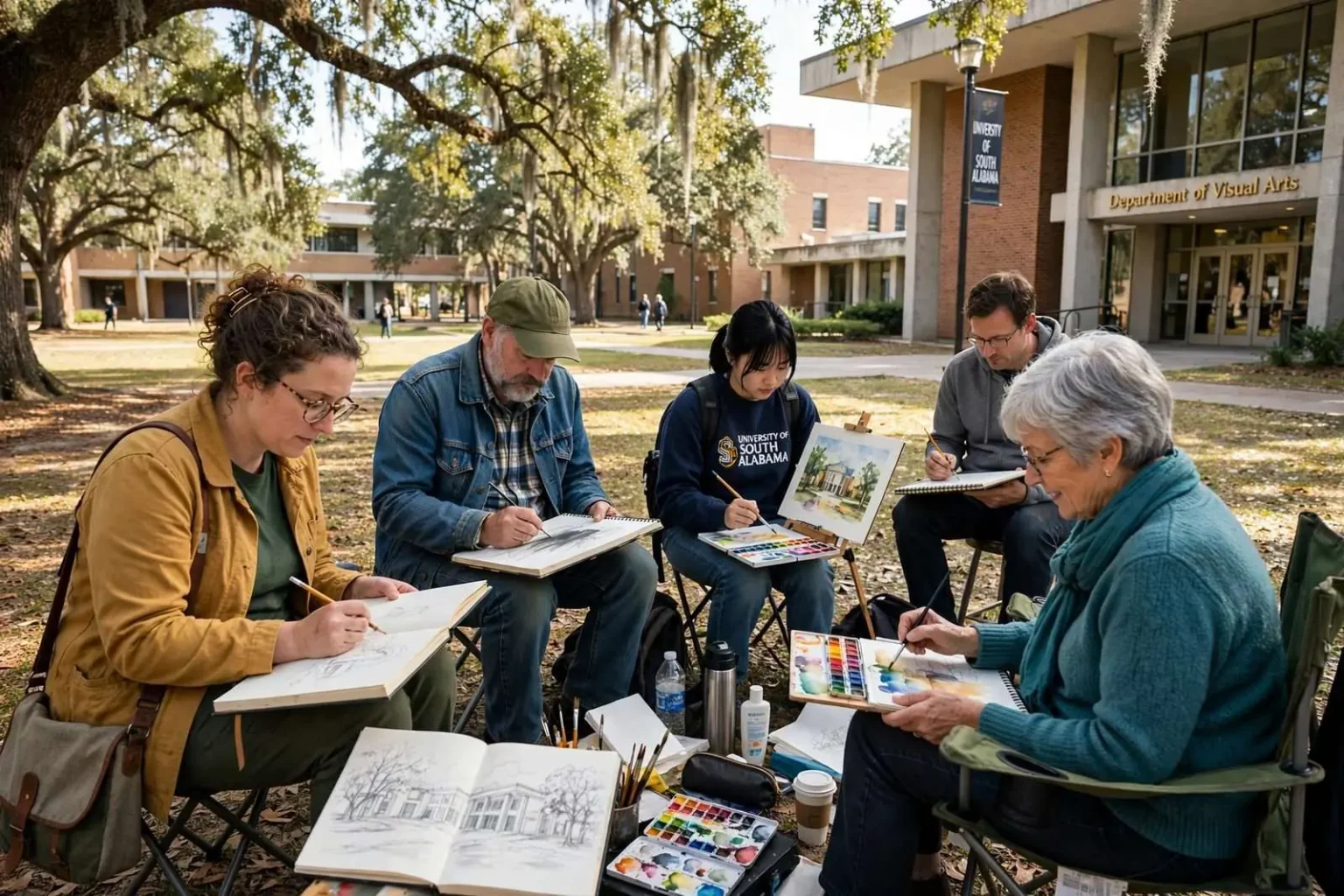
The Mobile Arts Council will host its ninth SketchCrawl on Saturday, Oct. 15, giving artists of every skill level a full day to sketch the University of South Alabama campus. The free event runs from 10 a.m. to 2 p.m., with participants checking in at the Department of Visual Arts before fanning out across the grounds to draw whatever catches their eye.
SketchCrawl is a worldwide drawing marathon created by illustrator Enrico Casarosa, in which artists in cities around the globe gather on a designated day to sketch their surroundings, then share the results online. The idea is disarmingly simple: treat drawing the way a pub crawl treats drinking, moving from spot to spot and filling a sketchbook along the way. Since its founding, the format has spread to cities on every continent, with each local chapter choosing its own routes and subjects while sharing the day’s output with a global community of sketchers.
Mobile’s chapter has previously drawn at the Gulf Coast Exploreum, and this edition takes the event to the University of South Alabama campus — a change of scene that hands participants a campus full of architecture, landscaping, student life and open space to work with. Organizers will scan drawings throughout the day and post them to the “Mobile SketchCrawl” Facebook page, and sketchers are encouraged to gather around 3:30 p.m. to share the results of their work in person.
A Day on the USA Campus
The University of South Alabama’s campus offers a sketcher’s variety in a single setting. The university, founded in the early 1960s as one of the state’s newer public institutions, has grown into a major campus with a mix of mid-century modern buildings, newer construction, wooded green spaces and busy pedestrian corridors. On a Saturday, the campus trades its weekday bustle for a quieter rhythm — fewer crowds, easier parking and long, uninterrupted sightlines for anyone setting up a sketchbook in the shade.
Participants check in at the Department of Visual Arts, the campus hub for drawing, painting and design instruction, and a fitting headquarters for the event. From there, sketchers can wander as they choose: the formal spaces around the academic buildings, the stands of longleaf and oak, the sculpture and benches scattered through the grounds, or the human activity of a college weekend. The marathon format imposes no schedule beyond the start and end times — artists draw at their own pace, in whatever medium they bring.
The event is free and open to anyone who wants to draw, regardless of skill level. That openness is a hallmark of the SketchCrawl concept, which was designed from the start as a community drawing exercise rather than a competition or a class. Beginners sketch alongside experienced artists, and the cross-pollination — watching how someone else approaches the same scene — is part of what draws regular participants back.
The SketchCrawl Idea
Enrico Casarosa, the illustrator behind the SketchCrawl concept, launched the drawing marathon as a way to combine sketching, community and the creative energy of a shared event. His own work as a storyboard artist and illustrator informed the format’s emphasis on quick, observational drawing — capturing what is in front of you without overthinking it. The worldwide SketchCrawl days that followed turned a personal exercise into a movement, with a shared website listing participating cities and a culture of posting drawings online after each crawl.
The global format gives a local event like Mobile’s a dual character: it is both a community gathering on the USA campus and one node in a worldwide day of drawing. The online sharing that organizers have built into the event — scanning drawings throughout the day and posting them to the Mobile SketchCrawl Facebook page — lets local participants see their work appear alongside the day’s output from sketchers in other cities, and lets friends and family follow along in real time.
The Mobile Arts Council’s Role
The Mobile Arts Council, which hosts the crawl, has long served as the center of gravity for the Port City’s visual and performing arts community. The organization supports local artists through gallery exhibitions, grants, workshops and collaborative events, and its programming reaches across the city — from downtown galleries to neighborhood schools. A SketchCrawl fits its mission precisely: a free, public, participatory event that puts art-making in ordinary hands and takes it out of the studio and into the streets.
Reaching its ninth edition says something about the event’s staying power. Community drawing events live or die on the mix of regulars and newcomers, and Mobile’s SketchCrawl has built a base by rotating its venues — from the Gulf Coast Exploreum science center, where a previous edition sent sketchers among the exhibits, to the university campus for this outing. Each location changes what there is to draw, and the rotation keeps the format fresh for repeat participants.
The Exploreum edition illustrated the range of subjects the crawl can tackle — indoor spaces, scientific displays, the downtown streetscape around the museum. The campus edition swings the opposite direction: outdoor scenery, architecture, open lawns and the leafy edges of a large property. Between them, Mobile sketchers have drawn much of the city’s most distinctive terrain.
What to Bring and What to Expect
The event’s only requirements are a drawing implement and something to draw on — pencil and sketchbook, pen and pad, or whatever medium the artist prefers. Everything else is optional. The crawl runs from 10 a.m. to 2 p.m., a four-hour window that participants can use in full or in part; some sketchers stay with a single subject for the whole session, while others move every half hour and fill pages with quick studies.
October in Mobile brings some of the year’s best weather — warm days, cooler mornings and reliable light — which makes an outdoor sketching event on the campus a comfortable prospect. Shaded lawns and covered walkways give artists plenty of spots out of the sun. Water, sunscreen and a folding stool are common additions to the kit of veteran sketch crawlers, and a portable chair turns any spot on the campus into a studio for an afternoon.
First-timers should not be deterred by the marathon label. The event’s structure — check in, draw, gather again later — is deliberately loose, and no one is required to produce finished work. SketchCrawls welcome the hesitant beginner and the practiced hand alike, and the sharing session at 3:30 p.m. is framed as show-and-tell, not critique: artists gather to see what everyone else did with the same four hours and the same campus.
Drawing in Public, Together
The value of an event like SketchCrawl goes beyond the drawings produced. Drawing in public, alone, can feel exposing; drawing in a loose group of dozens, it becomes ordinary — even celebratory. Passersby stop to look, ask questions and sometimes decide to join in, which is how the SketchCrawl community has grown in cities around the world, Mobile among them.
The gathering at 3:30 p.m. to share results cements that community dimension. Seeing the range of approaches — how one artist rendered a building facade while another drew the person sketching it, how the same oak tree becomes a careful study in one book and a two-minute gesture in another — is the quiet education the day provides. No instruction is offered, and none is needed; the group teaches itself.
For the Mobile Arts Council, the ninth SketchCrawl continues a simple proposition: that a city’s art life depends on people making art, and that the best way to get them started is to hand them a free event, a beautiful setting and a few hours in good company. On Oct. 15, the University of South Alabama campus becomes the Port City’s open-air studio — and anyone with a pencil is welcome.
Sketching the University of South Alabama
The choice of the USA campus rewards attention to what makes it visually distinct among Mobile’s landmarks. The university’s growth from a small commuter college into a major institution left the campus with architectural layers — original mid-century buildings with the clean lines of their era, later additions in brick and glass, and landscape elements that have matured over decades into the live oaks and pines that shade the walkways. For a sketcher, the mix means no two corners of the campus present the same subject twice.
Saturday adds its own texture. College campuses on weekends hold a particular atmosphere — quiet quads, occasional athletes training, the maintenance rhythm of a big institution — and those human touches give observational drawing life without the pressure of busy crowds watching over an artist’s shoulder. The Department of Visual Arts checkpoint places artists in the heart of the campus’s creative quarter, a natural launching point for a day of wandering with a sketchbook.
The four-hour window also suits beginners in a way that longer marathons do not. Ten to two is long enough to fill several pages and short enough that fatigue never sets in, and the optional 3:30 p.m. gathering means participants who cannot stay for the full session still share in the day’s closing tradition of comparing results.
From the Exploreum to the Campus
The rotation from the Gulf Coast Exploreum to the university tracks the evolution of Mobile’s SketchCrawl itself. Early crawls in the series introduced local artists to the format — the shared day, the online posting, the loose sociability — and each successive edition has tested the concept in a different corner of the city. The Exploreum offered indoor subjects and a downtown audience; the campus offers open air and a setting where an artist can claim a patch of shade for an hour without being disturbed.
The venue changes also serve the event’s outreach purpose. Drawing participants from the university community — students, faculty, staff — alongside the Arts Council’s established audience extends the crawl’s reach, and a campus setting lowers the intimidation factor for newcomers who might hesitate to sketch in a busy downtown public space. A Saturday on the campus is a forgiving environment for a first sketchbook.
Enrico Casarosa’s founding idea — that a drawing marathon should feel like a community event rather than a solitary discipline — has held up across the format’s global spread, and Mobile’s ninth crawl is a case study in why. The ingredients are minimal: a date, a meeting point, a Facebook page for the day’s scans and enough pencils in enough hands. Everything else is supplied by the participants and the place they choose to draw.
Why SketchCrawl Matters Locally
Mobile’s visual arts community draws strength from events that welcome everyone, and the SketchCrawl has become one of its most accessible entry points. There is no fee, no registration hurdle, no portfolio to present — just a time, a place and an invitation to draw. In a city with a rich arts calendar anchored by galleries, festivals and the Arts Council’s year-round programming, a free outdoor drawing day fills a niche the ticketed events cannot.
The event’s digital element extends that reach. Scanning drawings throughout the day and posting them to the Mobile SketchCrawl Facebook page means the crawl produces a public record — a collective sketchbook of the campus as drawn by the people who spent Oct. 15 looking at it closely. For participants, seeing their work online alongside the day’s other drawings is part of the payoff; for the community, the gallery of scans is a portrait of the city through local eyes.
And for the artists themselves, the day offers what all community drawing events ultimately provide: permission. Four hours set aside, a campus full of subjects and a gathering of kindred sketchers at 3:30 p.m. to share the results — that is all the structure a drawing marathon needs, and it has been enough to carry the SketchCrawl idea from Enrico Casarosa’s sketchbook to cities around the world, including this one.