April’s LoDa ArtWalk Goes Virtual Amid Coronavirus Shutdowns
April's LoDa ArtWalk in downtown Mobile went virtual on Facebook during the pandemic, with local artists and musicians sharing content online.
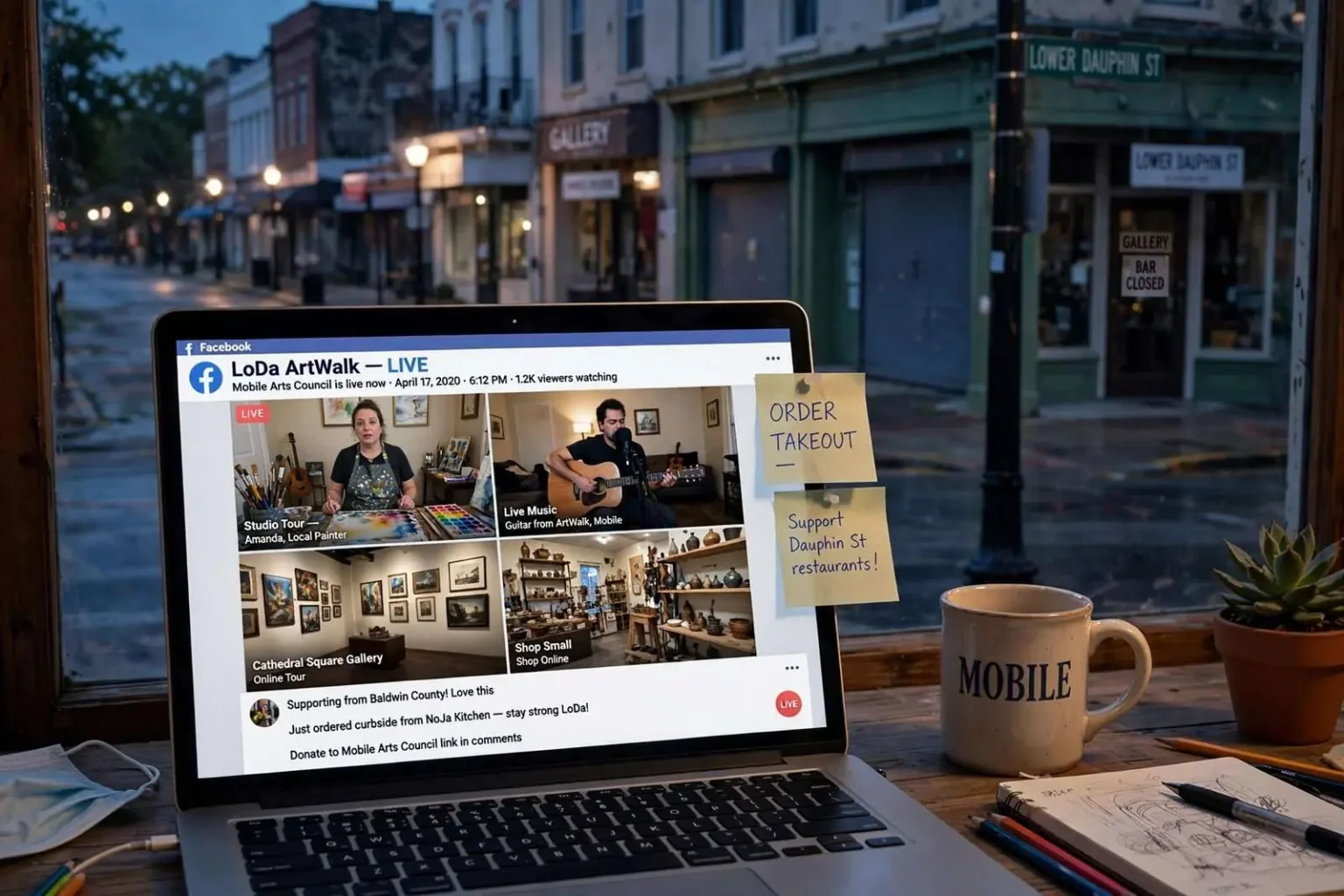
April’s LoDa ArtWalk in downtown Mobile went virtual on Friday night, April 17, 2020, as the coronavirus pandemic continued to keep large public gatherings off limits across the Gulf Coast. The monthly arts event, organized through the Mobile Arts Council, streamed live on Facebook from 6 p.m. to 9 p.m., trading the crowded sidewalks of Lower Dauphin Street for a scrolling feed of galleries, performances and studio tours beamed into living rooms across the region.
The transformation was stark for anyone who had attended the event before. On a normal second Friday, LoDa ArtWalk turns the heart of downtown Mobile into an open-air festival: galleries throw their doors wide, artists set up on the sidewalks, restaurants and bars fill with the post-work crowd, and thousands of residents drift up and down Dauphin Street from end to end. In April 2020, those same streets sat quiet under public health orders, and the art moved to the only public square that remained open — the internet.
Local venues, musicians, artists and businesses shared videos, photos and other content during the virtual event, encouraging residents to shop small and donate to local arts organizations. The format inverted the usual economics of ArtWalk night. Instead of foot traffic passing a gallery window, the stream passed from viewer to viewer, with each participating artist or venue carrying its own call to action: buy from a local shop’s online store, order from a downtown restaurant, support the museums and councils that keep Mobile’s cultural infrastructure standing.
Organizers also urged the public to support downtown Mobile restaurants by ordering delivery or curbside pickup during the event, helping small businesses weather the economic impact of COVID-19 restrictions. The request recognized that ArtWalk’s value has always been cumulative — the galleries alone do not make the night; the restaurants, bars and retail shops that depend on the monthly crowd are part of the same ecosystem. With dining rooms closed across Alabama under the state’s public health orders, takeout had become the restaurant industry’s only revenue, and every order placed during the virtual walk kept a kitchen staff employed a little longer.
A Signature Event Reimagined
The LoDa ArtWalk, held on the second Friday of each month, is a signature cultural event for Mobile’s Lower Dauphin Street entertainment district. The “LoDa” nickname — a portmanteau of Lower Dauphin — has become shorthand for the blocks at the center of downtown’s revival, where historic storefronts house galleries, restaurants, music venues and the small boutiques that give the district its character. The ArtWalk predates much of that revival and helped drive it: monthly crowds gave entrepreneurs a reason to sign leases on buildings that had sat empty, and the district’s growth followed the event’s momentum.
The Mobile Arts Council, which organizes the walk, has spent decades functioning as the connective tissue of the city’s arts scene — supporting working artists, staging exhibitions, running education programs and coordinating the calendar that links the museums, theaters and galleries spread across the city. Moving the April event online fell to the council’s staff, who had days to assemble a three-hour broadcast out of material contributed by dozens of participants working from shuttered studios and closed storefronts.
The shift to a virtual format reflected a broader trend across the Gulf Coast as arts organizations, businesses and community groups adapted to social distancing requirements during the spring of 2020. Museums in Mobile and Pensacola launched virtual tours. Community theaters moved table reads and archival performances online. Symphony orchestras and choir directors streamed rehearsals from living rooms. Almost every cultural institution in the region improvised some version of the same pivot within weeks, guided by a shared assumption that the 2020 season was lost to the virus but the audience could be kept — if not in seats, then at least in touch.
Mobile’s arts community, like many across the country, faced significant challenges during the pandemic, with galleries, performance venues and independent artists losing foot traffic and income. The economics of a working artist are unforgiving even in a good year: most painters, musicians, actors and craftspeople on the Gulf Coast piece together a living from sales, commissions, gigs and teaching, and the pandemic erased most of those income streams at once. Canceled art festivals — the spring season that normally carries artists from Fairhope to New Orleans — represented a huge share of annual sales for many, and no virtual stream fully replaces a festival tent’s cash register.
Virtual events like the ArtWalk offered a way to maintain community connections and visibility for local creators during an uncertain time. The immediate financial return was modest, but organizers pointed to other values that mattered in a spring of isolation: reminding the public that artists were still working, keeping the district’s name in the conversation, giving donors a reason to give, and maintaining the monthly rhythm so that the event could resume on the sidewalk the moment public health rules allowed.
The April 17 broadcast also arrived at a moment of peak uncertainty. By mid-April 2020, Alabama schools had closed for the year, unemployment claims had surged across the state, and the Gulf Coast’s tourism-dependent economy — already battered by the collapse of cruise travel at the Port of Mobile and the shutdown of the beaches — showed no clear path to reopening. In that context, a three-hour livestream was less a cultural event than a communal act of reassurance: a way for a city built on gathering to keep gathering, in whatever form the virus permitted.
For the artists who participated, the reach of the stream offered a small consolation. A sidewalk display during a physical ArtWalk competes with every other storefront on Dauphin Street for the attention of passersby; a Facebook stream travels to viewers who might never attend in person — snowbirds up north, former Mobilians scattered across the country, and residents of the smaller Eastern Shore and Baldwin County communities who rarely make the Friday-night drive downtown. Several participants used the platform to direct viewers to online shops and commission pages, planting seeds for sales that would materialize long after the stream ended.
The restaurant appeal proved equally important. Downtown Mobile’s dining scene had spent years building the critical mass that makes an entertainment district work, and the pandemic threatened that foundation directly. Independent restaurants operate on margins that a few weeks of closure can erase, and the delivery-and-curbside orders that organizers pushed during the virtual walk were the difference between a lean spring and a permanent closure for some establishments along Dauphin and the surrounding blocks.
By the end of the three hours, the event had done what it set out to do: kept April’s ArtWalk on the calendar, kept Mobile’s artists visible, and kept the community’s attention on the small businesses that give Lower Dauphin Street its life. No one involved pretended a livestream could replace the real thing — the crowds, the music spilling from doorways, the conversations that turn a first-time visitor into a regular. But the virtual walk made its own argument: that the arts community of Mobile endures not because of any single venue or event, but because the people who make it keep showing up, even when the showing up happens on a screen.
As the region waited out the spring of 2020, the LoDa ArtWalk’s pivot stood as a template for what adaptability looked like on the Gulf Coast — imperfect, improvised, and powered by exactly the community spirit the event was created to celebrate. When the crowds eventually returned to Lower Dauphin Street, they returned to a district whose galleries, restaurants and shops had been kept alive in the interval by residents who never stopped showing up for them, one stream, one order and one donation at a time.
The council’s move online followed weeks of cancellations across the Mobile cultural calendar. Mardi Gras 2020 — the city’s economic and social centerpiece — had already been effectively concluded by the pandemic’s arrival in early March, and every event that depends on crowds had fallen like dominoes behind it: festivals, gallery openings, theater runs, concert seasons. For an organization whose mission is built around public participation in the arts, the choice was between going dark entirely or reinventing the format, and the council chose reinvention.
There was also a longer-term bet embedded in the April stream: that audiences formed online would eventually convert to audiences on the sidewalk. Event organizers across the country made the same wager during 2020, using virtual programming to maintain their mailing lists, their sponsor relationships and their public profile while doors were shut. The Gulf Coast arts groups that kept communicating through the shutdown — with newsletters, streams and social media presence — entered the reopening period with their communities intact, while those that went quiet spent their first post-pandemic months rebuilding from zero.