Mobile County’s Vote to Post ‘In God We Trust’ Plaque Ignites Fierce Debate
The Mobile County Commission's 2-1 vote to display an 'In God We Trust' plaque drew a rebuke from a national watchdog group and touched off passionate debate among residents on both sides.
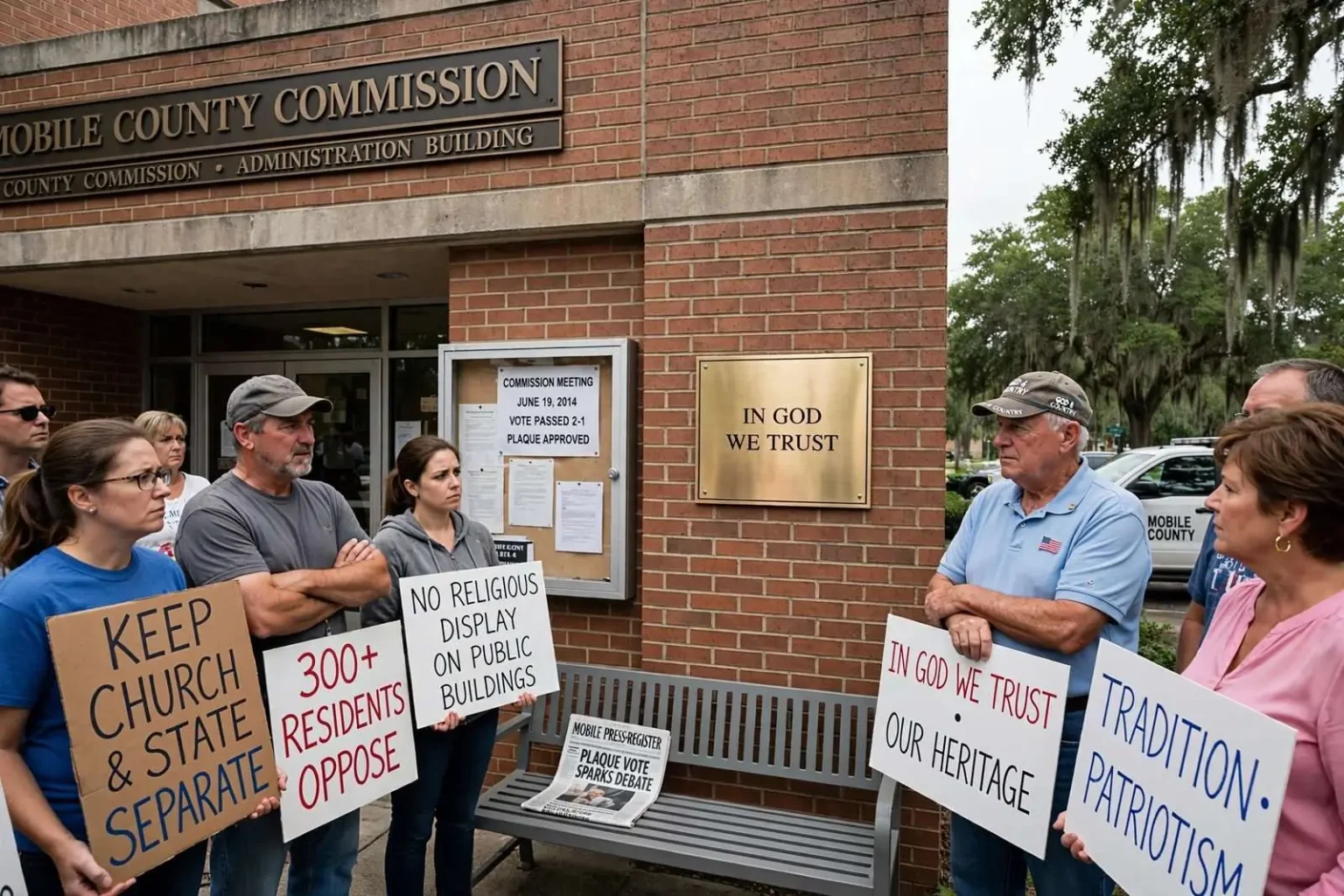
A decision by the Mobile County Commission to hang a plaque bearing the words “In God We Trust” has stirred one of the more emotionally charged local debates in recent memory, drawing objections from a national watchdog group and hundreds of impassioned comments from residents. The commission voted 2-1 on June 19, 2014, to approve the display.
The measure moved forward despite pointed opposition at the meeting itself: of the nine people who came to speak about the proposal, eight spoke against it. Only a single member of the public voiced support. The lopsided split in the room — against a measure that nonetheless passed — framed the question that would dominate the weeks of commentary that followed: whose voices was the commission weighing, and on what authority did a 2-1 vote commit the county to a fight with a national organization?
A national group weighs in
Just a week after the vote, the Freedom From Religion Foundation sent the commission a letter rebuking the panel for its decision. The Wisconsin-based organization, which advocates for the separation of church and state, argued that government displays of religious language raise constitutional concerns. Its letter added fuel to a controversy that had already spread well beyond the commission chamber.
The FFRF is, by design, a familiar presence in disputes of this kind. The foundation has spent decades monitoring government religious displays across the country, writing letters that serve as both warning and paper trail — the documented first step in the lawsuits that usually follow when the display stays up. Its intervention transformed a county-level symbolic vote into a matter with national legal dimensions, and put Mobile County on the list of government bodies the organization publicly tracks.
Supporters of the plaque framed the phrase as a longstanding element of American civic life, noting that “In God We Trust” has appeared on the nation’s currency since 1956 and is displayed in numerous public settings. The motto, adopted by Congress at the height of the Cold War as a statement of national identity, adorns courtrooms, schoolhouses and state capitols across the country, and has repeatedly survived legal challenge — a record that supporters cited as evidence the plaque posed no legal risk at all.
Residents divided
The debate played out vividly in public commentary. More than 300 people left remarks weighing in on the question, a volume that underscored how deeply the issue resonated across the county. Some argued that removing or omitting the phrase amounted to erasing a piece of national heritage, while others contended that public institutions should either recognize all faiths or none.
A recurring theme among opponents was practical as much as philosophical: several predicted the plaque would ultimately land the county in court and cost taxpayers money that could be spent elsewhere. “It would have been better to have done nothing and avoided all the expense,” one resident wrote, capturing a sentiment shared by others who worried about litigation.
Among supporters, the language of patriotism and tradition dominated, with many insisting the phrase should remain a visible expression of the community’s values. For that camp, the controversy itself was evidence the plaque was needed — a culture, in their telling, that bristles at a national motto displayed on a government wall is a culture in need of the display. Several supporters pointed to the plaque’s cost, a few hundred dollars or less, as trivial against the principle involved.
The sharp split in the comments mirrored the divide seen at the commission meeting, where opposition had been vocal even as the measure passed. County government in Mobile rarely generates three hundred public comments on anything — not roads, not budgets, not the county’s own fiscal crises — and the sheer volume made the plaque, for a few weeks, the most-discussed action the commission had taken in years.
Opponents countered that a county government should not lend its walls to a religious statement, and warned that the decision could invite a costly legal challenge. The two framings talked past each other all summer: one side argued the plaque was as American as the dollar bill, the other that the dollar bill’s precedent did not obligate a county commission to imitate it — and that the question was not what courts had tolerated elsewhere but what a local government should do with its own walls.
A response in the works
The controversy also prompted a planned counter-proposal. The local atheist community indicated it intended to propose a mural representing its own beliefs at some point later in the year, setting up the possibility of a broader conversation about which viewpoints a public building should accommodate.
The planned mural changed the legal and political shape of the debate. A government that displays one creed’s message on its walls invites the question of what it will do when another worldview asks for the same wall — accept it, refuse it, or remove the first display to avoid the dilemma. Supporters of the plaque suddenly faced the scenario separation advocates had described from the start: a public building either opening its walls to every persuasion or explaining why one inscription deserved the space and another did not.
Local atheists organizing around the proposal also gave the controversy a face the commission had not anticipated. Nonbelievers in south Alabama, as elsewhere, are accustomed to practicing their absence of faith quietly, and a public mural proposal forced a community that rarely identifies itself into the middle of a county government debate. Organizers said the point was not to displace the motto but to test the principle behind it: if “In God We Trust” belongs on a county wall because it expresses the community’s values, then the county must either mean that for everyone’s values or admit it means it for some.
What the vote settled — and didn’t
For the commission, the 2-1 vote settled the immediate question of whether the plaque would go up, but it left larger questions unresolved. The threat of legal action, the promise of a competing display and the sheer volume of public reaction all suggested that the debate over “In God We Trust” in Mobile County was far from over.
Commissioners who supported the measure did so in the knowledge that plaques of this kind almost never come down voluntarily. Removing a motto display after controversy carries its own political cost — a concession that courts or complaints, not conviction, drive county policy — and so the practical effect of the vote was to invite the issue to run its full course: letter, response, possible suit, possible mural, possible precedent.
What was clear in the days after the vote was the intensity of feeling on both sides. Few local decisions had generated such a torrent of commentary, and the split among residents, roughly tracking national arguments over religion in the public square, showed that the issue touched something deeper than a single plaque on a single wall.
The episode also illustrated the peculiar position county governments occupy in these fights. A county commission’s calendar is usually full of zoning variances, road contracts and budget line items — decisions of real consequence that draw almost no public attention. The plaque decision, by contrast, cost the county almost nothing and decided almost nothing, yet it dominated the commission’s public profile for a season and put its members’ names on a national organization’s correspondence. For better or worse, that was the trade the 2-1 vote made: a symbol on the wall, and a debate in the county that showed no sign of ending.
The plaque and its history
The phrase on the plaque carried more than two centuries of American history onto the commission wall. Congress made “In God We Trust” the national motto in 1956, during the Eisenhower administration, codifying into law a phrase that had already appeared on coinage since the Civil War era, when Treasury officials first placed it on the two-cent piece of 1864. Courts have periodically tested both the motto and its public displays, and while the outcomes have varied with the context — a motto on currency has fared better than devotional banners in schools — the phrase’s federal pedigree has given defenders a ready-made constitutional argument.
Local governments across the country had made the same choice Mobile County made in the years around the vote, usually with the same result: a plaque goes up, a complaint is filed, a national organization writes a letter, and the debate runs its course in council chambers and comment sections. In most such standoffs, the display stays and the lawsuit never arrives; in a handful, courts have ordered other religious displays — Ten Commandments monuments, most famously — removed at public expense. Which of those precedents Mobile County’s plaque resembled was precisely the question the sides could not agree on.
The commission’s vote also fit a regional pattern. Governing bodies across the Gulf South had taken up motto displays in the same era, often after a constituent request and usually with the same lopsided public division. The displays cost little, poll well in much of the electorate, and place a county government on the side of an issue where rural and suburban Alabama public opinion runs strongly in favor — a calculus that explains, if it does not excuse, why a 2-1 vote proceeded over a hearing room that had just heard eight speakers oppose it.
Living with the decision
In the weeks after the vote, the plaque became a fixture of the county’s civic conversation — a shorthand for what kind of community Mobile County considered itself, invoked by supporters and critics alike in discussions that had little to do with the plaque itself. Local congregations praised the commission from their pulpits; commentators in the press warned of lawsuits and divisiveness; and the comment threads that had carried three hundred responses kept filling.
The commissioners themselves, meanwhile, returned to the road projects and budget matters that fill a county agenda, leaving the plaque to do its symbolic work and the controversy to burn down at whatever pace it chose. Whether the Freedom From Religion Foundation’s letter would be answered with litigation, and whether the atheist community’s mural would ever reach the commission’s agenda, remained open questions — the two loose threads from which any future chapter of the dispute would be woven.
What the episode demonstrated beyond argument was the durability of the issue itself. A motto minted into the nation’s coinage, adopted by Congress, and contested in courthouses for sixty years had been installed on a Gulf Coast county wall in a single afternoon — and instantly re-opened, in one county, every question the national debate had ever raised. The plaque hung where the vote put it. The argument about whether it belonged there was just beginning.