Alabama Speaker Mike Hubbard to Lead Regional Legislative Group; Mobile to Host in 2013
House Speaker Mike Hubbard was chosen to lead the Southern Legislative Conference, which announced it would hold its next annual meeting in Mobile, bringing lawmakers from across the South to the coast.
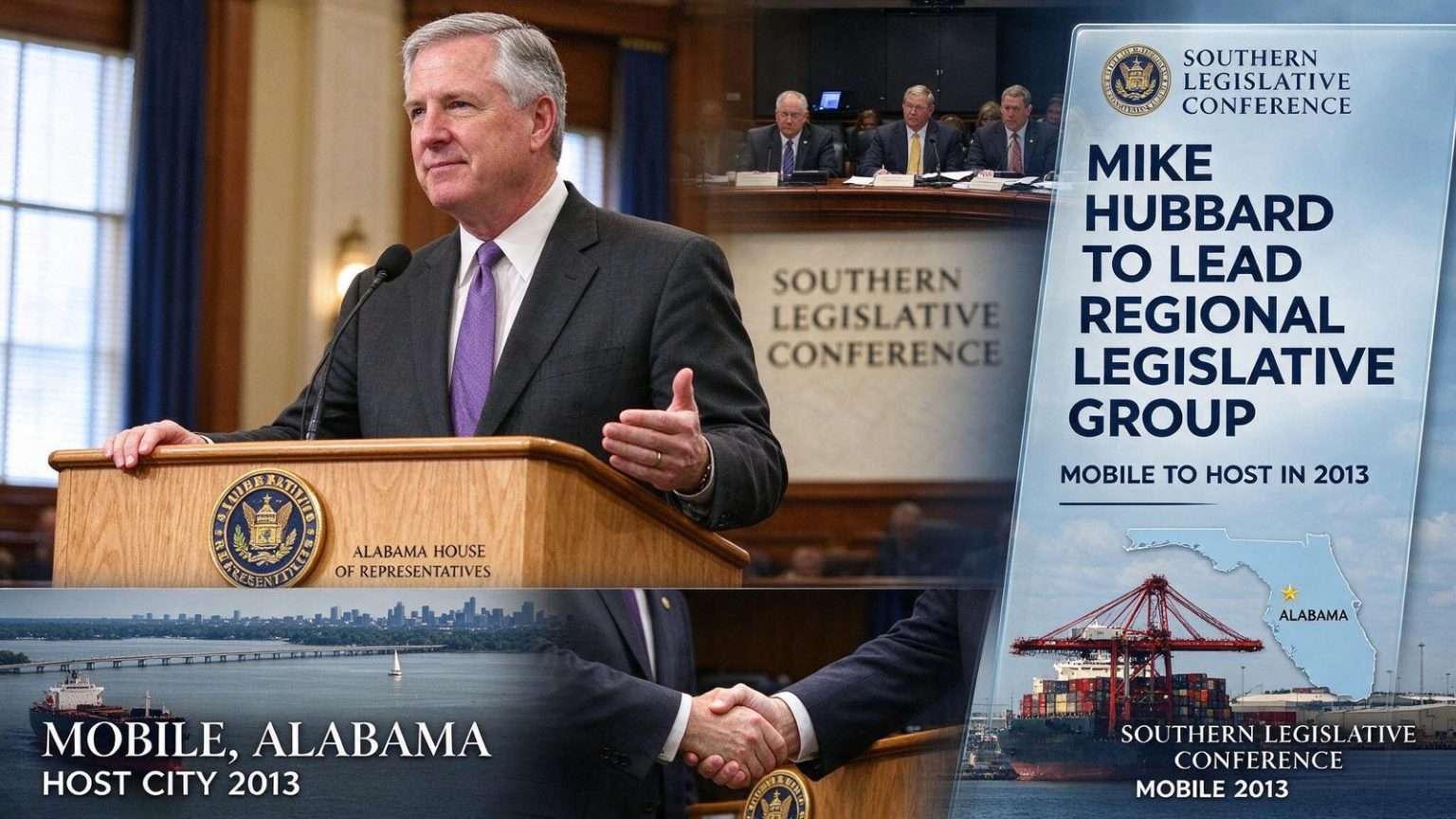
Alabama Speaker of the House Mike Hubbard was the unanimous choice to head the Southern Legislative Conference, the regional organization announced after meeting recently in Charleston, West Virginia. For the Mobile Bay area, the news carried a local dividend: the conference declared it would hold its next annual meeting in Mobile, putting the port city on a stage shared by lawmakers from across the South.
Hubbard’s selection placed an Alabama lawmaker at the helm of one of the country’s most substantial regional legislative bodies. The unanimous vote reflected the standing Hubbard had built among colleagues across state lines, and it gave Alabama a prominent seat at a table where legislators from a dozen and a half states compare notes on shared challenges. For a state that has often looked to its neighbors for models on economic development, transportation and education policy, holding the chairmanship carried more than symbolic weight.
Founded in 1947, the Southern Legislative Conference is the largest of the four regional legislative groups operating under the umbrella of the Council of State Governments, the national organization that has served state lawmakers since the 1930s. The conference’s membership spans a broad swath of the country. The states represented are Alabama, Arkansas, Florida, Georgia, Kentucky, Louisiana, Mississippi, Missouri, North Carolina, Oklahoma, South Carolina, Tennessee, Texas, Virginia and West Virginia.
The conference exists to give legislators from those states a forum to study issues that cross borders — from transportation and energy to agriculture, economic development and public finance — and to share approaches that have worked, or failed, in their respective capitals. For a region bound by common history and economy, that kind of exchange offers a practical way to learn from one another. A highway funding experiment in Georgia or a workforce training initiative in North Carolina may find echoes in Montgomery, and the conference’s standing committees and annual meetings are where those comparisons get made.
How the conference shapes Southern policy
Unlike Congress, the Southern Legislative Conference has no power to pass laws. Its influence works through ideas. Staff members and policy analysts track emerging issues for member legislatures, organize committee sessions where lawmakers hear from experts, and publish reports that statehouse offices across the region keep close at hand. Legislators who serve on the conference’s committees often carry what they learn straight into bill drafting back home, which means the organization’s fingerprints can show up on legislation in states far from where a proposal was first discussed.
The Council of State Governments structure divides the nation into regional conferences — Southern, Eastern, Midwestern and Western — so that lawmakers can dig into problems that look different in different parts of the country. For the South, those problems have long included rapid population growth, hurricanes and other natural disasters, water disputes between neighboring states, rural health care, and the constant work of recruiting industry. The annual meeting is the centerpiece of that work, drawing several days of committee sessions, speeches and informal exchanges.
Hosting duties rotate among member states, and the selection of a host city is itself a statement about where the region’s attention is pointed. Bringing the gathering to a Gulf Coast city signaled that the conference intended to put coastal issues, port commerce and the region’s fast-changing economy in front of its members.
Mobile in the spotlight
The decision to bring the next annual meeting to Mobile promised to put the port city on display before an influential audience. Gatherings of that size typically draw hundreds of lawmakers, staff members and guests, filling hotel rooms, restaurants and meeting spaces and offering a host city both an economic boost and a chance to make an impression. Delegates arriving for such meetings do more than attend sessions; they eat downtown, tour the area and carry home impressions that can influence where conventions, investments and even retirements end up.
For Mobile, which had worked for years to raise its profile as a destination for conventions and events, hosting a regional assembly of legislators represented an opportunity to showcase its downtown, its waterfront and its Southern hospitality to decision-makers from more than a dozen states. The city’s convention trade had grown alongside its downtown revitalization, with historic districts, a working port and a calendar of festivals giving visitors reasons to extend their stays. An audience of state legislators — people who make budget and policy decisions that ripple across the region — was among the more valuable audiences a city like Mobile could hope to court.
Hosting a multistate legislative meeting also carried practical benefits closer to home. Alabama legislators who might otherwise fly to distant host cities would find the 2013 gathering practically in their own backyard, making it easier for members of the State House and Senate to participate fully in committee work. Local officials from Mobile and Baldwin counties would have a rare chance to bend the ear of colleagues from Texas to West Virginia about the issues that define the Gulf Coast: hurricane recovery, coastal insurance, port expansion and the boom in industrial construction that has reshaped the region’s economy.
A convergence of interests
The pairing of Hubbard’s leadership with a Mobile meeting site aligned neatly. An Alabama speaker at the head of the organization and an Alabama city set to host its marquee event gave the state a double measure of visibility within the conference in the year ahead. Alabama’s legislative delegation would effectively serve as hosts for the gathering, and the state’s policy priorities would naturally color the agenda in the period leading up to the meeting.
Hubbard, who led the Republican majority in the Alabama House, had built his reputation in part on economic development work, and his colleagues’ decision to elevate him suggested confidence that he could steer the organization effectively. A speaker’s schedule is already crowded with state duties, but regional leadership posts have historically been treats that ambitious lawmakers pursue precisely because they broaden relationships beyond state lines. Those relationships tend to pay dividends when states compete for projects or negotiate shared resources.
The announcement came as a comparatively small item amid a busy political summer on the coast, but its implications reached forward. When the conference convened in Mobile, it would bring with it a cross-section of Southern political leadership and, with them, attention and activity for a city eager to welcome both. Hotel occupancy, restaurant traffic and meeting space bookings would register the visit in the short term, while the longer-term return would come from the relationships and impressions formed over several days of sessions.
What it means for the region
For the Mobile Bay area, the meeting was expected to land in a season when the city’s profile was already rising. The port continued its work as one of the Gulf’s deepwater gateways, aerospace and shipbuilding anchored the local industrial base, and the wider Gulf Coast had spent years rebuilding and diversifying after hurricanes. A gathering of Southern legislators would see that story firsthand rather than through press releases.
Regional organizations like the conference also serve as an early-warning system for state capitals. When several states begin wrestling with the same problem — a court ruling on school funding, a shift in federal transportation policy, a dip in energy prices — the conference’s meetings are often where the pattern becomes visible. Members leave with a sense of which approaches are working in comparable states, and staff analysts compile that intelligence between gatherings.
In the meantime, Hubbard’s elevation ensured that Alabama’s voice would help shape the organization’s agenda leading up to the event. The chairman traditionally influences which issues receive emphasis, which sites are studied and how the conference engages the Council of State Governments’ national work. For Alabama, that meant a year in which the state’s perspectives on manufacturing, coastal restoration and rural development would carry the extra weight that comes with holding the gavel.
The vote in Charleston was brief and unanimous, but its effects were set to stretch across two calendar years: first through the run-up to the Mobile meeting, then through the meeting itself, when hundreds of Southern lawmakers would gather on the Gulf Coast under the leadership of an Alabama speaker. For a state that has long measured its standing by what its neighbors think, the arrangement was an unambiguous upgrade.
The council’s regional structure dates to an era when state legislatures were part-time bodies with small staffs, and the need for shared research was acute. That premise still holds. A state representative serving a two-year term has little time to study how neighboring states handled, say, a change in Medicaid policy or a new federal education standard. The conference compresses that learning curve by putting the people who lived through those decisions in the same room.
Committee work continues between annual meetings. The organization’s policy committees — covering areas such as fiscal affairs, human services, energy and environment, agriculture, and transportation — hold interim sessions in different member states, letting host communities showcase local industries and letting visiting legislators examine problems on the ground. Reports generated from those sessions circulate to every member legislature, giving even the smallest state access to policy research it could never produce alone.
The annual meeting itself blends formal programming with the kind of relationship-building that keeps regional cooperation moving. Delegates hear keynote addresses from national figures, sit through committee updates, and spend evenings comparing notes on sessions, redistricting and budget fights back home. Longtime legislative observers note that many durable interstate collaborations — from compact negotiations to joint disaster-preparedness planning — trace their origins to conversations at these gatherings.
Mobile’s convention moment
For Mobile’s hospitality industry, an event of this scale lands at the intersection of commerce and image-making. Convention delegates booked into downtown and midtown hotels spend at restaurants and attractions, but the deeper value is the introduction itself. Many of the visiting legislators had likely never toured the city’s historic districts, its riverfront or its port facilities; the meeting would give them a working tour of a Gulf Coast economy in transition.
Local business and civic leaders had spent years courting exactly this kind of gathering, understanding that every convention plants seeds. A legislator impressed by Mobile in 2013 might recommend the city for a future meeting, steer a conference there, or simply talk about the city back home in terms that help its reputation. Cities on the convention circuit compete for those impressions, and Mobile’s selection over the region’s larger destinations registered as a quiet victory for its tourism and civic leadership.
By the time the gavel came down on the Mobile meeting, the Southern Legislative Conference would have completed a full arc: a new chairman from Alabama, a showcase event on the Gulf Coast, and an organization whose work — largely invisible to the public — continues to shape how Southern states solve shared problems. For Hubbard and for Mobile, the year ahead offered a stage that neither would have enjoyed without the other.