Bedsole and Rich Endorse Peavy in Mobile Mayoral Runoff
Defeated mayoral candidates Ann Bedsole and Bess Rich threw their support to John Peavy days before Mobile's runoff, urging their supporters to back him over frontrunner Sam Jones.
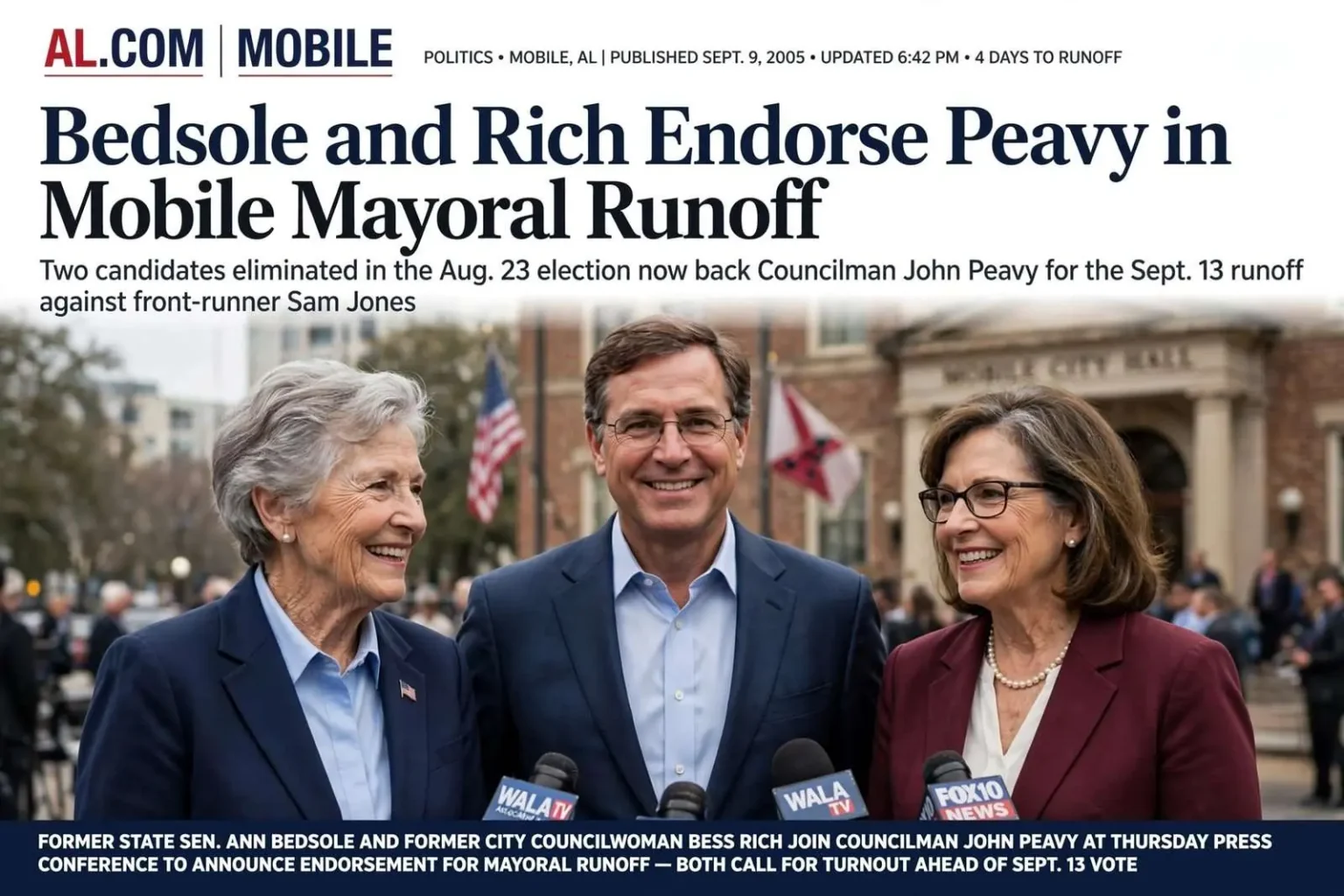
The two candidates eliminated in Mobile’s first round of mayoral voting moved to consolidate the field behind John Peavy, as former state Sen. Ann Bedsole and former City Councilwoman Bess Rich both endorsed the councilman in his bid to overtake front-runner Sam Jones in the Sept. 13 runoff.
Together, Bedsole and Rich had drawn about 27 percent of the vote in the Aug. 23 election. Jones had taken nearly 48 percent and Peavy more than 25 percent, forcing the runoff.
Because no candidate reached the majority Mobile’s mayor-council charter requires, the top two finishers advanced to the second round — and the arithmetic of the runoff hinged on a single question: whether the votes of two defeated candidates could be transferred to a third.
That question was the central issue of the campaign’s final week. Endorsements do not carry votes automatically, but they signal to a defeated candidate’s supporters where their candidate believes the city’s interests lie — and both eliminated candidates chose the same direction.
Bedsole: ‘The Ideals I Promoted’
“I believe John has the ability to move this great city forward with the ideals I promoted and my supporters care about,” Bedsole said in a statement distributed by the Peavy campaign. “And I would ask my supporters to consider voting for John Peavy in Tuesday’s runoff election.”
Bedsole said Peavy’s vision for the city more closely mirrored her own than did Jones’.
The endorsement carried weight beyond its arithmetic. Bedsole was one of the most recognizable names in Mobile politics, a former state senator whose career in public office stretched across decades of the city’s legislative life, and her decision to weigh in publicly told her supporters that the runoff was a real choice rather than a formality.
Peavy returned the compliment in expansive terms.
“It is indeed an honor to receive endorsements from Ann Bedsole, one of Alabama’s most respected leaders,” he said. “Ann Bedsole is a true Mobile treasure. Her confidence in my vision for Mobile’s future is encouraging, her trust in my dedication to preserving its past, heartening. My respect for her is endless.”
The exchange highlighted the pairing that Peavy’s campaign wanted voters to see: a candidate promising continuity with the city’s traditions, endorsed by one of its best-known civic figures, against a front-runner whose campaign had leaned on sheer vote total.
Rich: ‘Sam Jones Never Called’
Rich’s endorsement was pointedly personal, resting on which candidate had bothered to court her supporters after the election.
“Immediately after the election John wrote me a card, he left several messages, he held numerous meetings with my supporters and volunteers and most importantly he was interested in what concerned us and sought our advice,” Rich said. “Sam Jones never called, he never reached out to any of us. It is clear to me that there is only one candidate who has any intentions of reaching out to everyone in Mobile and that is John Peavy.”
The complaint was as much a governing philosophy as a grievance. Rich framed outreach — the act of asking what a defeated candidate’s voters wanted — as the test of whether a would-be mayor intended to represent the whole city or merely the coalition that elected him.
She also cited policy overlap.
“John and I campaigned with similar platforms, including lower taxes and improved police and fire protection, particularly in West Mobile,” Rich said, adding that Peavy had agreed to consider several of her proposals, including adopting a CitiStat-style performance management system for city government and undertaking new comprehensive long-range planning.
He also agreed, she said, that planning commission meetings should be televised and that inducements for annexation should be created.
Each item carried a practical meaning for Mobile residents. CitiStat — the data-driven performance system pioneered in Baltimore, where department heads are questioned weekly about response times, overtime and service backlogs — promised a measurable, public accounting of how city services actually performed. Televised planning meetings opened a process that shapes every development in the city to public view. Annexation inducements touched the standing question of whether unincorporated West Mobile neighborhoods would ever join the city and share in its services — and its tax base.
Peavy said Rich’s supporters had met with him for many hours over the previous two weeks, and suggested she might have a place in his administration.
“I think the people of Mobile would be honored if she would consider serving in my administration, but that is something I will have to leave up to her,” he said.
The offer of an administration post — vague, contingent, and effective — folded Rich’s network into his campaign rather than merely borrowing her endorsement. Her volunteers knew neighborhoods, schools and precincts that a councilman serving part of the city might otherwise have to learn from scratch.
The $1,000 Bounty
Peavy also renewed a campaign gambit aimed at Jones, offering $1,000 to the first person who could produce a previously published, detailed written plan by Jones for the city’s future.
“Ann is one hundred percent correct in saying campaigns are built on trust,” Peavy said. “I just don’t understand how anyone can trust a candidate who does not even have a written plan of his vision.”
Jones dismissed the offer as grandstanding, suggesting that his responses to a newspaper survey amounted to a written plan and joking that he might claim the reward and donate the money to victims of Hurricane Katrina.
The exchange was small but pointed. A front-runner with nearly half the first-round vote had little need to produce a formal platform; the challenger needed every contrast he could find. The bounty gambit tried to make the absence of a written plan a character issue — trust, in Peavy’s framing — and Jones’ Katrina joke let him refuse the premise while nodding to the disaster that hung over the whole campaign.
A Storm Over the Campaign
Rich voiced a worry shared across both camps: that Katrina, which had devastated the Mississippi and Louisiana coasts weeks earlier and battered Mobile, had left voters distracted.
“Tuesday’s election is critical to our city’s future for many generations to come,” Rich said. “We need to get the word out to everyone; there is only one election and only one chance to change Mobile. I encourage everyone to contact their family and friends to remind them that their vote is important.”
The concern was grounded in plain fact. Weeks after the hurricane, Mobile was still hosting evacuees, sorting debris from its own wind damage, and following national news that remained fixed on the Gulf Coast. A municipal runoff — never a high-turnout event — risked being lost entirely beneath the larger story. Both campaigns built their final-week pushes around the same assumption: turnout, not persuasion, would decide the race.
Low turnout also carried partisan arithmetic with it. Which side’s voters were more reliable, and which candidate’s base felt more urgency, mattered more than any late persuasion — a reality both camps acknowledged by spending their final days on reminders rather than new arguments.
The Partisan Undercurrent
Though Mobile’s city elections are nonpartisan, the alignment was not lost on anyone.
Jones, a Democrat, had served eighteen years on the Mobile County Commission.
Peavy, Bedsole and Rich had all sought public office as Republicans.
Party labels are kept off the municipal ballot, but voters in a city of Mobile’s size know the histories, and the runoff’s shape — a veteran county commissioner against a councilman backed by two Republicans — read like a partisan contest wearing a nonpartisan label.
Peavy’s own council history gave the race an extra wrinkle. He served on the Mobile City Council from 1985 to 1993, left for a span of years, and later won a special election to complete the final year of Stephen Nodine’s District 7 term after Nodine was elected to the county commission in 2004.
The special-election return meant Peavy was a returning officeholder rather than a fresh face — known quantity to West Mobile voters, and a reminder that the runoff paired the city’s past officeholders against each other at nearly every level.
Four Days Out
With four days to go, the runoff had resolved into a simple test: whether the coalition that had produced 27 percent for two other candidates would follow their lead, or stay home.
The structure of the race made the question unavoidable. Jones needed only to hold his first-round coalition and add a fraction of the eliminated candidates’ voters; Peavy needed to convert most of them while keeping his own base intact. Endorsements were the instrument, and both Bedsole’s and Rich’s had been built to do exactly that work — to give their supporters permission, reasons and reminders.
Whatever the answer, the week’s maneuvering settled the manner in which Mobile would talk about its next mayor: either as the front-runner who closed the deal, or as the second-place candidate who assembled the field behind him. Four days remained for the voters to decide which description would stick.