Spring Hill College Hires Veteran Fundraiser to Lead Advancement Efforts
Spring Hill College named Fred Salancy, a longtime fundraising leader from Florida State University, as its vice president for advancement, bringing 25 years of development experience to the Mobile campus.
Spring Hill College has tapped a seasoned fundraising executive to guide its development work, naming Fred Salancy as its new vice president for advancement. Salancy comes to the Mobile campus from Tallahassee, where he served as assistant dean of fine arts for the Florida State University Foundation. In his new role, Salancy will oversee development, alumni programs, and communications and marketing for the college. According to a release from Spring Hill, he brings 25 years of fundraising experience to the position and is scheduled to begin work on Aug. 4.
The vice presidency for advancement is one of the most consequential non-academic posts at any private college. The position sits at the junction of the institution’s finances and its future, responsible for the relationships that bring in philanthropic support, the alumni network that sustains it across generations and the communications apparatus that tells the college’s story to prospective donors, students and the public. At Spring Hill, the office also carries the institution’s distinctive identity into that work, since the college’s claims on donors, oldest Catholic college in the Southeast, Jesuit tradition, Mobile roots reaching back nearly two centuries, are the currency of its fundraising.
Salancy’s quarter-century in the profession spans the full arc of institutional advancement, from the annual funds that keep a college’s yearly budget balanced to the major and principal gifts that endow scholarships, chairs and buildings. His arrival in early August placed him at the start of a new academic year, with the college’s giving calendar, alumni events and communications planning all coming under his direction at once.
A central role in college giving
Salancy will serve as the primary staff liaison to the development committee of the college’s Board of Trustees, placing him at the center of Spring Hill’s efforts to strengthen its finances and expand support from alumni and donors. The development committee sets the institution’s fundraising priorities and, with the board, watches over the endowment’s health; the staff liaison to it is the officer who translates board direction into the daily work of the advancement office. The arrangement gives the vice president direct access to the trustees most engaged with the college’s finances, and it makes the office’s performance a recurring item at the board’s table.
The college manages an endowment of about $20 million and raises roughly $5 million each year, with an enrollment of about 1,300 students. Those figures frame the scope of the job ahead. An endowment of that size is modest by the standards of American higher education, and a college that raises $5 million a year against the costs of running a residential campus, paying faculty and maintaining a historic district of buildings must treat every donor relationship as significant. For a private college of Spring Hill’s size, sustained fundraising is essential to supporting academic programs, financial aid and campus operations, and the advancement office plays a leading part in cultivating the relationships that make such giving possible.
The arithmetic also explains why the position matters so much to the college’s trajectory. Private colleges across the country, and small liberal arts institutions in particular, have spent recent decades navigating demographic pressure and rising financial aid needs, and the ones that thrive are typically those whose advancement operations compound steadily: alumni who give, gifts that grow into endowment, and endowment income that reduces the pressure on tuition. Spring Hill’s appeal to a fundraiser with two and a half decades of experience reflects the institution’s stake in getting that compounding right.
A track record at Florida State
Salancy had held his position at Florida State since 2009. As the chief advancement officer for FSU’s College of Visual Arts, Theatre and Dance and its College of Motion Picture Arts, he raised more than $23 million in major gifts for the university’s foundation over five years, according to the release. During his tenure, he implemented a strategic plan for the arts programs with a goal of reaching $40 million as part of Florida State’s $1 billion capital and endowment campaign.
That experience, guiding fundraising for creative and performing arts programs within a large public university’s broader campaign, gave him a background in both major-gift cultivation and annual giving, the two engines of institutional advancement. Major-gift work is a long game of relationship building, moving prospects from interest to investment over months and years, while the annual fund lives or dies on participation and habit. Arts programs test both skills in distinctive ways: their alumni spread across creative industries rather than clustered in corporate pipelines, and their case for support rests on the cultural value of the work as much as on institutional need.
Florida State’s campaign context also shaped the hire’s credentials. A billion-dollar capital and endowment campaign at a flagship public university is a factory of modern advancement practice, with prospect management systems, stewardship programs and volunteer structures at a scale few institutions operate, and an officer who ran a major division of one brings those systems to a campus that can scale them to its own size. Spring Hill’s leadership pointed to exactly that: the release framed his five years of results inside the campaign, the strategic plan and the $23 million in major gifts as the reason he fit the Mobile institution’s needs.
What the move means for Spring Hill
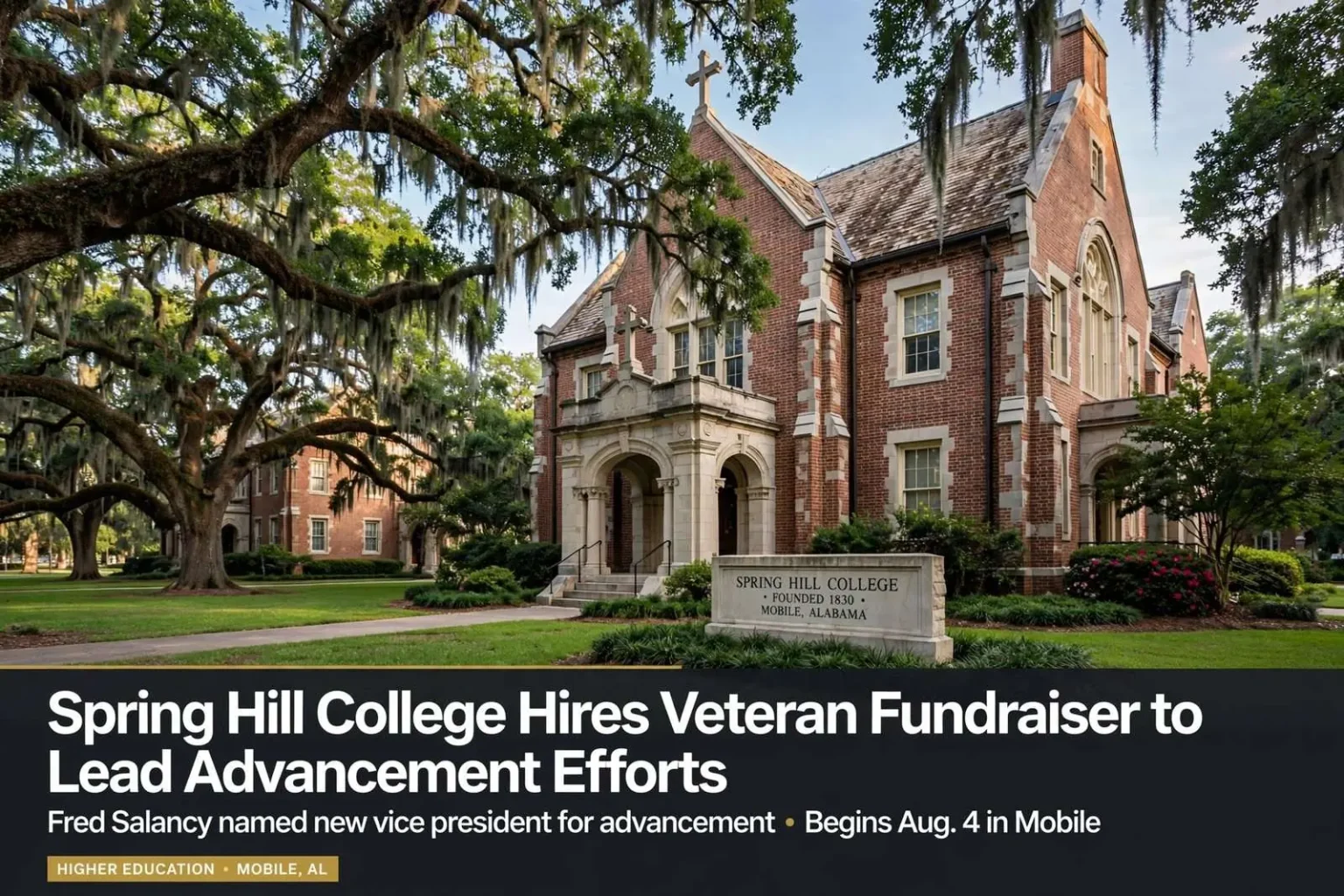
The college’s recruitment of an established advancement executive from a major public university signals its intentions. Spring Hill, founded in 1830 by Bishop Michael Portier as the first Catholic college in the Southeast, occupies a distinctive position in American higher education: a small Jesuit liberal arts college in Mobile, with a campus of live oaks and historic buildings along the city’s Museum District, whose graduates have anchored the professions, churches and civic institutions of the Gulf South for generations. That history is the college’s fundraising asset, and the new vice president’s task is to convert it into current support at a moment when small colleges everywhere are competing harder for each dollar.
The portfolio he inherits, development, alumni relations and communications, is deliberately integrated at Spring Hill, reflecting the way modern advancement offices work. Alumni programs feed the donor pipeline; communications shape the institutional story that fundraising asks people to invest in; and the development staff moves prospects along a path that runs from reunion attendance to annual gift to endowed scholarship. A vice president who oversees all three can align them, so that the story the magazine tells and the event the alumni office hosts both serve the campaign the development committee has prioritized.
For Mobile, the hire also strengthens one of the city’s oldest institutions at a moment of civic momentum. Spring Hill’s enrollment of about 1,300 students, its partnerships with the city’s schools, hospitals and businesses, and its campus presence in the heart of the city make it more than a local employer; it is part of Mobile’s identity. A successful advancement operation there means more scholarships for local students, better facilities on a historic campus and a college better able to play its role in the city’s growth, outcomes that the college’s trustees will be measuring from the development committee’s table when Fred Salancy takes up the work on Aug. 4.
Advancement in the small-college era
The environment Salancy steps into is one that every small private college in America now navigates. Tuition-dependent institutions face a shrinking pool of college-age students, intense competition on price and a national conversation about the value of a liberal arts degree, and the institutions that weather those pressures are the ones with loyal alumni bases and diversified revenue. Fundraising sits at the center of that equation, because philanthropy is the one income source a college can grow without raising tuition or drawing down reserves, and a vice president for advancement is the officer charged with growing it.
Spring Hill’s Catholic identity and Jesuit tradition give the case for support a character that larger institutions cannot replicate. The college’s mission, forming students intellectually, morally and spiritually, with an emphasis on service and social justice, has produced alumni who speak of their education in terms that go beyond career outcomes, and the most effective advancement work at such institutions marshals that testimony. Major gifts at small faith-based colleges frequently trace to exactly those relationships: a graduate whose life was redirected by a professor, a family that has sent four generations to the college, a donor moved by the campus ministry’s work in the city around it.
The Mobile setting adds its own dimension. The college’s alumni network is dense across the Gulf Coast’s professional community, from the medical district to the legal and banking establishments of downtown Mobile, and its presence in the city’s history, the first institution of higher learning in Alabama, gives it claims on local philanthropy that predate every other college in the state. An advancement leader arriving from out of state spends his first months learning that landscape, and Salancy’s own record suggests he knows how to do it: his FSU success was built on arts programs whose donors, like Spring Hill’s, give out of affection for a specific formative experience rather than institutional loyalty alone.
The work ahead on Aug. 4
Beginning in early August gives the new vice president the academic year’s opening season, the most productive stretch of the advancement calendar. Convocation and move-in produce the first class of new alumni parents, the group whose giving careers often start with gratitude and nearness; homecoming and reunion season follow in the fall, when returning classes are solicited for class gifts; and the end-of-year appeal closes the calendar. Staffing decisions, campaign planning and the communications strategy for the year ahead all get built in those same weeks, which makes an Aug. 4 start date the equivalent of joining at the beginning.
The liaison role to the trustees’ development committee will define his first months. Boards at small colleges increasingly expect their advancement professionals to arrive with metrics, funnel data and a realistic projection of what the year’s fundraising will yield, and the committee meetings ahead will establish the baseline against which the office’s performance is judged. With $5 million in annual expectations and an endowment whose growth the board watches closely, the vice president’s first report to the committee will likely set the terms of the relationship.
For the college’s students, faculty and alumni, the hire is a bet on continuity and growth together. Spring Hill’s story, its 1830 founding, its Jesuit character, its generations of Gulf Coast graduates, has never needed embellishment; it needs the professional infrastructure that turns stories into support, the way Salancy’s FSU arts division turned a strategic plan into $23 million within a billion-dollar campaign. The college’s release announcing the appointment made the point plainly: with 25 years of experience and a record of results inside a major campaign, Fred Salancy arrives in Mobile to lead the office whose work determines whether the institution’s next chapter is funded by the affection its history has already earned.