Mobile Police Search for Gunman Who Flagged Down Driver and Stole His Keys
Mobile police were searching for a man who flagged down a passing motorist late one night near Moffett Road, pulled a gun and made off with the driver's keys in an armed robbery on St. Charles Court.
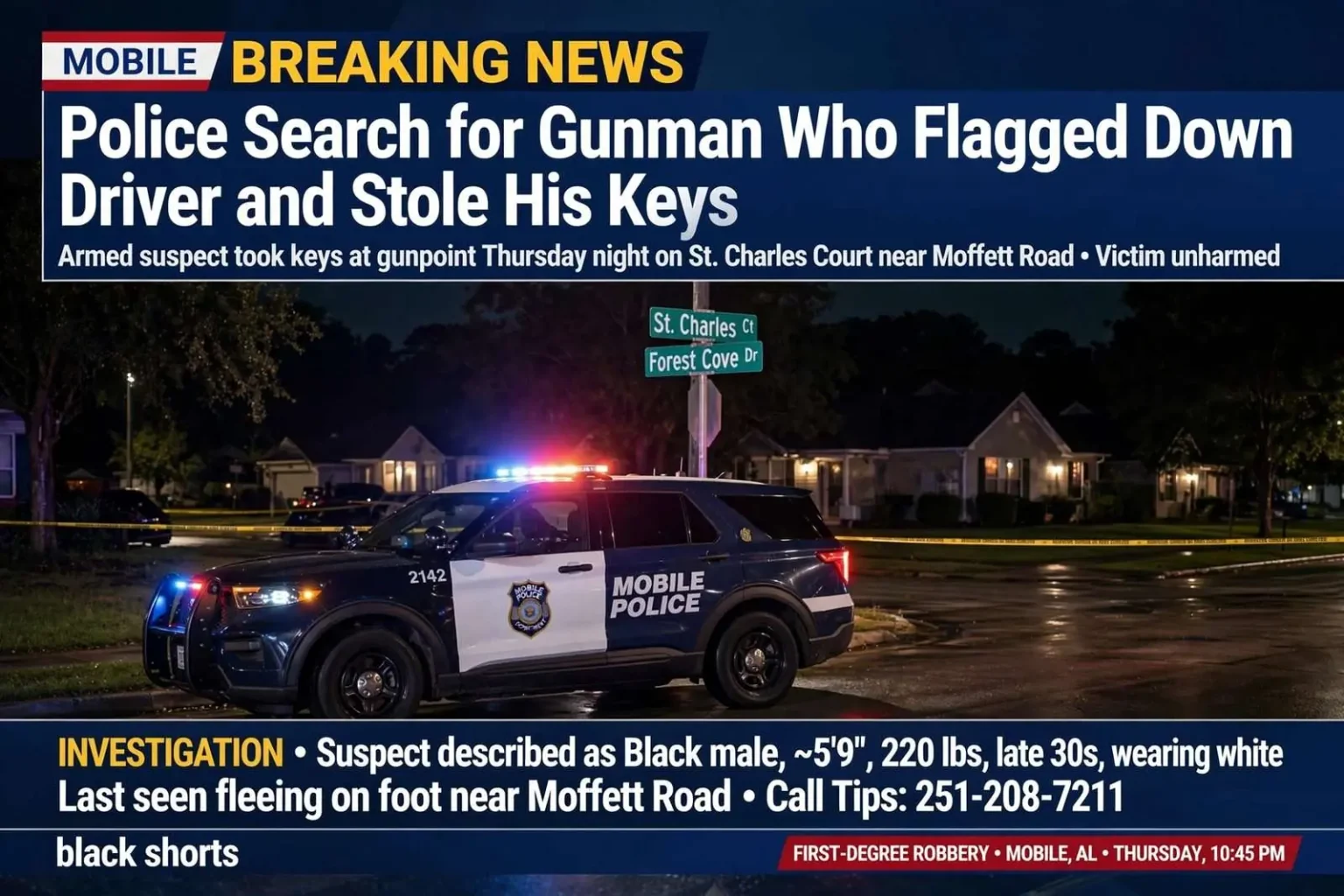
Mobile police were searching for an armed suspect after a driver was robbed of his keys at gunpoint on a residential street in the northwestern part of the city. The robbery unfolded late on a Thursday night on St. Charles Court, near Moffett Road, and left the victim shaken but unharmed.
Officers responded to the reported holdup at around 10:45 p.m., according to Mobile Police Department spokesman Officer Terence Perkins. The driver told investigators he had been near the intersection of St. Charles Court and Forest Cove Drive when a stranger flagged him down, as if seeking help or a moment of the driver’s time.
A quick, brazen theft
When the motorist stopped, the man walked up to the vehicle and drew a handgun, Perkins said. Rather than demand the car itself, the robber reached in, grabbed the keys from the ignition and fled the area on foot. The victim was not injured, and his vehicle was left behind.
The relatively unusual target, a set of keys rather than a wallet or the car itself, gave the case an odd wrinkle, but the use of a firearm made it a serious felony. Police said the suspect was wanted on a single count of first-degree robbery, one of the most severe robbery charges under Alabama law because it involves the use or threat of a deadly weapon.
Why a robber would take keys and leave the car is the question investigators could not immediately answer. A set of keys can open more than one door — a house, an office, a second vehicle parked elsewhere — and stealing them rather than the car itself can also suggest the theft was improvised rather than planned. Whatever the motive, the choice spared the victim the far greater loss of his vehicle while leaving him stranded on a dark street, on foot, moments after having a gun pointed at him.
The geometry of the encounter also explains how it happened so quickly. A driver who stops for someone waving at the curb is, for a few seconds, stationary with the window down and the ignition running. The distance from that moment to an armed confrontation is short, and the victim had essentially no opportunity to drive away once the man reached the vehicle. It is the kind of crime measured in seconds, witnessed by no one, and over before any neighbor hears anything.
A description for the public
Investigators released a description of the man they were seeking. He was described as a Black man of about 5 feet 9 inches tall and roughly 220 pounds, with a dark complexion and short hair. Police estimated he appeared to be in his late 30s. At the time of the robbery, according to the account provided to officers, he was wearing a white tank-top and black shorts.
The description was specific enough that detectives hoped residents of the area would recognize the man if he lived nearby or had been seen in the neighborhood before. In cases like this one, where the suspect fled on foot through residential streets, he either left the area quickly in a waiting vehicle or went to ground close by — and in either case, someone in the community may have seen something without knowing what they were looking at.
The incident took place in a quiet stretch of the city, the kind of residential pocket where late-night traffic is light and a stranger waving down a passing car might not immediately raise alarm. The neighborhood sits in the shadow of Moffett Road — U.S. Highway 45 as it leaves Mobile toward the Mississippi line — a corridor of older subdivisions, churches and small businesses where most crime reported to police involves property rather than confrontation.
That context made the holdup more unsettling for the people who live there. A robber who approaches a stopped car on a side street has chosen his moment carefully: no foot traffic, no businesses open, and homes set back from the road where a single flash of a handgun at 10:45 p.m. is unlikely to be seen. For residents, the lesson was uncomfortable but clear — a quiet street is not the same as a safe one after dark.
Police did not indicate whether the victim and suspect had any prior connection, and no arrests had been announced. Detectives were left with the victim’s account, the description he provided and whatever physical evidence the scene and the abandoned vehicle held. The car itself became part of the investigation once the keys were gone — evidence of the encounter, but also a locked, immovable reminder that the man who took the keys knows exactly where it sits.
First-degree robbery under Alabama law
The charge police said they would seek reflects the seriousness of what occurred. First-degree robbery in Alabama covers a theft accomplished by force coupled with the use or threatened use of a deadly weapon or serious physical injury, and it carries a potential sentence measured in decades. Unlike theft or even simple assault, the statute treats the introduction of a gun into what should have been an ordinary interaction as the defining fact of the crime.
That is why prosecutors in Mobile County pursue armed street robberies aggressively even when the property taken is trivial. A stolen set of keys can be replaced in the morning; the trauma of a gun drawn on a public street, and the risk that a terrified victim or a jumpy suspect makes a deadly mistake, is what the law is built around. The felony classification also ensures that when the suspect is found, the case will be handled in circuit court rather than treated as a minor property matter.
For the victim, the practical aftermath extended beyond the criminal case. Losing his keys meant losing access to his home and whatever else they opened, and the vehicle left at the scene needed to be secured, recovered and re-keyed. Those are small losses beside what might have happened, but they are real ones — the ordinary costs of an encounter that lasted less than a minute.
How to help
The Mobile Police Department asked anyone with information about the robbery to come forward. Residents who may have seen the man in the area, or who could help identify him, were urged to contact the department at 251-208-7211.
Tips from the public remain the single most productive avenue in cases like this one, where the suspect is a stranger to the victim and fled on foot. Patrol officers can saturate the neighborhood for a night or two, and detectives can canvass for doorbell cameras and security footage, but the break in such investigations usually comes from a resident who recognizes the description or remembers a detail — a direction of travel, a parked car, a face seen earlier that evening — that only someone who lives there would think to mention.
Armed robberies of motorists, while not common in the neighborhood, tend to draw close attention from investigators because of the danger they pose to victims and to the public. In this case, authorities emphasized that the driver had cooperated and escaped without injury, and that the priority now was identifying and locating the man who had confronted him.
As the search continued, police reminded residents to be cautious about stopping for strangers on darkened streets, particularly late at night, and to report suspicious activity promptly. The advice runs against every instinct of a helpful driver — most people who flag down a car genuinely need assistance — but officers suggest a compromise that preserves both safety and goodwill: keep driving, call 911, and report the location of a person who appears to need help rather than stopping alone in the dark.
The department said it would provide additional information as the investigation progressed. Until then, the case stood as a brief, violent interruption to an ordinary Thursday night — a man driving home, a stranger in the road, a gun, and a set of keys gone — and as an open file on the desk of Mobile detectives who, with the public’s help, expected eventually to put a name to the description.
The intersection where the driver stopped — St. Charles Court at Forest Cove Drive — sits a short drive west of University of South Alabama facilities and the shopping strips along Moffett Road, an area that empties quickly after the evening rush. Detectives asking for tips specifically wanted to hear from anyone who was in the neighborhood between 10:30 and 11 p.m. that Thursday, whether on foot, driving through, or awake in a home facing the street, since even a partial sighting could confirm the direction the man took after fleeing.
In the meantime, the vehicle left at the scene served as a quiet standing appeal of its own. Neighbors passing the spot in the following days were reminded of how close the danger had come to their own driveways, and several told officers they were keeping porch lights on and watching for unfamiliar faces — the kind of alertness police departments count on when they ask a community to help find a man who, for now, exists only as a description on paper.