Four Mobile Residents Arrested in Florida Panhandle Shoplifting Ring
Four Mobile residents were arrested after Walton County deputies linked them to a coordinated retail theft ring at Florida Panhandle outlet stores.
Four Mobile residents are facing felony theft charges in Florida after deputies say they were part of a coordinated shoplifting operation that hit outlet stores across the Panhandle.
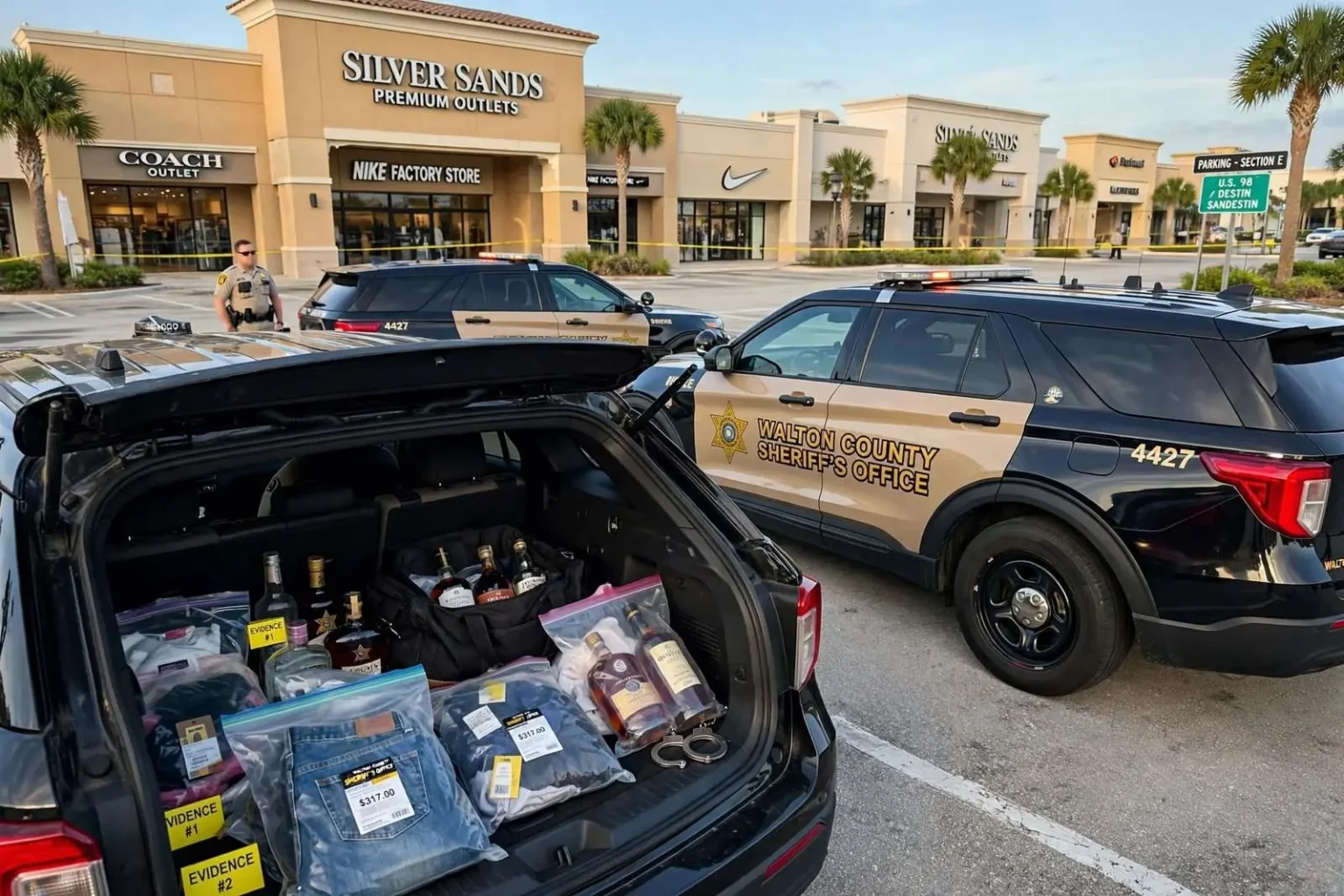
The arrests came after the Walton County Sheriff’s Office responded to a call at the Silver Sands Premium Outlets in Sandestin. According to investigators, a witness described the suspects’ vehicle, which deputies later stopped. During the stop, officers reported seeing a pair of jeans valued at $317 in plain view inside the car. A subsequent search of the vehicle turned up roughly $2,500 worth of stolen merchandise, including a large quantity of alcohol.
Investigators say the alcohol had been taken earlier the same day from stores in Destin and Fort Walton Beach, based on information shared by the Okaloosa County Sheriff’s Office. Store security footage and witness statements reportedly tied the four Mobile suspects to that earlier theft as well.
How the case unfolded
Deputies say the group worked together using a common shoplifting tactic, distracting store employees while other members of the group took merchandise. The approach, often called a distraction theft, relies on multiple actors moving through a store at once, with one or more suspects drawing the attention of clerks or security officers while accomplices conceal goods and walk out. Loss prevention teams at large shopping destinations like Silver Sands are trained to watch for the pattern, but investigators say the volume of traffic at an outlet complex makes it a frequent target.
Silver Sands Premium Outlets, located along the U.S. 98 corridor in Sandestin, is one of the largest retail destinations in the Florida Panhandle, drawing shoppers from Destin, Santa Rosa Beach, Freeport and beyond, along with a heavy flow of tourists during the summer and holiday seasons. Its mix of national brand outlets, wide parking areas and multiple entrances creates both opportunity for thieves and a challenge for the private security teams and local deputies who patrol the property.
The break in the case came from an observant witness who noted the suspects’ vehicle and described it to deputies. A traffic stop followed, and the plain-view discovery of the high-value jeans gave deputies grounds to search the car, where they found the cache of stolen merchandise that transformed a routine shoplifting call into a felony investigation involving multiple jurisdictions.
The charges
All four suspects, ranging in age from 24 to 35, were booked on charges of retail theft involving a scheme to distract a merchant or law enforcement, a third-degree felony under Florida law. Florida’s retail theft statute escalates an ordinary misdemeanor into a felony when the theft is committed through a coordinated scheme, when multiple people act together, or when the value of the merchandise crosses statutory thresholds. A third-degree felony in Florida carries a potential sentence of up to five years in prison and a $5,000 fine, and prosecutors can aggregate the value of merchandise taken in a series of thefts when charging a repeated scheme.
One of the suspects also faced additional charges, including operating a vehicle without a valid license and providing false identification to law enforcement while detained. Records show that suspect had an active warrant out of Alabama for a probation violation at the time of the arrest, meaning he faces extradition proceedings in addition to the Florida charges.
A second suspect in the group was not in the vehicle when it was initially stopped. Deputies say she was later located hiding in nearby bushes and was taken into custody on a loitering and prowling charge. Records indicate she also had an outstanding warrant out of Escambia County, Alabama, related to a separate theft case.
The manhunt for the fourth suspect illustrates how these cases expand once deputies begin taking people into custody. In a multi-person theft operation, suspects frequently scatter when a traffic stop occurs, and deputies must secure the vehicle, its occupants and evidence while simultaneously searching the surrounding area. Canine units, backup patrols and store security footage often play a role in locating a suspect who slipped away, as happened here when the woman was found concealed near the scene.
Organized retail theft across state lines
The case highlights how organized retail theft rings sometimes operate across state lines, and why the Panhandle’s retail corridors have become a focal point for such activity. The stretch of the Gulf Coast from Pensacola through Destin, Sandestin and Panama City Beach concentrates major shopping centers within a short drive of each other, connected by U.S. 98 and State Road 30-A. Theft crews can hit several stores in multiple counties in a single afternoon and be back across the Alabama line before store reports reach investigators.
Coordination between county sheriff’s offices is essential to building those cases. In this investigation, the Okaloosa County Sheriff’s Office shared information about the Destin and Fort Walton Beach thefts with Walton County deputies, and the combined evidence, security video, witness statements and the merchandise recovered from the stopped vehicle, linked all four suspects to the day’s series of thefts. Without that sharing, each theft might have remained a misdemeanor shoplifting report filed in a separate county, with the scale of the operation never becoming apparent.
Law enforcement agencies along the coast have increasingly treated retail theft as organized crime rather than petty shoplifting. Multi-jurisdiction task forces, shared intelligence about repeat offenders and coordination with retailers’ loss prevention networks have become standard practice. The penalties reflect that approach: under Florida law, theft offenses can be enhanced based on prior convictions, and out-of-state warrants, like the Alabama probation violation and Escambia County theft warrant discovered in this case, follow suspects wherever they are arrested.
What happens next
The four Mobile residents will now face the Florida court system, with initial appearances in Walton County and, depending on the disposition of the Alabama warrants, possible extradition proceedings to answer the outstanding charges at home. Prosecutors in the Panhandle have generally pursued strong outcomes in organized retail theft cases, particularly where defendants have prior records, and the value of the merchandise involved here, roughly $2,500 recovered in a single vehicle stop, supports felony charging decisions.
What it means for local shoppers
For shoppers in the region, the case is a reminder that outlet centers and beach-market retailers are not immune to organized theft, and that retailers pass the cost of stolen merchandise along through prices. Loss prevention specialists advise store employees to stay alert to groups working in coordination, particularly when one person engages staff in conversation while others browse nearby, and they encourage shoppers to report suspicious activity to security rather than confronting suspects themselves.
The role of the witness in this case, whose description of the suspects’ vehicle set the entire investigation in motion, underscores how much these cases depend on ordinary observation. Deputies who responded to the Silver Sands call had little to go on until the witness came forward, and the resulting traffic stop turned a single report into the recovery of roughly $2,500 in stolen goods and felony charges against four people.
The outcome also illustrates the reach of outstanding warrants. Two of the four suspects were already wanted in Alabama when deputies stopped the vehicle, one for a probation violation and one on a theft charge out of Escambia County, which includes the Pensacola area just west of the Florida line. Warrant checks are now a routine part of every traffic stop and detention, and for suspects in multi-jurisdiction theft operations, an arrest in one state typically means answering charges in another before the case is over.
The pattern behind the arrests
Investigators say groups like the one arrested at Silver Sands tend to target easily resold merchandise, from brand-name clothing to alcohol and small electronics, moving goods through informal resale channels rather than consuming them. The presence of a large quantity of alcohol among the stolen merchandise in this case fits that pattern, since liquor carries a stable resale value and is harder to trace than serialized goods.
Sheriff’s offices along the Panhandle have warned retailers to watch for the distraction scheme specifically, because it defeats the most common defenses stores rely on: attentive clerks and floor security. When an employee is deliberately engaged by a suspect while accomplices work elsewhere in the store, even well-staffed shops can lose hundreds of dollars of merchandise in minutes. Deputies say that is exactly what happened at the stores in Destin and Fort Walton Beach before the group moved on toward the Sandestin outlets.
The four suspects, all from Mobile and ranging in age from 24 to 35, remain in the Florida criminal justice system as their cases proceed. For the retailers involved, the arrests close a chapter on a single day’s losses; for investigators across two states and three counties, the case stands as another example of how the region’s retail corridors, and the cooperative work of the agencies that police them, are coping with theft crews that treat shoplifting as a business.