Falling Gas Prices Give Baldwin County Drivers Extra Cash to Spend
A record streak of falling gas prices in early 2015 left Baldwin County drivers with extra cash, boosting local spending and consumer confidence.
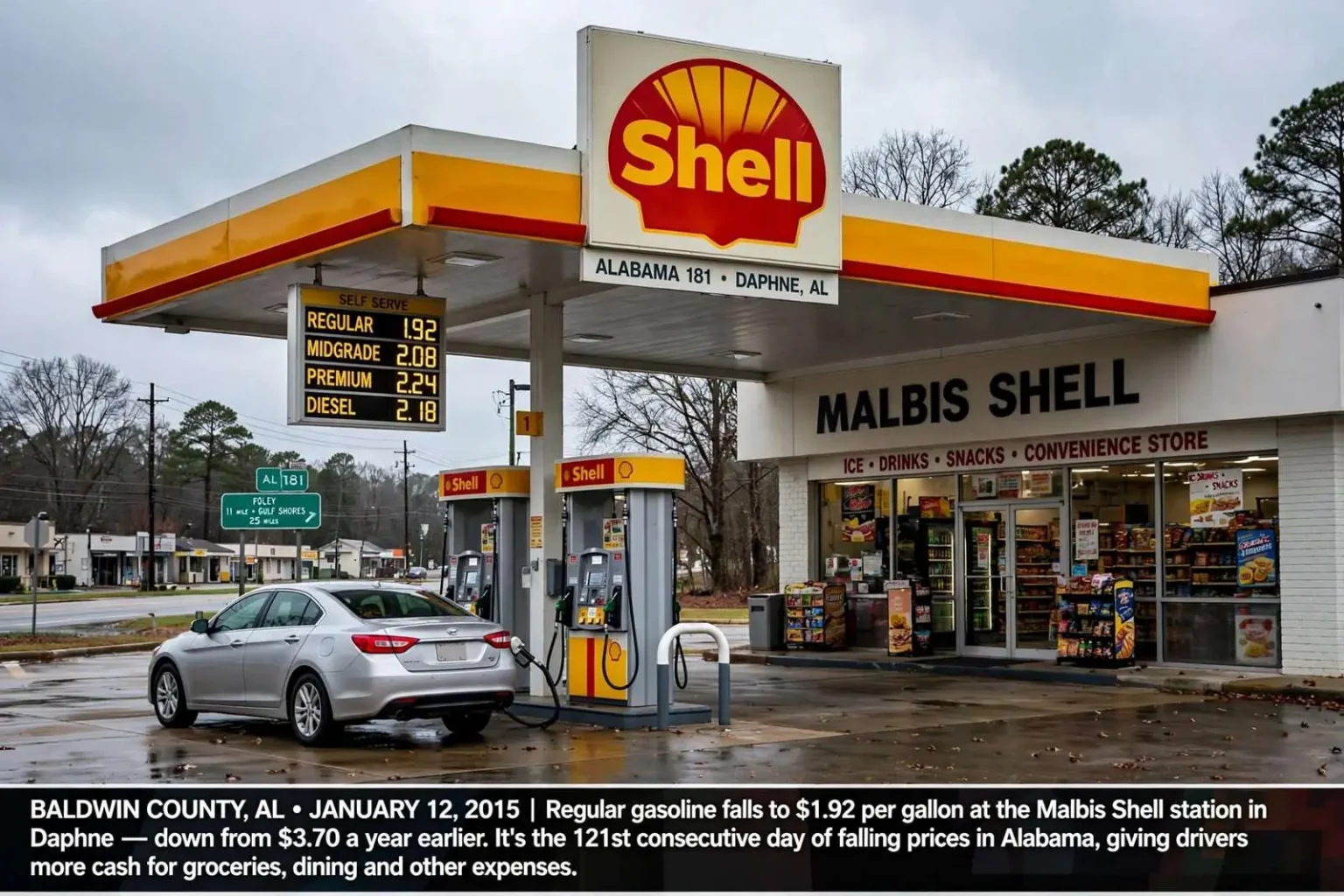
Drivers filling up at gas stations across Baldwin County in January 2015 found themselves paying roughly half what they had a year earlier, a stretch of falling prices that left many with unexpected extra cash for everything from groceries to nights out. The slide, part of a national collapse in fuel costs, turned the year’s first weeks into an impromptu economic stimulus for households across south Alabama, where long commutes and car-dependent suburbs make gasoline one of the most visible line items in the family budget.
At a Malbis Shell station along Alabama 181 in Daphne, one Loxley motorist described watching his fuel savings translate directly into a bigger household budget for entertainment, joking that the money he wasn’t spending on gas was going straight into extra spending money. He wasn’t alone. Across the region, retailers and economists alike pointed to falling pump prices as an unexpected boost to household budgets heading into the new year, a windfall that arrived without any change in paychecks or tax bills.
The average price for a gallon of regular gasoline in Alabama stood at $1.92 that Monday, below the national average of $2.05, marking the 121st consecutive day of falling prices statewide, a new record for Alabama. The unbroken decline — more than four straight months of day-after-day decreases — reflected a global glut of crude oil feeding directly through refineries, pipelines and wholesale terminals to the pumps of Daphne, Foley, Fairhope and Bay Minette.
Prices Not Seen in Years
Prices at that level hadn’t been seen since 2009, when Alabama gas averaged $1.78 a gallon, or roughly $1.96 in inflation-adjusted 2014 dollars. The last time prices were this low before that stretch was 2005. For drivers, the comparisons landed with force: a fill-up that had cost a driver of a typical sedan north of $70 at the previous year’s peak now cost in the mid-$40s, freeing $25 or more per tank for other spending.
University of Alabama economist Ahmad Ijaz said the drop in fuel costs was providing a modest but real lift to the broader economy, estimating the decline could add somewhere between four- and five-tenths of a percentage point to gross domestic product nationally. He said the extra disposable income created by cheaper gas was likely to show up in increased consumer spending in the months ahead, with households historically quick to convert fuel savings into restaurant meals, retail purchases and travel rather than savings.
AAA-Alabama spokesman Clay Ingram said at the time that prices were likely to keep falling through the end of January and into February, predicting the decline could continue at roughly a penny a day and shave another 10 to 15 cents off the price of a gallon before leveling out. February, he noted, tends to be a more stable month for fuel pricing, since demand stays low after the holidays and refineries have not yet shifted into the more expensive summer-blend production that begins each spring.
A Global Story at the Local Pump
The price collapse traced back to a global slide in crude oil prices, which had fallen by nearly half since the previous year. The crash had its roots in a supply wave — surging U.S. shale production, returning output from Libya and Iraq, and a decision by OPEC not to cut its own production to defend prices — colliding with softer demand from slowing economies abroad. Crude prices are the largest single component of what drivers pay at the pump, so the global oversupply flowed straight through to the retail level, overwhelming the seasonal patterns that normally govern fuel prices.
For Alabama, the windfall came with a complicating underside. The same low prices that filled motorists’ wallets squeezed the oil and gas sector, an industry with a meaningful footprint in the state’s southwest corner and along the Gulf, where exploration, production and pipeline jobs depend on crude staying above certain levels. Economists noted that consumers collectively spend fuel savings faster than the energy sector cuts, which is why falling gas prices have historically been a net positive for state economies even where energy employment is significant.
What Cheap Gas Meant on the Ground
In Baldwin County, the effects played out in distinctly local ways. The county’s geography — spread-out communities from Fairhope to Foley connected by highways like Alabama 181, U.S. 98 and the Beach Express — makes driving the default for nearly every errand, and commuters crossing Mobile Bay on the Wallace Tunnel or the Azalea Road corridors were among the clearest beneficiaries. Seasonal traffic patterns mattered too: even in the winter lull, the county’s tourism businesses watched pump prices closely, knowing that cheap gasoline lowers the effective cost of a Gulf Shores weekend for families across the Southeast.
Retailers along the U.S. 98 and Eastern Shore corridors reported the kind of steady weekend traffic that economists associate with extra disposable income, and the timing — falling prices arriving just as holiday credit card bills landed — amplified the psychological boost. A dollar saved at the pump in January, when household budgets are tightest, tends to feel larger than the same dollar saved in June.
The Anatomy of a Pump Price
What drivers pay at the pump is a layered product: the underlying price of crude oil, the cost of refining it into gasoline, the cost of distributing and marketing it, and taxes — federal and state — layered on top. When crude collapses, taxes and distribution become a much larger share of each gallon, which is part of why pump prices never fall as fast or as far as the oil they come from. Alabama’s fuel taxes, among the components that keep a floor under prices, remained unchanged through the slide, meaning the state’s drivers captured the crude savings without any offsetting increase elsewhere in the price.
Station owners, meanwhile, operate on thin margins regardless of the price level, and many reported that the fast-moving market of early 2015 was hardest on small independents, who had to sell inventory bought at higher wholesale prices while competing against neighbors selling cheaper gas bought later. Volatility, not the level of prices, is what squeezes the retail end of the business.
Enjoy It While It Lasts
Veteran watchers of the fuel market cautioned that the windfall was unlikely to be permanent. Cheap prices carry their own correction: drilling activity slows, marginal production comes offline, demand grows into the supply, and prices eventually find a floor and climb again. But for the moment, across Baldwin County and the rest of the state, the arithmetic was simple and pleasant — a gallon of regular for under two dollars, 121 days of falling prices and counting, and a little extra cash at the end of every week that hadn’t been there a year before.
A Pattern With Precedent
Longtime Alabamians had seen versions of this story before. The 2008-2009 price collapse, which brought the state average to the levels now being compared in the headlines, followed the record spike of summer 2008, when a gallon of regular briefly climbed past four dollars and Hurricane-refinery disruptions pushed Gulf Coast prices even higher. That whiplash — from record high to decade low inside six months — taught both drivers and station owners how violently fuel markets can swing, and it made the 2014-2015 slide feel familiar to anyone who had been paying attention at the pumps a few years earlier.
Daphne and the Eastern Shore corridor, with their dense cluster of stations along Highway 98 and Alabama 181, became a natural proving ground for the trend, where drivers could compare prices block by block and watch the decline unfold week by week.
The 2005 comparison carried its own memories for Gulf Coast residents. Later that year, Hurricanes Katrina and Rita damaged refineries and pipelines across the central Gulf, sending prices spiking and prompting shortages around the region. In a state whose fuel supply flows largely through Gulf Coast refineries and Colonial Pipeline connections, storms are a recurring variable in what drivers pay — one more reason the steady, storm-free decline of late 2014 and early 2015 stood out as unusual.
Economists also pointed out that cheap gasoline functions differently for different households. For lower-income families, who spend a larger share of their budgets on transportation, a dollar-per-gallon drop is among the most regressive-friendly windfalls the economy can deliver, freeing real money in the budgets that need it most. For rural commuters and long-haul drivers, the savings compounded weekly; for occasional drivers, they barely registered. The aggregate effect on consumer spending was real, but it was distributed unevenly across the state’s households.
Whether the savings went to restaurants, retailers or savings accounts, the record-setting slide of early 2015 gave Alabama drivers a stretch of good news at the pump that had no visible end in sight — a penny a day cheaper, and falling.