Daphne Backs Traffic Signal Study for Congested Ala. 181 Stretch Near Bellaton
Daphne's council voted to support a study on adding a traffic signal to Ala. 181 as growth around Bellaton strains the busy Eastern Shore corridor.
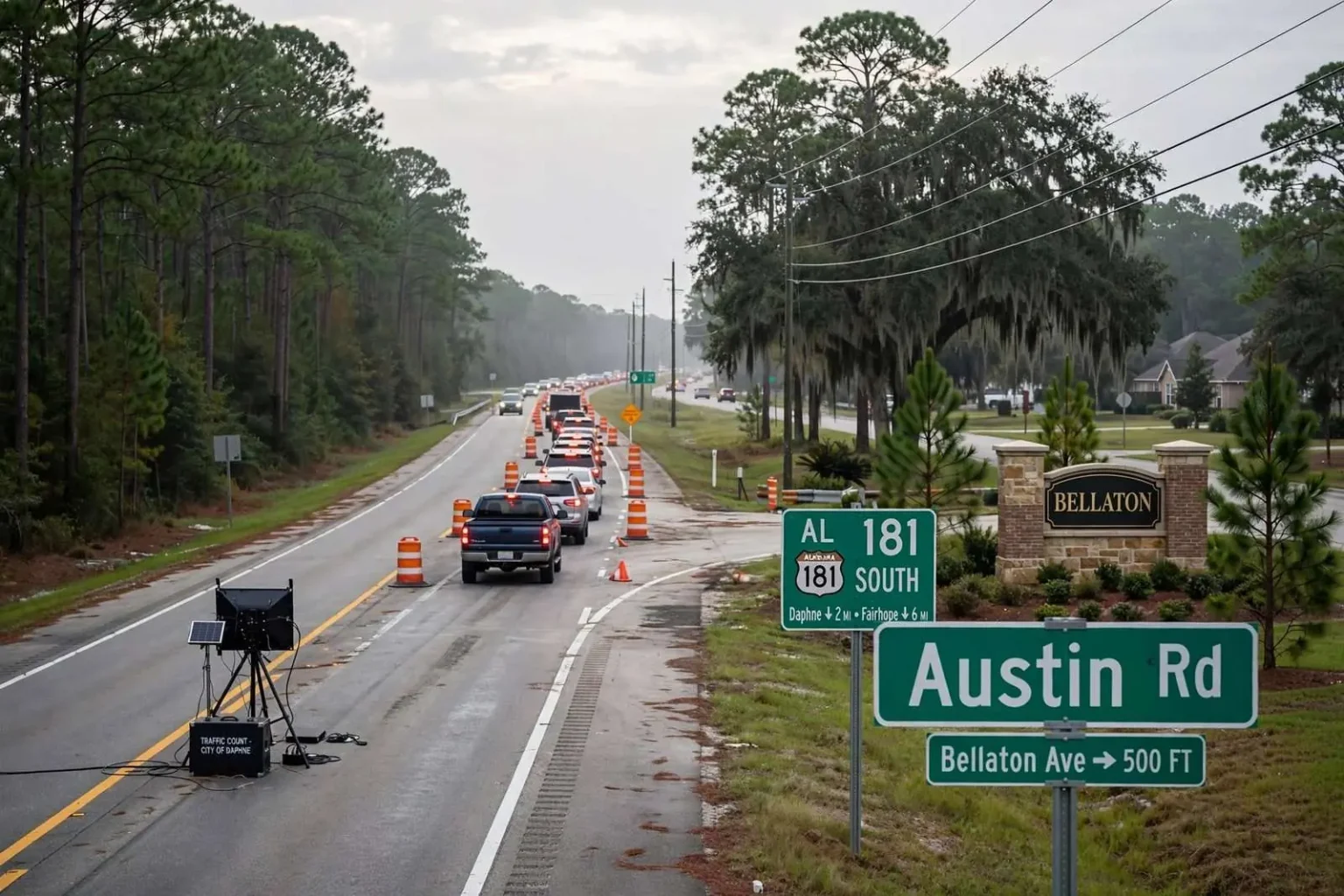
Rapid growth along the Eastern Shore has pushed Daphne’s stretch of Alabama 181 to a breaking point during peak commuting hours, prompting the city council to back a study on whether a new traffic signal is warranted near the Bellaton subdivision. The request grew out of months of complaints from residents who say the four-lane highway turns into a high-speed obstacle course each morning where their neighborhood connects to it.
The Daphne-Fairhope-Foley area has been one of the fastest-growing metro regions in the country in recent years, with the broader area’s population climbing from roughly 183,000 in 2010 to nearly 200,000 by 2013. Much of that growth has landed directly along Ala. 181, where the Bellaton, Old Field and Dunmore subdivisions sit between Ala. 104 and Baldwin County 64, filling in what had been rolling pine land at the edge of Daphne’s city limits a generation ago.
A Highway Built for a Smaller Baldwin County
The road itself tells the story of growth outrunning construction. Ala. 181 runs north-south through the heart of the Eastern Shore’s residential boom, connecting growing neighborhoods to the job centers, schools and shopping of Daphne, Fairhope and the Interstate 10 corridor. An earlier widening phase between U.S. 90 and Baldwin County 64 wrapped up in 2011, turning a two-lane farm road into a four-lane commuter artery through the middle of the city’s newest subdivisions.
South of Baldwin County 64, however, the widening stops. Southbound drivers who cruise four lanes through the morning rush suddenly find the pavement narrowing to two lanes just north of Bellaton, compressing hundreds of vehicles into a single lane at the precise point where three neighborhoods’ worth of traffic is trying to enter the highway.
Residents of Bellaton say the problem is a bottleneck just north of their neighborhood, where southbound Ala. 181 narrows from four lanes to two. Drivers exiting Dunmore and Old Field often reach highway speed right around the point where they merge with Bellaton traffic at the Austin Road intersection. The result is a merge zone where neighborhood cars pulling out at low speed meet commuter traffic traveling at full flow — a geometry that works only as long as gaps are generous, and the gaps stopped being generous years ago.
Daphne’s public works director described the scene bluntly, saying commuters routinely hit around 55 mph as they approach the intersection during the morning rush, making it difficult and at times dangerous for Bellaton residents to pull out onto the highway. At that closing speed, the margin for error between a neighborhood car easing onto the highway and a commuter lane closing at highway pace is measured in seconds — and shrinking each year as volumes grow.
A Widening Plan Years Away
The Alabama Department of Transportation has long-term plans to widen Ala. 181 farther south toward Baldwin County 48 in Fairhope, but city officials say that phase of construction remains at least five years away. Funding gaps have since slowed additional work on the corridor, leaving the two-lane gap south of the 2011 project in place for the foreseeable future.
That timeline puts the state’s permanent fix far beyond the patience of residents who face the merge every weekday. A traffic signal, by contrast, is a project a city can study, fund and install on its own timescale — provided the engineering supports it. Signals on high-speed rural-style corridors carry their own tradeoffs, and transportation engineers typically require a warrant study showing that traffic volumes, delay times and crash history justify placing a light where drivers have learned to expect none.
In November, a group of Bellaton residents raised the traffic concerns directly with Daphne’s Public Safety Committee, asking the city to consider a signal at Bellaton Avenue and Austin Road. The appearance followed the classic pattern of Baldwin County’s fast-growing subdivisions: neighbors compare notes in the homeowners association, collect the near-misses, and eventually bring a folder of concerns to the council members who can actually start something moving.
The Public Safety Committee heard them out and passed the request along, and city staff began weighing how a signal request would fit into the region’s larger transportation planning process. City officials say the request lines up with signalization improvements already under discussion through the Eastern Shore Metropolitan Planning Organization, the regional body that coordinates federal transportation spending across the Baldwin County side of the Mobile metro area.
That alignment matters. The MPO process is where local priorities become funded projects, and a signal that appears in the regional plan stands a far better chance of design dollars and eventual construction than one pursued by a single city alone. For Bellaton residents, hearing that their request fits into existing regional discussions turned a neighborhood complaint into a line item with a future.
Council Action on Dec. 1
On Dec. 1, the Daphne City Council voted unanimously to support moving forward with a study of whether the signal is warranted, a step that puts the city’s weight behind the residents’ request and begins the formal engineering review. A unanimous vote on a traffic measure is uncommon enough to signal how thoroughly the concern had spread beyond one subdivision — council members whose districts touch Ala. 181 have heard versions of the same complaint from Old Field, Dunmore and the corridors farther south.
The study itself will count and classify vehicles through the intersection, measure delays and gaps during peak hours, and review crash history along the merge zone. If the numbers meet the warrants, the city can move toward design and installation; if they fall short, the study still produces the traffic data the city can use to press the state on enforcement, speed management or earlier phasing of the widening project.
Growth, Roads and the Price of Popularity
The dispute along Ala. 181 is a familiar one across Baldwin County, where the population boom of the last decade has outpaced road capacity on corridor after corridor. The Daphne-Fairhope-Foley area’s climb from roughly 183,000 residents in 2010 to nearly 200,000 three years later translated directly into morning traffic: more subdivisions feeding more cars onto the same arterial roads, with each new development approved long before the highway network caught up.
For residents of the neighborhoods along the highway, the intersection issue is not an abstraction. It is the daily calculation of when it is safe to turn a family car onto a road where traffic closes at 55 mph, and the knowledge that the permanent fix — a wider, safer Ala. 181 — is still half a decade away even in the best case. A traffic signal will not widen the road, but it would guarantee what drivers merging at Austin Road now only hope for: a gap with their name on it.
City officials say the next steps are straightforward — let the study run, compare the findings with the regional signalization priorities already on the MPO’s agenda, and move as quickly as the data allows. For Bellaton and its neighboring subdivisions, the unanimous council vote is the first concrete sign in a long process that their morning bottleneck is now officially the city’s problem to solve.
What a Signal Warrant Study Involves
Residents often assume a traffic signal is a matter of political will, but the engineering behind it is deliberately unglamorous. A warrant study counts the vehicles entering an intersection by approach and by hour, weights the traffic on the major road against the traffic waiting on the side street, and measures how long side-street drivers actually wait for a workable gap. It also looks at crash patterns — not just the number of collisions but their type, since a pattern of angle crashes from failed merges is a classic signal justification.
The study period usually spans weekdays and weekends across several weeks, capturing the school-year morning rush that defines the Ala. 181 bottleneck. Engineers will also weigh the speed differential at the merge zone, which along the corridor south of the four-lane section is unusually stark: four lanes of flow narrowing to two just as three subdivisions’ worth of low-speed traffic enters at one point.
Should the study support a signal, design and installation follow on a municipal timeline — generally months, not years, and at a fraction of the cost of highway widening. Should it not, the data becomes ammunition of a different kind: documentation of daily delay and close calls that the city can take to the state as it lobbies to accelerate the long-deferred widening phase toward Baldwin County 48.
The Corridor’s Next Decade
Either way, the Ala. 181 corridor will keep growing. The subdivisions between Ala. 104 and Baldwin County 64 were built on the expectation of a four-lane highway that construction and funding have not yet delivered, and every new roof between Daphne and Fairhope adds another car to the morning merge at Austin Road. City planners have watched this pattern repeat across Baldwin County as development follows the roads, and the lesson of the last decade is that residential growth arrives faster than any highway project.
That is why the Bellaton request has drawn regional attention rather than a local shrug. The Eastern Shore MPO’s signalization discussions treat intersections like Bellaton Avenue and Austin Road as part of a network problem: as long as the state’s widening remains unfunded, traffic control at the worst merge points becomes the practical substitute, implemented city by city across the corridor.
For now, the process that began with neighbors in a committee room in November has become a council resolution, and soon an engineer’s clipboard at the roadside. The residents of Bellaton will keep easing out onto Ala. 181 each morning, watching the southbound lanes close at 55 mph, waiting for the study that decides whether the gap they need finally comes with a red light attached.