Armed Robbery at Mobile Restaurant Ends With Shot Fired, No Injuries
Mobile police say an armed man robbed a local restaurant and fired a shot on his way out, though thankfully no one was hurt in the evening incident.
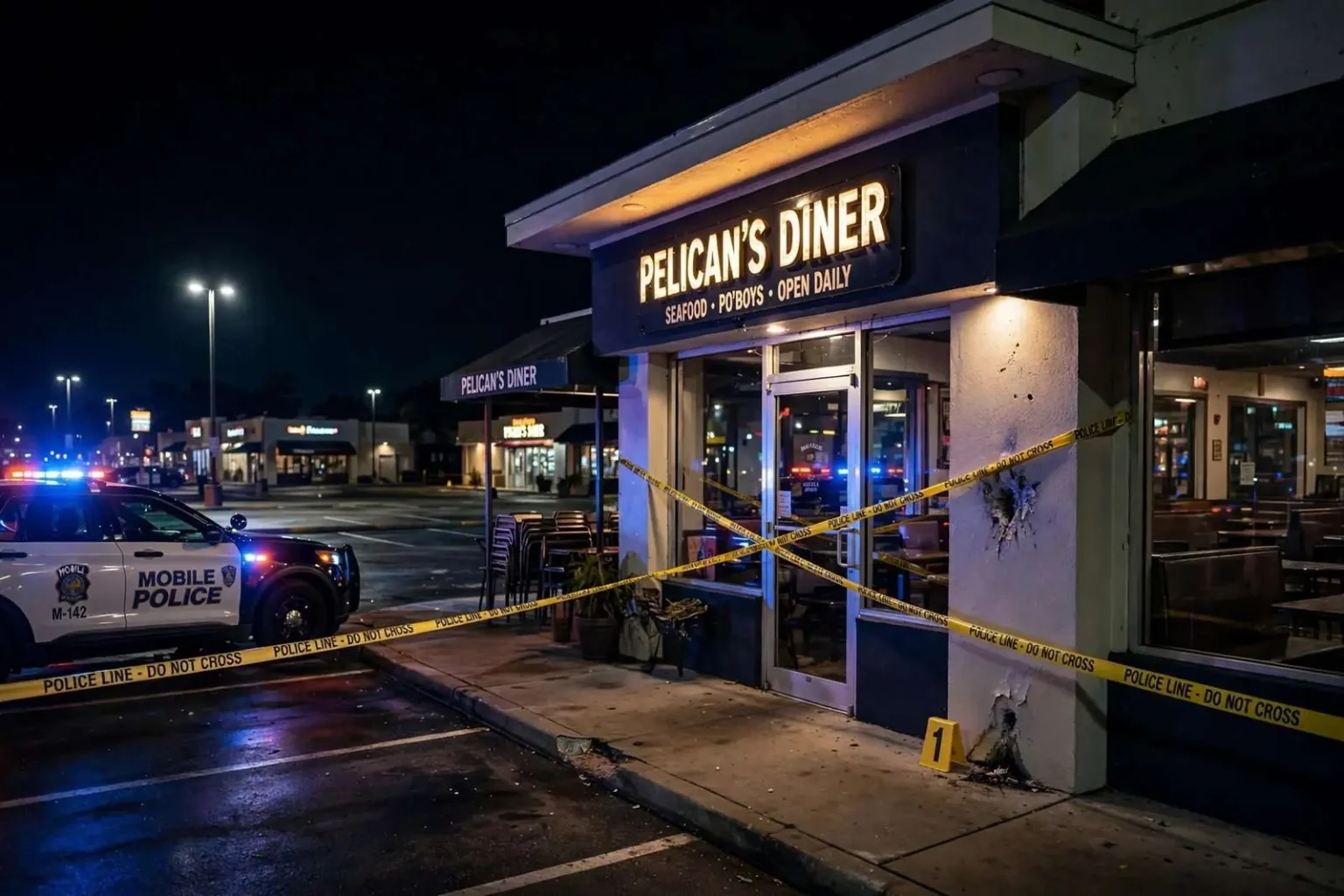
Mobile police are investigating an armed robbery at a local restaurant during which a suspect fired a shot as he fled, though no one was injured, according to authorities.
The robbery took place in the evening hours at a Mobile eating establishment, according to a Mobile Police Department spokesman. Police said an unidentified man entered the restaurant and demanded money while armed with a handgun. As the suspect left the business, he fired a single shot into the property before fleeing the scene.
No employees or customers were struck or injured during the incident, according to police. Investigators have not announced an arrest in connection with the robbery and continue to seek information from the public that could help identify the suspect.
What happened inside the restaurant
The evening hours are among the busiest for Mobile restaurants, and the robbery unfolded while staff and diners were inside the establishment. Employees complied with the armed man’s demands for money, and witnesses described a frightening few moments between the suspect’s entrance and his departure — an interval that in restaurant robberies typically lasts less than two minutes but leaves staff shaken long afterward.
The shot the suspect fired into the property as he left added a dangerous dimension to the crime. A round fired inside or into a building at close range during a robbery can strike employees or customers, and police noted that the outcome could easily have included serious injuries. Investigators documented where the round struck as part of their evidence collection, since the trajectory and impact point can help establish the shooter’s position and movement.
Police have not released a detailed description of the suspect, and detectives were reviewing the restaurant’s surveillance system along with any footage from neighboring businesses that might have captured the man arriving or leaving. In robbery cases where the suspect flees on foot or by vehicle into surrounding streets, camera coverage from nearby shops, gas stations and residences often proves decisive in tracing his path.
How Mobile police work robbery cases
Mobile police routinely rely on surveillance footage, witness statements and community tips to build cases in armed robbery investigations, particularly when a suspect flees before officers arrive. Detectives from the department’s robbery unit take over after patrol officers secure the scene, and their first days are typically spent collecting camera video, canvassing the area and interviewing everyone who was inside the business.
Robbery investigations in Mobile also draw on physical evidence: fingerprints left on counters or doors, the gunman’s handling of the weapon, and any items he touched. Even when a suspect takes cash, the evidence trail from the scene — combined with descriptions from employees and customers — forms the backbone of the case that prosecutors would present if an arrest follows.
Police urged anyone who may have been in the area that evening, or who noticed a person matching the suspect’s description leaving the restaurant, to contact investigators. Detectives stressed that details which seem minor — the direction a car turned, a jacket worn by someone walking past — often help confirm or eliminate suspects when matched against other accounts.
Armed robberies at Mobile-area restaurants and small businesses remain a persistent concern for owners and employees, who are often the most vulnerable during evening and late-night hours when cash transactions are common and fewer witnesses may be present. Closing-time staff in particular face elevated risk, and safety trainers who work with restaurant operators advise employees never to resist an armed robber and to focus on remembering details instead.
Local business owners have periodically called for increased patrols and improved lighting around commercial corridors as a way to deter similar crimes. Lighting is among the most frequently cited deterrents in crime-prevention guidance, since well-lit parking lots and entrances reduce the cover an armed robber has when arriving and fleeing, and business groups in Mobile have worked with the city on lighting upgrades and camera placements along commercial strips in recent years.
Restaurant industry groups also encourage owners to limit visible cash registers after dark, install drop safes, and use signage stating that minimal cash is kept on hand — measures that reduce the incentive for a robbery without confronting anyone. Many Mobile-area restaurants added or upgraded camera systems after similar incidents, and insurers increasingly require documented security practices for coverage of after-hours robberies.
Crimestoppers and community tips
Mobile police continue to encourage anyone with information about crime in the city, including this incident, to contact investigators directly or reach out through Crime Stoppers, which allows tipsters to remain anonymous. Officials say tips submitted through Crime Stoppers or by text have historically helped close cases that might otherwise go unsolved, particularly when a suspect’s identity isn’t immediately clear from evidence at the scene.
The anonymity of the Crime Stoppers system is central to its effectiveness in robbery cases like this one. Tipsters can submit information by phone or text without giving their names, and rewards are paid for tips that lead to arrests, with the process designed so that neither investigators nor suspects can trace where information came from. That protection matters in neighborhoods where a suspect may be locally known and witnesses fear retaliation.
In armed robbery cases, tips often do the work that forensics cannot: identifying a suspect by name, linking the same gunman to other holdups, or locating the vehicle used in the getaway. Detectives compare each new tip against surveillance footage and witness descriptions, and a single identifying detail from a tipster has historically been enough to break open a string of cases.
The incident adds to a string of armed robberies that Mobile police have investigated at businesses across the city in recent months, a pattern that keeps the department’s robbery unit working a steady caseload and keeps owners alert. When a suspect in one robbery is linked to others, charges multiply, and prosecutors in Mobile County typically pursue the cases together with enhanced penalties for the use of a firearm.
Under Alabama law, robbery with a deadly weapon is classified as first-degree robbery, a Class A felony that carries a potential sentence of 20 years to life in prison. Firing the weapon during the offense, as occurred here, increases the danger to victims and strengthens the state’s hand at sentencing, and prosecutors treat any shot fired during a holdup as evidence of the suspect’s willingness to use lethal force.
For the employees and customers who were inside the restaurant that evening, the aftermath of an armed robbery is rarely discussed publicly, but it is significant. Workers who have had a gun pointed at them frequently take time away from work, and restaurant owners in Mobile have responded to past incidents with counseling resources, revised closing procedures and, in some cases, security staffing during peak evening hours.
Police have not said whether the suspect in this case is believed to be connected to any other recent robberies, and detectives typically examine method-of-operation details — the time of night, the demand for money, the firing of a weapon on the way out — against the files of other open cases before ruling connections in or out.
No further updates on the investigation had been released as of the most recent report, and police said the case remained open. Anyone with information about the robbery, the suspect’s identity or his direction of flight was urged to contact Mobile police investigators or to submit an anonymous tip through Crime Stoppers, where information leading to an arrest may qualify for a cash reward.
Restaurant robberies hold a particular place in Mobile’s crime picture because of the mix of factors that converge in the evening: a building full of strangers, a register that grows through the dinner rush, and exits that open directly onto parking lots where a getaway car can wait. Detectives who work these cases say the first several minutes after a suspect flees are critical, since nearby officers can set a perimeter that catches a fleeing robber before he can shed evidence or blend into traffic.
Patrol procedures in the aftermath of an armed robbery call for officers to check vehicles leaving nearby streets, interview everyone present, and broadcast the suspect’s description to surrounding units. If the man fled on foot, the search narrows to the blocks around the restaurant; if witnesses saw a vehicle, its description goes out immediately to officers across the precinct.
Business associations in Mobile have also pushed for greater use of shared camera networks, in which neighboring businesses agree to provide footage on request, dramatically shortening the time detectives need to trace a suspect’s movements through a commercial corridor. Participation in those networks grew after a series of robberies in prior years, and investigators credit the footage collaborations with helping clear cases that once stalled for lack of witnesses.
For now, detectives are asking anyone who was near the restaurant that evening — whether or not they think they saw anything significant — to come forward. Witnesses often hold pieces of the puzzle without realizing it: a car idling too long in the lot, a customer who left abruptly before the robbery, or a person seen changing direction in the parking lot just after closing time. Each of those observations, matched against the others, can point investigators toward the man who walked in with a handgun and walked out firing a shot.