Mobile’s ASMS Gallery Turns Fibonacci Numbers Into Art With ‘Fibonacci Octopus’
A Mobile painting called "Fibonacci Octopus," on view at the Alabama School of Mathematics and Science through August 23, uses an eight-armed octopus and golden spirals to bring the Fibonacci sequence and the Golden Ratio to life as visual art.
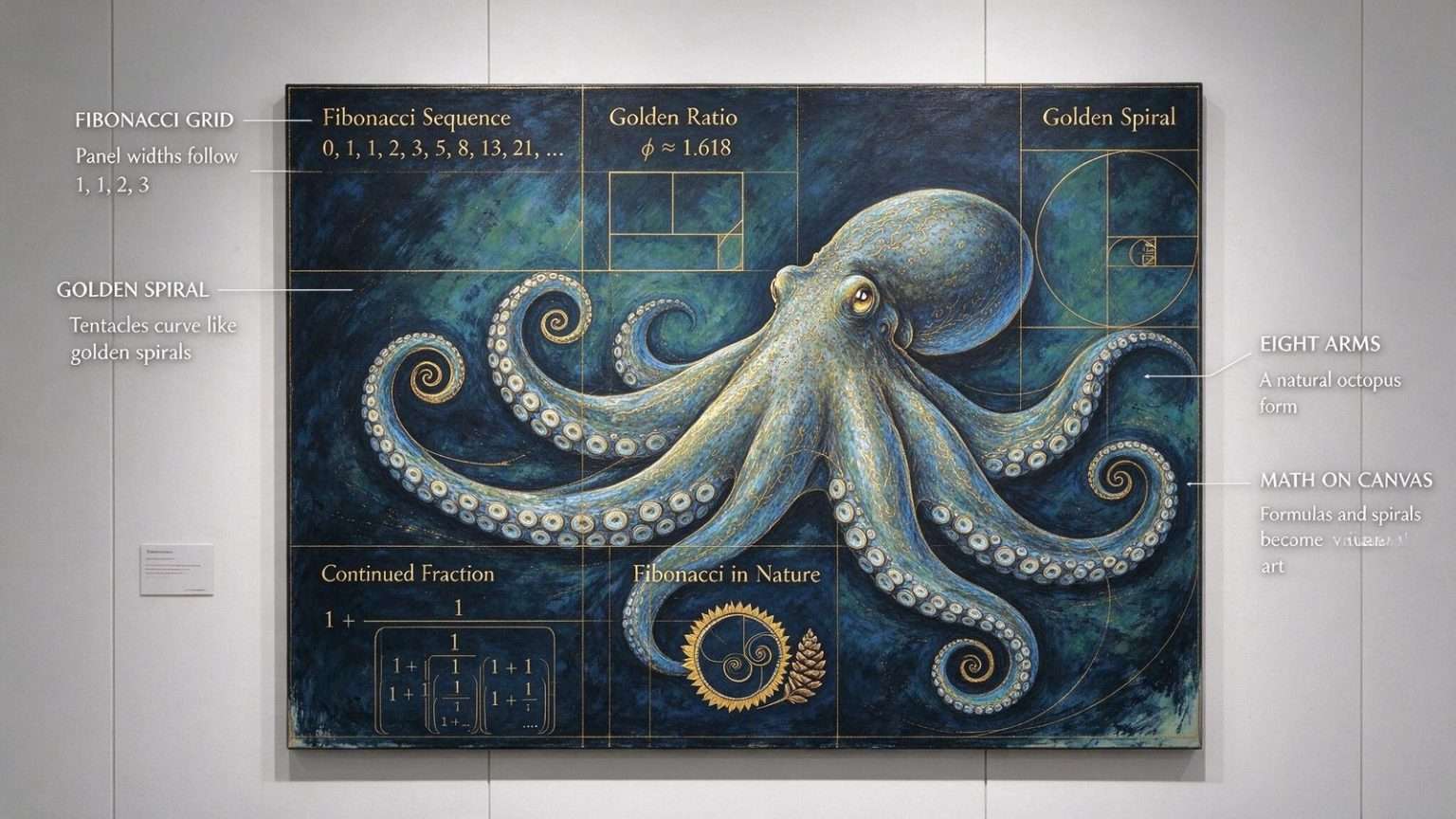
A painting on display at the Alabama School of Mathematics and Science in Mobile is turning heads for an unusual reason: it is as much a math lesson as it is a work of art. Titled “Fibonacci Octopus,” the piece is part of “Visual Mathematics,” a gallery show running through August 23 at the ASMS Gallery that pairs visual art with the equations, ratios, and geometric patterns that underlie it.
The painting layers an octopus motif over a grid built from the Fibonacci sequence, the famous string of numbers in which each term is the sum of the two before it: 0, 1, 1, 2, 3, 5, 8, 13, 21, and onward. According to details shared about the work, the panel spacing in the piece follows the sequence’s early terms, 1, 1, 2, 3, across five panels, while the octopus itself, drawn with its natural eight arms, has tentacles rendered as golden spirals, the curling shape mathematicians associate with the Fibonacci sequence’s most famous byproduct, the Golden Ratio. The work also incorporates written formulas and expressions that resolve to the Golden Ratio, including an infinite continued fraction, giving viewers a chance to see the arithmetic behind the imagery displayed alongside it.
What Makes a Number “Golden”
The Golden Ratio, often represented by the Greek letter phi and valued at approximately 1.618, emerges naturally from the Fibonacci sequence. If you divide any Fibonacci number by the one before it, the resulting ratio drifts closer and closer to phi the further out in the sequence you go: 2/1, 3/2, 5/3, 8/5, 13/8, 21/13, 34/21, 55/34, and so forth. Mathematicians have long been fascinated by the fact that a simple, additive sequence of whole numbers converges on an irrational number with such distinctive geometric properties.
That geometry is most easily visualized through the golden rectangle, a shape whose long and short sides are in the Golden Ratio to one another. Cut a square off one end of a golden rectangle, using the rectangle’s shorter side as the square’s edge length, and the sliver left over is itself a smaller golden rectangle. The process can be repeated indefinitely, and if you draw a quarter-circle arc through each successive square, connecting the corners, the result is the golden spiral, a curve that expands outward while keeping the same proportions at every scale. That self-similar spiral is the same shape “Fibonacci Octopus” borrows for its tentacles, and it is also the shape most often pointed to in shells, galaxies, and, according to popular legend, the nautilus.
The underlying algebra is straightforward enough to work out on paper, which is part of why the Golden Ratio has become a staple of math education. Label the shorter side of a golden rectangle “x” and the shorter side of the smaller rectangle nested inside it “1.” Because the larger rectangle and the smaller one share the same proportions, the ratio (1+x)/x must equal x itself. Solving that equation produces the Golden Ratio’s exact value, (1 plus the square root of 5) divided by 2, an irrational number that cannot be written as a simple fraction no matter how far its decimal is carried out.
From Sunflowers to Pinecones: The Golden Ratio in Nature
One of the most commonly cited real-world appearances of the Golden Ratio is phyllotaxis, the pattern by which leaves, seeds, and other plant structures arrange themselves around a stem or seed head. Botanists have documented that many plants space new growth at an angle of roughly 137.5 degrees relative to what came before, a figure known as the golden angle because it splits a full circle into two arcs whose lengths are in the Golden Ratio to each other.
Sunflowers are the textbook example. The seeds in a sunflower’s head are packed in interlocking spiral arms curving in opposite directions, and when counted, the number of spirals running clockwise and counterclockwise are typically consecutive Fibonacci numbers, such as 34 and 55, or 55 and 89. Researchers who study plant growth generally attribute the pattern to efficiency: packing new growth at the golden angle allows a seed head or a stem’s leaves to fill available space as densely as possible without directly overlapping their neighbors, maximizing each one’s access to sunlight or room to develop. Similar spiral arrangements show up in pinecones, pineapples, and artichokes, and the pattern is common enough in botany that it is frequently used as an entry point for introducing students to the Fibonacci sequence before they ever encounter a textbook definition of it.
It is worth noting that mathematicians and science communicators have also pushed back in recent years on some of the more sweeping claims made about the Golden Ratio’s ubiquity, particularly in art and architecture, where the evidence for intentional use in famous historical works is often thinner than popular accounts suggest. The phyllotaxis pattern in plants, by contrast, is well documented and has been studied extensively by botanists and mathematicians alike, making it one of the more reliably cited natural examples of Fibonacci numbers and the Golden Ratio at work.
Math as a Visual Art Form
Pairing mathematics with visual art is not a new idea, but it has become an increasingly common way for schools and galleries to make abstract concepts tangible. Where a lecture or a textbook might present the Golden Ratio as a formula to be memorized, a painting like “Fibonacci Octopus” lets viewers see the same idea rendered as a spiral, a set of panel proportions, or a repeating angle, giving students and visitors a visual anchor for what can otherwise feel like a purely abstract exercise in algebra.
That approach fits naturally with the mission of the Alabama School of Mathematics and Science, a public residential high school in Mobile created through state legislation in the late 1980s to serve Alabama students with a strong aptitude for math and science. The school draws juniors and seniors from across the state to live and study together in Mobile, with a curriculum built around advanced coursework in mathematics, the sciences, and research, alongside a full slate of humanities and arts offerings. A gallery show built around the intersection of visual art and mathematical concepts fits comfortably with that dual emphasis, giving the school’s community, and the wider Mobile public, a chance to see the kind of thinking that goes on in its classrooms translated into an exhibit.
Continued Fractions and the Many Faces of Phi
Beyond the spiral and the rectangle, “Fibonacci Octopus” also incorporates written mathematical expressions that resolve to the Golden Ratio, including a continued fraction: an expression of the form 1 plus 1 over the quantity 1 plus 1 over the quantity 1 plus 1 over the quantity 1, repeating indefinitely. Mathematicians consider this one of the purest expressions of phi because the pattern never terminates, and each additional layer of the fraction nudges the value closer to the Golden Ratio without ever exactly reaching it in a finite number of steps, mirroring the way ratios of consecutive Fibonacci numbers approach phi without ever landing on it precisely.
That a single mathematical constant can be approached through so many different routes — an infinite continued fraction, a sequence of whole-number ratios, the geometry of a rectangle, or the angle between two sunflower seeds — is part of what has kept the Golden Ratio a subject of fascination among mathematicians, artists, and students alike for centuries. It is also, evidently, flexible enough to be reimagined as the curling arms of an octopus on canvas.
A Sequence Eight Centuries in the Making
The sequence at the center of the painting takes its name from Leonardo of Pisa, the medieval Italian mathematician better known by his nickname, Fibonacci, who introduced the pattern to a European audience in a 1202 text on arithmetic. Fibonacci had used the sequence to work through a hypothetical problem about the growth of a rabbit population, but the pattern he described turned out to reach far beyond the puzzle that produced it, eventually surfacing in fields as varied as computer science, financial market analysis, architecture, and, as “Fibonacci Octopus” demonstrates, painting. Centuries after it was first written down, the sequence remains a fixture of introductory math courses precisely because it is easy to state, simple enough to compute by hand, and yet leads directly into much richer ideas like the Golden Ratio and the golden spiral.
That long history is part of what makes the sequence such durable material for artists and educators alike. Because the Fibonacci sequence and the Golden Ratio can be approached through arithmetic, geometry, or algebra, and because their patterns show up in recognizable natural forms like shells, seed heads, and flower petals, they offer multiple entry points for people with very different backgrounds to connect with the same underlying idea, whether that person is a student solving for x, a botanist counting spirals in a sunflower head, or a painter working out how to divide a canvas into panels sized 1, 1, 2, and 3.
Seeing the Show
“Fibonacci Octopus” is one work among several featured in “Visual Mathematics” at the ASMS Gallery, with the show scheduled to remain on view through August 23. School gallery exhibits of this kind are typically free to view during regular hours, offering a low-key way for Mobile-area residents, students, and math and art enthusiasts alike to see how a concept as old as the Fibonacci sequence can still generate new work centuries after it was first described. For anyone who studied the Golden Ratio in a classroom and only ever saw it as a formula on a whiteboard, the exhibit offers a chance to see the same idea rendered instead in paint, panels, and spirals.