Mobile Police Investigate Afternoon Shooting on Holcombe Avenue
A man was hospitalized with non-life-threatening injuries after a shooting on Holcombe Avenue that Mobile police say followed an altercation.
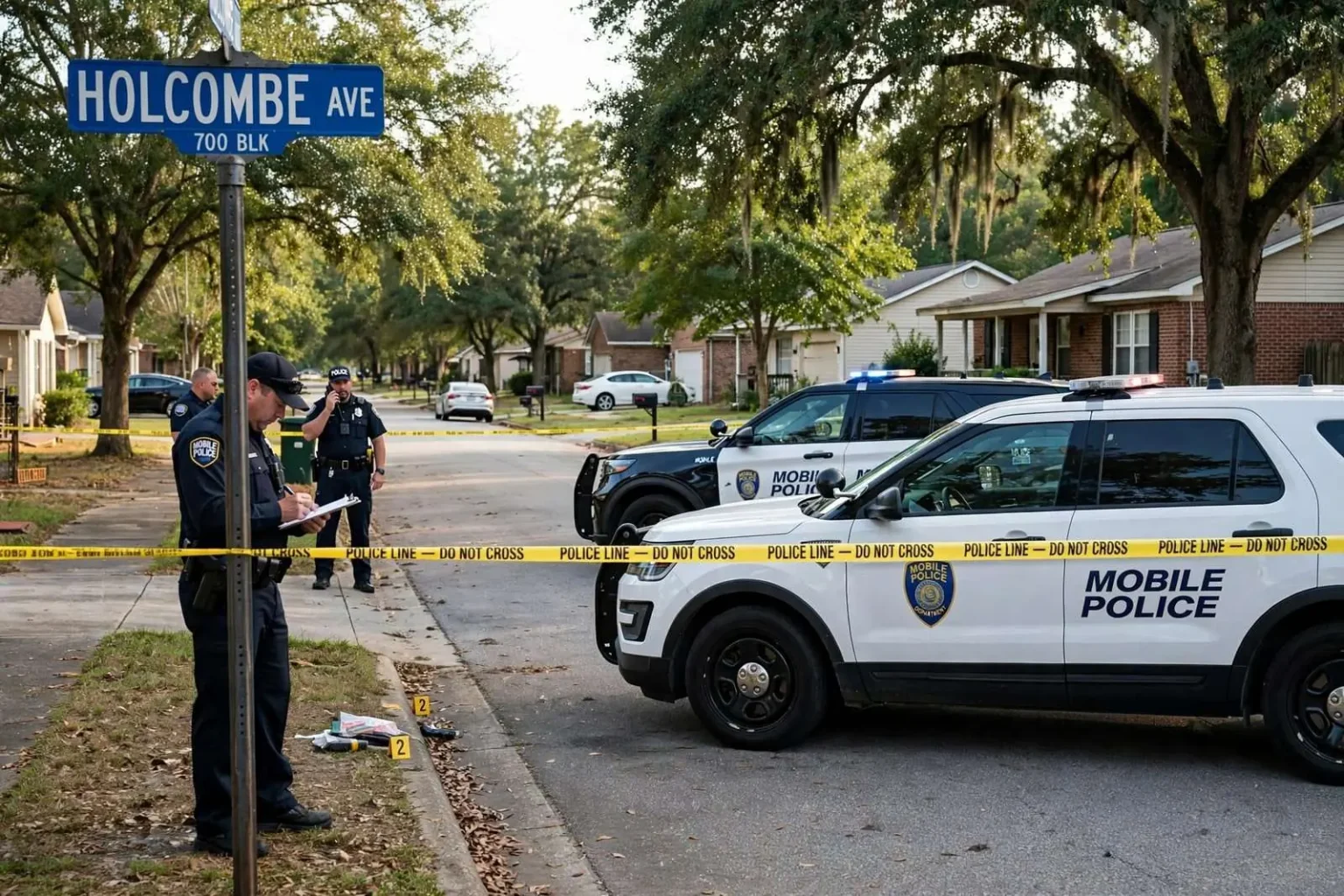
Mobile police are investigating after a man was shot and hospitalized in an afternoon shooting on Holcombe Avenue, according to authorities. The incident added another entry to the city’s ongoing tally of non-fatal shootings and left officers working the surrounding blocks for witnesses as the afternoon wore on.
Officers responded to the 700 block of the street after receiving a report that someone had been shot. Dispatchers sent patrol units to the residential block shortly after the call came in, and the first arriving officers secured the scene while medics treated the wounded man.
A Mobile Police Department spokeswoman said officers arriving at the scene found a man suffering from a gunshot wound. He was taken to a local hospital, and police said his injuries were not considered life-threatening at the time. The victim’s name and condition were not released, which is standard practice in the early stages of an active investigation.
According to witnesses interviewed by officers, the shooting followed some kind of altercation, though police have not released additional details about what led up to the confrontation or whether a suspect has been identified. Detectives spent the hours after the shooting speaking with residents and others who were nearby, asking what they saw and heard in the moments before gunfire erupted.
An Active Scene
The investigation remained active in the hours following the shooting, with officers continuing to gather information from those who were in the area at the time. Patrol officers established a perimeter around the block while investigators documented evidence and checked with nearby homes and businesses for anything that might have captured the incident.
Holcombe Avenue runs through a residential section of Mobile, and shootings tied to personal disputes have periodically prompted concern from neighbors about safety in the surrounding blocks. Residents described hearing the commotion and seeing police cars fill the street, a familiar scene for a neighborhood that has seen its share of police activity.
Mobile police have not indicated whether this incident is connected to any broader pattern of activity in the area. Investigators cautioned that early information in cases like this is often incomplete, and that witness accounts can shift as people come forward over the following days.
How These Cases Get Solved
Investigators typically rely on witness accounts, forensic evidence and any available video footage to piece together the sequence of events in cases like this one, particularly when the shooting stems from an altercation rather than an apparent random act. Detectives will look for surveillance cameras on nearby homes and businesses, physical evidence left at the scene and the accounts of anyone who saw the dispute unfold.
Anyone with information about the incident was encouraged to contact the Mobile Police Department. Officials stressed that even fragments of information — a description, a direction of travel, a vehicle seen leaving the area — can help detectives establish a timeline and identify those involved.
Non-fatal shootings tied to personal disputes remain one of the more common categories of gun violence reported in Mobile, and police have repeatedly urged residents to report escalating conflicts before they turn violent. Department officials have said many of the city’s shootings begin as arguments — between neighbors, acquaintances or family members — that relatives and friends saw building in the days beforehand.
The Mobile Police Department has pushed that message through community meetings, school programs and its neighborhood watch partnerships, asking residents to treat threats and repeated disputes as warnings worth reporting rather than private matters. Violence intervention workers in the city make the same appeal, noting that a call placed before a confrontation can prevent a hospital visit or worse.
The Department’s Appeal to Residents
The department continues to ask community members with any information related to gun violence in their neighborhoods to come forward, noting that tips from residents often play a critical role in resolving cases that begin with limited information at the scene. Detectives can follow up on anonymous tips, and investigators said people who are reluctant to speak on the record can still pass along what they know.
As of the most recent update, no arrests had been announced in connection with the Holcombe Avenue shooting, and Mobile police said the investigation was ongoing. Charges, if any, will depend on what detectives are able to establish about who fired the shots and why.
What Neighbors Can Expect
For residents of the 700 block and the streets around it, the investigation means a continued police presence in the coming days. Detectives may return to canvass again, and officers typically increase patrols in an area after a shooting, both as a deterrent and to reassure the people who live there.
Police have also encouraged anyone in the neighborhood with a security camera to review footage from the afternoon of the shooting. Even video that seems unhelpful at first glance — a car passing, a person walking quickly down the street — can give investigators the timestamp they need to line up other accounts.
The wounded man’s recovery will be another thread in the case. Once his condition allows, investigators will attempt to interview him about what happened, and his account could resolve questions that witnesses could not answer about how the altercation began and who was involved.
Mobile police said updates would be released as the investigation progresses, and anyone with information was asked to come forward through the department’s regular channels.
Afternoon Shootings and Response Times
Afternoon shootings present a different investigative picture than overnight incidents. More people are awake and outside, which means more potential witnesses, but also more activity — traffic, deliveries, children coming home from school — that can complicate the scene. Mobile officers responding to daytime calls are trained to lock down the area quickly before accounts of what happened begin to blur together.
Medics who treated the wounded man worked alongside officers under the department’s standing practice of staging emergency care while the scene is secured. The decision to classify his injuries as non-life-threatening came after initial hospital evaluation, offering relief to a neighborhood that has learned not to take that news for granted.
The Broader Picture in Mobile
The Holcombe Avenue shooting lands within a familiar pattern for Mobile, where the police department and city leaders have spent years iterating on strategies to reduce gun violence. Enforcement efforts alone, officials have acknowledged, cannot address the arguments and grievances that spark many of the city’s non-fatal shootings, which is why the department pairs investigations with community outreach.
Neighborhood associations on the west and central sides of the city have worked with police to identify problem properties and repeat locations, and the department credits those relationships with improving the flow of tips. On blocks like the one where this shooting occurred, officers say, the residents who live there day to day know more about rising tensions than any report can capture.
If You Know Something
Investigators reiterated that people with information do not need to be certain of what they saw to come forward. A partial detail — the color of a car, an overheard argument earlier in the day, a name mentioned in the neighborhood — often becomes the piece that connects other evidence.
Information about the Holcombe Avenue shooting, or any other incident involving gun violence, can be passed to the Mobile Police Department through its investigations division or anonymous tip channels. Detectives said the case will remain open until those responsible are identified and accounted for, and updates will follow as the investigation allows.
Life on the Block After a Shooting
Residents on streets like Holcombe Avenue often describe a stretch of unease in the days after a shooting. Parents keep a closer eye on children waiting for the bus, and the sight of detectives knocking on doors becomes part of the neighborhood’s rhythm until the case resolves. Mobile officers encourage residents to use that period to connect with the department’s neighborhood resource officers, who can walk them through crime prevention steps and keep lines of communication open.
City data in recent years has shown that non-fatal shootings outnumber fatal ones by a wide margin in Mobile, a pattern seen in cities across the country. Each survival still leaves a victim, a family and a block dealing with the aftermath, and police say the public often underestimates how much information those incidents generate when the community engages.
Victims of non-fatal shootings in the city are also connected with support services through hospital and community partners, an approach meant to break the cycle in which disputes escalate into retaliation. Intervention specialists sometimes reach out to people close to a shooting before tensions harden, offering mediation before a second incident occurs.
Where the Case Stands
The Holcombe Avenue case remains in the hands of Mobile police investigators, who are working to establish who was involved in the altercation that preceded the gunfire. Until that work produces a suspect, the department has limited what it releases publicly, a practice intended to protect the integrity of the investigation and the safety of witnesses.
Police said anyone who was in the area that afternoon, even briefly, should consider coming forward. Witnesses who have moved or who hesitate to get involved can still provide information anonymously, and detectives noted that the passage of a few days often gives people time to reconsider what they saw.
South Alabama News will continue to follow the investigation and provide updates as Mobile police release additional information about the Holcombe Avenue shooting.