Ray-Mont Logistics Breaks Ground on New Export Facility at Port of Mobile
Construction is underway on Ray-Mont Logistics' new export-focused transloading facility at the Port of Mobile, the Canadian bulk logistics provider's first Gulf Coast operation.
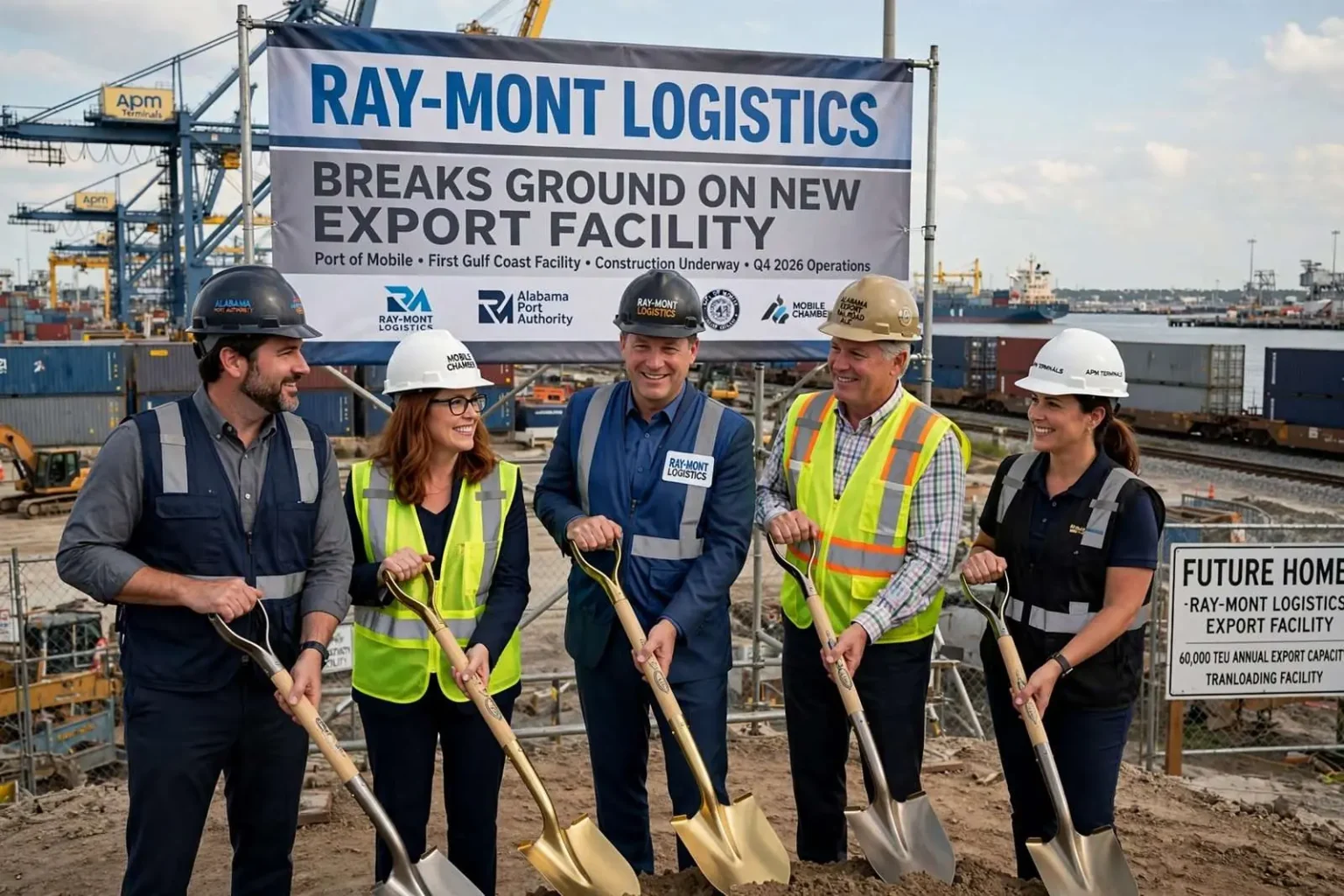
Construction is underway on a new export-focused transloading facility at the Port of Mobile being built by Ray-Mont Logistics, a project company officials describe as a significant milestone in expanding export capabilities and strengthening Mobile’s standing as a global logistics gateway.
The investment will establish Ray-Mont’s third facility in the United States and the Canadian bulk logistics provider’s first operation on the Gulf Coast, a choice company officials attribute to growing demand tied to the Port of Mobile’s deepwater access, rail connectivity, and expanding container capabilities. The project is being supported by the Mobile Chamber, the City of Mobile, and the Mobile County Commission, reflecting the kind of multi-agency economic development backing that Gulf Coast ports frequently assemble to attract new logistics investment.
Expected to begin operations in the fourth quarter of 2026, the transloading facility will increase exports of plastic resin packaging, forest products, and other goods moving through the Port of Mobile. Transloading facilities like this one serve as a critical link in the supply chain, allowing bulk commodities arriving by rail or truck to be repackaged or reloaded into shipping containers for ocean export — a function that has become increasingly valuable as U.S. petrochemical and forest products producers look to reach overseas markets more efficiently.
Rail and Deepwater Access Anchor the Site
The facility will operate on property owned by Alabama Export Railroad, known as ALE, at the Port of Mobile, giving Ray-Mont direct access to the port’s 50-foot shipping channel as well as the Alabama Port Authority’s on-dock rail infrastructure and its expanding inland intermodal network. That combination of deep-water access and rail connectivity is central to the facility’s value proposition, allowing exporters to move product from inland production facilities to oceangoing vessels with fewer handling steps than facilities lacking direct rail-to-dock access.
“Ray-Mont’s decision to establish operations here speaks to the competitive advantages we can offer manufacturers, shippers and their global customers,” said Alabama Port Authority Director and CEO Doug Otto. “With the deepest container port on the Gulf Coast, growing multimodal connectivity and expanding inland reach, the Port of Mobile continues to strengthen its position as America’s Gulf Gateway.”
The facility stands to benefit directly from a recently completed effort to widen and deepen Mobile’s shipping channel to 50 feet, a project that established the Port of Mobile as the deepest container port on the Gulf Coast. That additional depth allows vessels calling on Mobile to carry more cargo per trip, creating new opportunities specifically for export-intensive commodities like plastic resins and forest products that are typically shipped in high volumes.
Ray-Mont’s operations at the new facility are projected to add approximately 60,000 TEUs — twenty-foot equivalent units, the standard measure of shipping container volume — of annual export volume through the Port of Mobile once the facility’s first phase is fully operational. That volume figure gives a concrete sense of scale for a single new tenant’s expected impact on the port’s overall container throughput.
Port and Industry Leaders React
“The Port of Mobile is an increasingly important gateway for global trade, and we see this project as a meaningful opportunity to build long-term value around that momentum,” said Charles Raymond, President and Chief Executive Officer of Ray-Mont. “For Ray-Mont, this terminal expansion investment is about establishing a strong logistics platform in Mobile that connects inland resin and forest products production to international markets through an efficient, scalable and strategically positioned export hub.”
That characterization underscores why Gulf Coast port access has become increasingly attractive to logistics firms serving the petrochemical-heavy Gulf region: rather than routing export cargo overland to more distant ports, producers and logistics providers can shorten supply chains substantially by working through a Gulf-facing facility with direct rail access to inland production.
“This project is a strong example of how CN can help customers unlock growth where rail, port access and export demand come together,” said Buck Rogers, Vice President of Petroleum and Chemicals for CN. “Mobile gives us a scalable platform to support new volumes in the southern region of our network, while helping customers move their products to global markets with greater efficiency.”
Kate Bourgeois, CEO of Mississippi Export Railroad and Alabama Export Railroad, credited the broader Mobile business community for helping bring the project together. “ALE is proud to have found an innovative, solutions-oriented partner like Ray-Mont, and we are grateful to the City of Mobile, the Mobile Chamber, the Port of Mobile and APM Terminals for making this community so attractive for new business,” Bourgeois said.
Brian Harold, Managing Director of APM Terminals Mobile, welcomed the new tenant as a vote of confidence in the terminal’s container-handling capabilities. “APM Terminals is excited to welcome Ray-Mont Logistics to Mobile, Alabama, and applaud their decision to establish a new state-of-the-art bagging facility here,” Harold said. “We greatly appreciate Ray-Mont Logistics choosing Mobile for this important operation and the strong confidence they are showing in APM Terminals to reliably handle their high-volume container needs. Their presence will bring meaningful economic impact to the region and strengthen Mobile’s position as a premier logistics hub.”
The Port of Mobile continues to emerge as a major logistics hub along the central Gulf Coast, connecting inland production centers to international trade lanes and supporting more than one in seven jobs statewide. Since 2019, the port has generated $415 billion in statewide economic impact. Through its Mobile America Express, or MAX, service line, the Alabama Port Authority has continued efforts to strengthen multimodal connectivity between ship, rail, and truck transport, aiming to expand capacity, improve operational efficiency, and support faster cargo movement across every stage of the supply chain — a strategy the Ray-Mont facility fits squarely within.
Mobile’s Growing Role as a Logistics Hub
Transloading facilities like the one Ray-Mont is building occupy a specific niche in global supply chains, serving as the point where bulk commodities shipped by rail or truck are repackaged into containers suited for ocean freight, or vice versa. For producers of plastic resin and forest products — both bulky, high-volume commodities typically manufactured well inland from coastal ports — a nearby transloading facility with direct rail access can meaningfully reduce the cost and complexity of reaching export markets compared with trucking finished product to a more distant port lacking the same rail infrastructure.
Ray-Mont’s decision to establish its first Gulf Coast facility in Mobile, rather than at a larger, more established Gulf port, reflects a calculation increasingly common among logistics providers: that a deep, growing port with available capacity and competitive costs can offer better long-term value than squeezing into an already congested larger facility elsewhere along the coast. Mobile’s recent channel-deepening project, which established the port as the Gulf Coast’s deepest container facility, has been a central selling point the Alabama Port Authority has used to attract exactly this kind of new tenant investment.
Ray-Mont’s arrival adds to a broader cluster of petrochemical and resin-related logistics activity that has developed around the Port of Mobile in recent years, drawn by the region’s combination of deepwater access, rail connectivity, and proximity to Gulf Coast petrochemical manufacturing hubs stretching from Louisiana to the Florida Panhandle. As that cluster grows, each new tenant investment tends to reinforce the port’s attractiveness to the next, since shared rail infrastructure, terminal services, and logistics expertise become more efficient and cost-effective to maintain as more tenants rely on them.
A Boom in Gulf Coast Petrochemical Exports
The plastic resin exports the new Ray-Mont facility is designed to handle reflect one of the more significant shifts in American manufacturing over the past fifteen years. The U.S. shale gas boom made ethane — a key feedstock for producing polyethylene and other plastic resins — abundant and inexpensive relative to international competitors, prompting petrochemical companies to invest tens of billions of dollars in new cracker and polymer production facilities concentrated heavily along the Gulf Coast, from southeast Texas through Louisiana and into the Florida Panhandle. That surge in domestic resin production created a corresponding need for export infrastructure capable of moving bulk plastic pellets from inland production facilities to overseas customers in Asia, Europe, and Latin America, since much of the added U.S. resin capacity was built specifically to serve export markets rather than only domestic demand. Ports and logistics providers positioned to handle that bagging, transloading, and containerization work have consequently seen years of steady investment, and Ray-Mont’s decision to locate its first Gulf Coast operation in Mobile places the company squarely within that broader petrochemical export buildout rather than representing an isolated, one-off investment.
CN’s involvement in the Ray-Mont project highlights how heavily modern port competitiveness depends on rail connectivity rather than shipping channels alone. CN, formally Canadian National Railway, operates one of North America’s largest rail networks, connecting the Gulf Coast to the U.S. Midwest and Canada through a system that gives Gulf ports like Mobile a direct rail pathway to inland manufacturing and agricultural regions far from the coast. For exporters of bulky commodities like resin pellets or forest products, the difference between a port with direct on-dock or near-dock rail access and one that requires an additional trucking leg can materially affect total shipping costs, which is why railroads increasingly market their Gulf Coast port connections as a core part of their commercial pitch to industrial customers. Mobile’s growing rail infrastructure, including the Alabama Export Railroad network the Ray-Mont facility will sit on, reflects a broader pattern among Gulf ports of building out rail capacity specifically to attract exactly the kind of bulk export tenants that CN’s Buck Rogers described the project as unlocking.
APM Terminals, the container terminal operator welcoming Ray-Mont as a new customer in Mobile, is part of the A.P. Moller-Maersk group, one of the world’s largest integrated shipping and logistics companies, and operates container terminals at dozens of ports across the globe. Having a globally connected terminal operator managing Mobile’s container facility gives local exporters access to shipping line relationships and international trade lane connections that a smaller, independently operated terminal might struggle to match, a factor port officials frequently cite when courting new tenants considering where to locate export-focused operations. APM Terminals’ willingness to publicly welcome a new high-volume customer like Ray-Mont also signals confidence in the terminal’s available capacity, since accommodating a projected 60,000 TEUs of new annual export volume requires sufficient berth availability, yard space, and container-handling equipment to absorb that additional throughput without degrading service for existing customers.
Alongside plastic resins, the new facility’s focus on forest products exports reflects another long-running strength of the American South’s export economy. The region’s extensive timberland and pulp and paper manufacturing base has made forest products — including wood pellets, pulp, and various paper and packaging materials — a consistent export category moving through Gulf Coast ports for decades, with international demand driven in part by growing use of U.S.-sourced wood pellets as a biomass fuel source in European power generation and by steady global demand for pulp used in paper and packaging manufacturing. Bundling forest products and plastic resin export capability within the same transloading facility allows Ray-Mont to serve two of the Gulf South’s most consistent bulk export categories through a single operation, diversifying the facility’s customer base rather than depending on demand from a single commodity sector that could fluctuate with broader economic cycles.