Mobile Police Continue Search for Missing 76-Year-Old Man
Mobile police asked for the publics help locating a 76-year-old man who was reported missing earlier in January and last seen near his apartment.
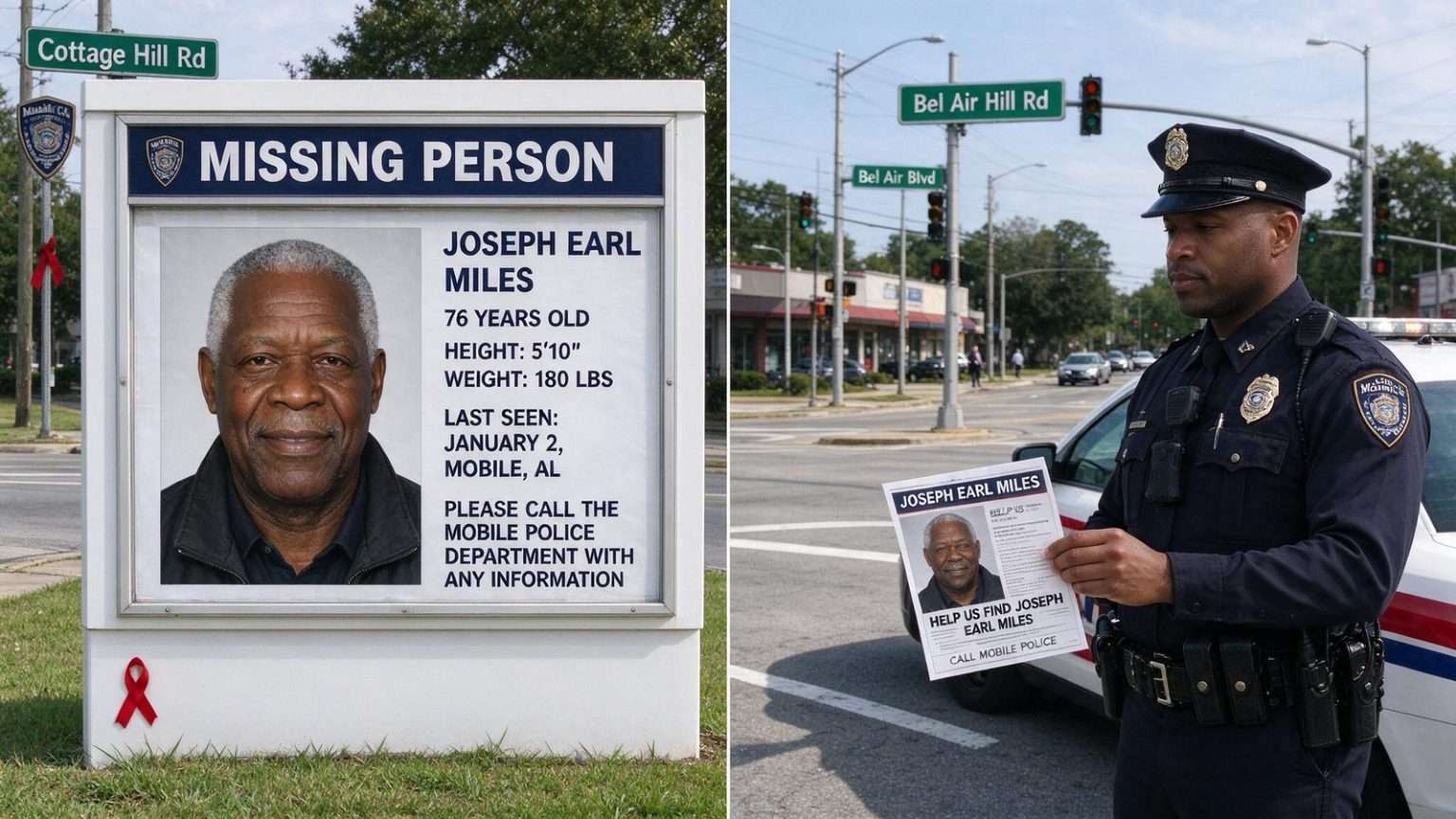
Mobile police continued searching this week for a 76-year-old man who has been missing since the beginning of January, and investigators renewed their public appeal for help as the case stretched into another week without resolution. The man, identified by the department as Joseph Earl Miles, was reported missing on Jan. 2, and police say every additional day without confirmed contact raises the level of concern for his welfare.
According to a Mobile Police Department spokesman, Miles was last seen at his apartment in the area near the intersection of Cottage Hill Road and Bel Air Boulevard, a busy commercial and residential corridor in west Mobile. The area, which sits near the Bel Air Mall district and carries daily commuter traffic between Midtown and the city’s western neighborhoods, is familiar ground for thousands of Mobile residents, but investigators say that familiarity does not lessen the urgency of locating an elderly man who has been out of contact for days.
Police described Miles as standing 5 feet 10 inches tall and weighing approximately 180 pounds. Those physical details, along with the location where he was last seen, have been circulated in the department’s public appeals as officers ask residents, business employees and drivers in the Cottage Hill and Bel Air area to keep an eye out for anyone matching his description.
Investigators said Miles has no known prior arrests, a detail that underscores how quickly an ordinary resident’s disappearance can become the focus of a police search. Court records reviewed as part of the effort to find him showed that he had previously listed a home address in Pensacola, Florida, as recently as 2008, though he was living in the Mobile area at the time he went missing. That history has given investigators a second jurisdiction to check as they work to establish a timeline of his recent movements.
The Search So Far
The Mobile Police Department has not released additional details about the circumstances surrounding Miles’ disappearance, but officers have continued to ask the public for tips as the search goes on. In missing persons investigations, the first week is considered critical, because memories are freshest, surveillance footage is most likely to still exist, and sightings reported by the public can most easily be confirmed or ruled out.
Police in Mobile typically handle cases like this one by canvassing the neighborhood where the person was last seen, checking with nearby businesses for camera footage, contacting hospitals and shelters, and notifying neighboring agencies so that patrol officers in surrounding jurisdictions know to be alert. When the person missing is an older adult, those steps often happen on an accelerated timeline because of the heightened medical risks involved.
The department has not said whether foul play is suspected, and no evidence has been presented publicly to suggest it is. What investigators have emphasized instead is the simple arithmetic of an aging population: the longer a 76-year-old man remains out of contact, the greater the chance that an underlying medical issue, disorientation or an accident is contributing to his absence.
Across Alabama, law enforcement agencies have built their missing-persons procedures around those realities. The Alabama Law Enforcement Agency maintains a statewide clearinghouse for missing persons information, and when an adult goes missing with documented medical vulnerabilities, departments can amplify their local appeals through regional media and neighboring police agencies. Mobile, as the largest city in south Alabama, sees its share of these cases each year, and the department’s practice of publicly naming and describing missing residents is part of a deliberate strategy: more eyes mean more leads.
Why the First Days Matter Most
Local law enforcement agencies routinely rely on public awareness to help locate missing residents, particularly in the days immediately following a disappearance when leads are freshest. Memories fade, security camera footage is often overwritten within days, and the trail a missing person leaves grows colder with each passing week.
That is why departments push details to the public quickly and keep them in circulation: a description on the news, a photo shared across social media, a bulletin passed among patrol officers. In cases involving older adults, the public’s role is often decisive — a neighbor, a store clerk or a passerby who recalls a face is frequently the tip that breaks the case.
The Unique Concerns of Missing Older Adults
Missing persons cases involving older adults often prompt an urgent community response, since factors such as memory issues, medical conditions or unfamiliarity with an area can complicate a person’s ability to find their way home safely. An older adult who becomes disoriented miles from home may be unable to ask for help or explain where they belong, even to someone standing in front of them.
Emergency responders and search teams treat such cases with a characteristic urgency. Weather exposure, missed medications and the physical demands of walking long distances all compound quickly for elderly missing persons, and search windows that might stretch for days in other cases compress to hours in these.
Families and caregivers of older adults can reduce the risk by keeping recent photos on hand, maintaining routines that neighbors recognize, and reporting a concern to police early rather than waiting — a call made within hours of a missed arrival is far more productive than one made the next morning.
Health conditions add another layer that families should document. Knowing an older relative’s medical needs, the medications they take daily and the doctors they see gives investigators immediate, concrete places to check — pharmacies, clinics, hospitals — and often shortens the search dramatically when a missing adult turns up somewhere receiving care.
How the Community Can Help
Anyone who believed they had seen Miles or had information about his whereabouts was urged to contact the Mobile Police Department directly. Even details that seem minor — a sighting from a car window, a man matching his description at a bus stop or store — can be the piece that points searchers in the right direction.
Residents in the area near Cottage Hill Road and Bel Air Boulevard were asked to check their own surroundings: garages, sheds, vehicles and other sheltered spots where a confused person might wander out of the weather. Business owners along the corridor were likewise encouraged to review any available security footage from the days after the disappearance was reported.
Community tips have historically played a key role in resolving missing persons cases across Mobile County, and police continued to encourage anyone with information, however small it might seem, to come forward. Departments would rather sort through a dozen dead-end tips than miss the one that matters.
A Reminder for Mobile Families
Cases like this serve as a reminder for Mobile-area families to stay in regular contact with elderly relatives and neighbors, and to notify police promptly if an older adult living alone cannot be reached. A daily phone call, a shared meal, a check-in from a nearby relative — these small habits are often what first signals that something is wrong.
They also matter for what they provide before anything goes wrong. An older adult who is known to neighbors, who has family checking in and who keeps regular routines is far easier to locate than one living in isolation, and far more likely to be noticed quickly if something changes.
Neighbors in the search area can help in practical ways too — sharing the police description with household members who may not have seen it, keeping porch lights on in the evening hours, and watching for anyone who appears confused or out of place along the corridor. Searchers describe such grassroots vigilance as the difference between a case that moves and one that stalls.
As the search for Miles continued into its second week, the Mobile Police Department’s appeal remained unchanged: stay alert, remember the description, and call in anything that might help bring a 76-year-old man home.
The Wider Network Behind a Missing Persons Search
A search like the one for Miles draws on more than the patrol division. Investigators review records, canvass the neighborhoods around the last-seen point, coordinate with other agencies in the region and work with family members to reconstruct the missing person’s habits, contacts and routines — the map of an ordinary life that tells searchers where an ordinary day might have gone.
Regional cooperation matters in a case with out-of-state connections. A prior address in Pensacola means Escambia County agencies and Florida media may be part of the circulation, widening the pool of eyes looking for the missing man across state lines.
Missing persons databases also come into play as a case continues. Descriptions entered into state and national systems ensure that any law enforcement officer anywhere who runs a check on a matching person will see the alert, extending the search far beyond the officers assigned to it and keeping it active even as the trail ages.
Media and social sharing extend the search further still. A photograph that reaches a few thousand local social media users can generate sightings leads that no canvass would find, and departments in Mobile County have long made use of both traditional press releases and online posts to keep missing persons cases in front of the public.
Standing by for Answers
For the family and friends of a missing person, the days after a report is filed are an agonizing mix of waiting and work — distributing flyers, answering detectives’ questions, holding out hope while preparing for any outcome. The public appeal that accompanies the search is part of that work, and the response of the community around Cottage Hill Road and Bel Air Boulevard was the resource investigators were counting on.
Joseph Earl Miles’ disappearance remained under investigation as the search stretched into its second week. Mobile police continued to ask anyone with information to come forward, and the case stood as a plain reminder of how much a community’s attention can matter to a family waiting for word.