Mobile Council Weighs Contract Diversity Rule, MoonPie Drop Turnout
Mobile's City Council debated a contractor diversity reporting rule, MoonPie Drop attendance data and a proposed flea market animal sale ban.
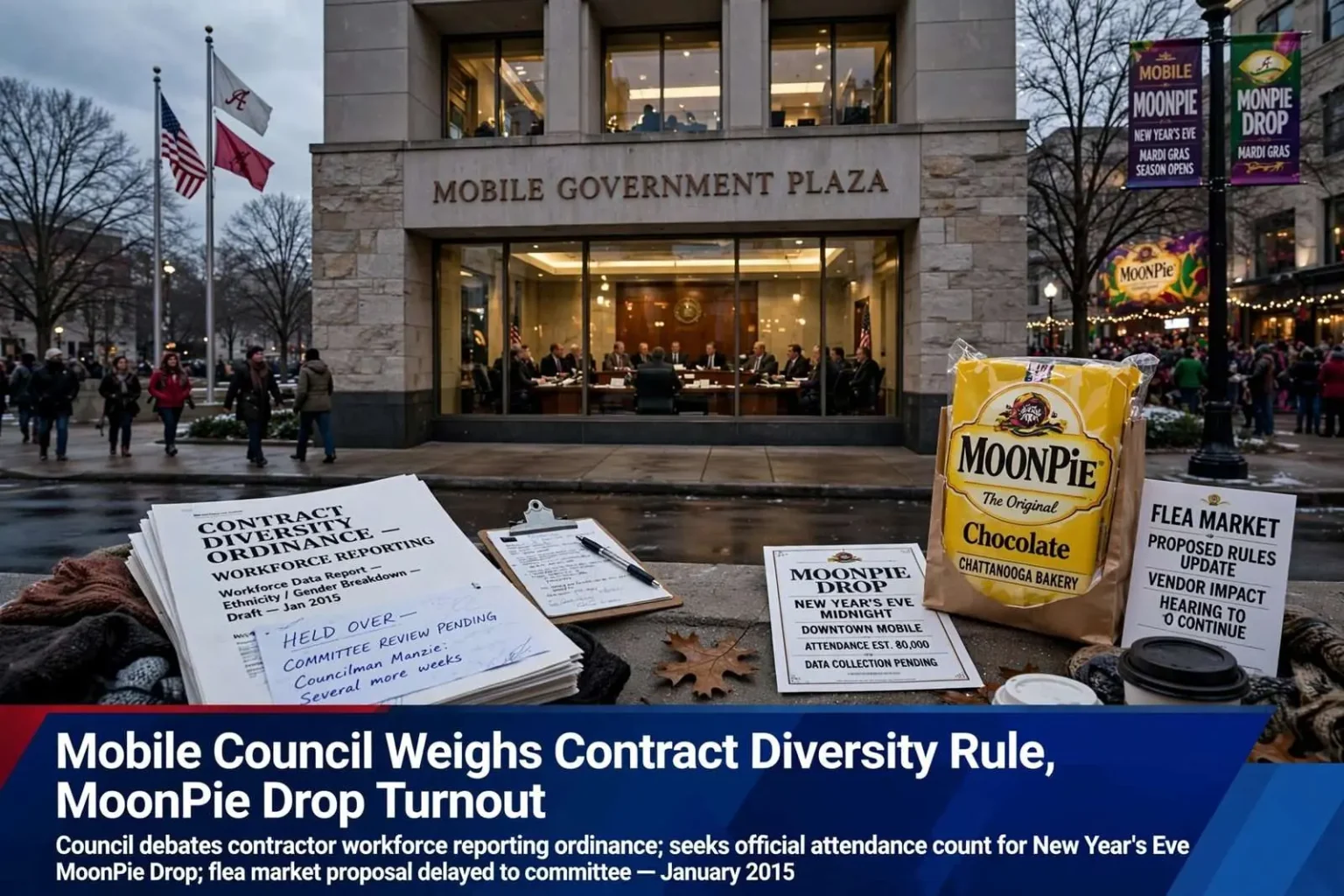
The Mobile City Council opened the first full week of January 2015 with a packed agenda that touched on city contracting policy, tourism data and a controversial proposal affecting the city’s flea market, offering a snapshot of the issues shaping local government early in the year.
Chief among the items was a proposed ordinance, sponsored by District 1 Councilman Fred Richardson, that would require companies and individuals contracting with the city to report workforce data, including total employee counts along with the ethnicity and gender breakdown of their staffs. The measure, first raised during a work session the previous November, was expected to come up for consideration, but Council President Gina Gregory said the city’s administrative services committee had not yet reviewed it because of the holiday schedule.
Councilman Levon Manzie asked that the item be held over for several more weeks to allow for proper committee discussion, and the council agreed to postpone action. The deferral meant the ordinance would return to the council’s agenda later in the winter, after the committee had weighed questions about how the reporting would be collected, what thresholds would apply to different sizes of contracts, and how the data would be used once the city had it in hand.
The contracting debate
Workforce reporting requirements like the one Richardson proposed are common instruments in municipal contracting policy, used by cities across the country to understand who actually benefits from public spending. The data itself imposes little cost on contractors — a headcount and demographic summary of existing staff — but it can become the foundation for later decisions about how the city awards work, and whether minority- and women-owned firms are getting a share of the business that public dollars generate.
Supporters of such ordinances argue that a city cannot address disparities it refuses to measure. Mobile, like many Southern cities, has long debated how well its contracting reflects the composition of its population, and Richardson, the council’s longest-serving and most vocal advocate on issues affecting the city’s Black community, has repeatedly pushed for policies that connect city spending to local and minority employment.
The committee review that Manzie requested is where those questions get answered in detail: which city departments would administer the reporting, whether the requirement would apply to subcontractors as well as prime contractors, and what consequences, if any, would follow for a contractor that fails to file. Until the administrative services committee completes that review, the ordinance sits in the pipeline rather than before the full council.
Counting the MoonPie Drop crowd
Council members also spent time discussing the economic impact of the city’s New Year’s Eve MoonPie Drop, a signature downtown Mobile event that kicks off Mardi Gras season each year. Richardson expressed frustration that no official attendance count was yet available, noting that reliable numbers are needed for the city to compete for tourism accolades and grants from groups such as the Southeastern Tourism Society. He estimated the crowd at roughly 80,000 based on his own observation, though city officials confirmed no formal count exists.
The gap between Richardson’s estimate and the city’s lack of formal data captures a recurring frustration for elected officials in tourism-driven cities. Crowds of that scale fill downtown streets and hotel rooms, but without a documented count, the event cannot be entered in competition for tourism recognition, and grant applications that ask for attendance figures must rely on estimates that reviewers may discount.
Al Hutchinson, head of the Mobile Bay Convention and Visitors Bureau, said preliminary reports suggested all four of downtown Mobile’s major hotels sold out over the holiday weekend, with restaurants reporting long waits. Hotel occupancy and restaurant volume are the proxies convention bureaus use when direct attendance counts are missing, and a complete sellout across a downtown’s full hotel inventory is one of the strongest indicators that a signature event draws visitors from outside the area who stay overnight rather than attending from home.
Mayor Sandy Stimpson’s chief of staff said responsibility for collecting future attendance data would be assigned going forward so the city has hard numbers to work with. The commitment matters for more than bragging rights: cities use attendance and economic-impact figures to justify public spending on events, to negotiate sponsorships, and to demonstrate to the tourism organizations that rank and reward destinations that an event merits recognition.
The MoonPie tradition
The MoonPie Drop is Mobile’s answer to the ball drop in Times Square, and its choice of object is a declaration of local identity. The snack cake has deep Gulf Coast roots — it is made in Chattanooga, but it has been the traditional treat of Mobile’s Mardi Gras for generations, tossed from floats by maskers to crowds along the parade routes. Dropping a giant electric MoonPie from a downtown building at midnight ties the New Year’s celebration directly to the Mardi Gras season that Mobile claims as its own, a tradition the city traces to the early 18th century and celebrates as the oldest in the nation.
That timing matters commercially as well as culturally. The drop serves as the opening event of carnival season, drawing regional visitors downtown weeks before the first parades roll and extending the tourism season through what is otherwise a quiet stretch after the holidays. Businesses around Bienville Square and the lower Dauphin Street corridor see some of their strongest nights of the winter around the event.
The discussion of attendance data also reflects how cities increasingly compete for events and visitors. Tourism organizations regionally and nationally rank destinations, hand out awards and direct grant funding, and they expect host cities to document their crowds. An uncounted crowd of 80,000, however real, cannot do that work on the city’s behalf.
The flea market question
The agenda also carried a controversial proposal affecting the city’s flea market, an issue that has divided vendors, customers and nearby residents. Mobile’s flea market operations raise questions that recur in cities across the region: how the city manages the property, what it charges the vendors who depend on it for their livelihoods, and how the operation fits into the neighborhoods around it. The council’s discussion signaled the matter would remain on the city’s docket into the new year, with details to be worked out as the proposal moves through the same committee process as the contracting ordinance.
For the vendors who set up at the market each week, the stakes are direct. Flea market stalls are small businesses in every sense — inventory, overhead and customers — and changes in city policy can determine whether a vendor’s weekend operation remains viable. That is why such proposals draw crowded council chambers: the people affected show up, and their council members hear about it.
What the week’s agenda revealed
Taken together, the items on the first agenda of 2015 mapped the tensions and ambitions of a city entering a new political era. The contracting ordinance raised the question of who shares in public spending. The MoonPie Drop discussion raised the question of how a city proves its own success. The flea market proposal raised the question of how city government manages the small-scale commerce that operates in its shadow.
The Stimpson administration, in its second year, was still putting its own stamp on city operations, and assignments like the one given for attendance data — small on their face — are how administrations reorganize the machinery of government around their priorities. The council, meanwhile, balanced members’ individual initiatives against the procedural need for committee review, deferring action where the process required it.
Each deferred item carried a promise of return. The contracting ordinance was headed to committee with a several-week timetable, the flea market proposal remained in play, and the city’s data-collection commitment was on record for the next New Year’s Eve. For a council opening a fresh year, the first week’s work was less about deciding than about ordering the decisions to come.
Why attendance figures drive tourism dollars
The Southeastern Tourism Society and similar organizations promote and rank destinations across the region, and their recognition programs ask host cities to document attendance, economic impact and media reach. Cities that can produce verified figures stand a better chance of landing designations that appear in travel coverage, and travel coverage sells hotel rooms. Grant programs operate the same way: a request backed by third-party verifiable attendance carries weight that a councilman’s estimate, however accurate, cannot match.
That is why the chief of staff’s commitment to assign data collection going forward resonated beyond the MoonPie Drop itself. Cities that institutionalize crowd counting — using methods from turnstile and gate counts to vendor sales data and parking revenue — build a year-over-year record that strengthens every future application, from festival grants to convention bids. Mobile’s decision to formalize that process put its signature event on the same professional footing as those of the cities it competes against.
Richardson’s long push on contracting equity
The workforce reporting ordinance fits a pattern stretching across Richardson’s tenure. He has repeatedly pressed the city to examine who gets its business, arguing that public contracts should reflect the community the money comes from. Reporting requirements are typically the first step in that argument — before any set-asides or goals can be debated, the city needs to know the baseline, and that is exactly what the ordinance would produce.
Opponents of such requirements generally raise cost and intrusiveness rather than principle: firms complain about paperwork, and administrators worry about burdening small vendors who bid on modest contracts. The committee process Manzie requested is where those concerns are weighed, and the several-week holdover gives both sides time to bring data and proposals to the discussion. When the ordinance returns to the full council, it will arrive with a record of review behind it — and with the council’s first big policy question of 2015 finally ready for a vote.