University of South Alabama Mobile
New Mobile Billboards Aim to Unite Gulf Coast Nonbelievers
A coalition of Mobile-area secular groups unveiled billboards along Interstate 10 in early 2015 aimed at connecting nonbelievers across the Gulf Coast.
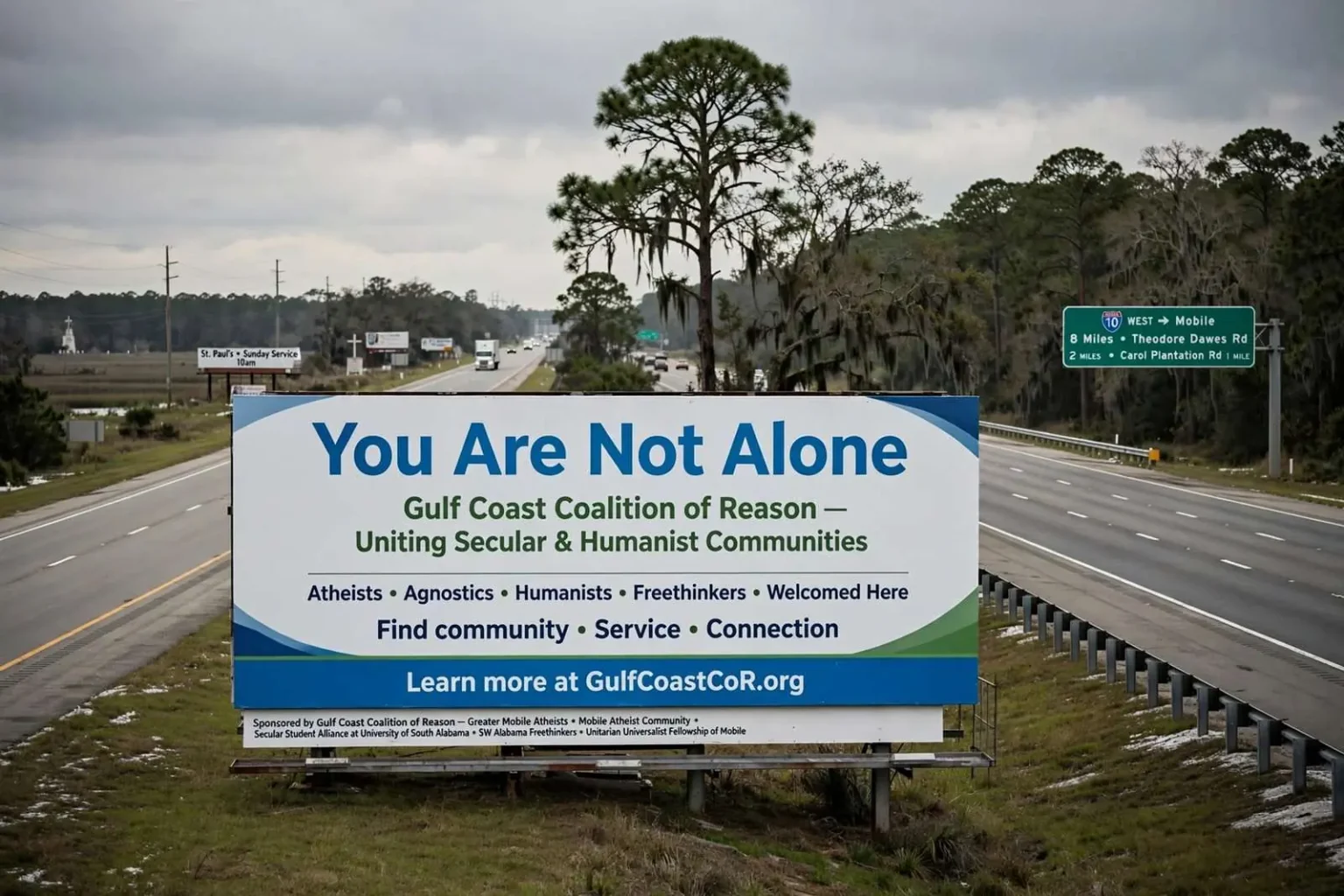
A coalition of secular and humanist organizations based in Mobile rolled out a series of new billboards in early 2015, part of a regional push to give nonbelievers along the Gulf Coast a visible sense of community. The Gulf Coast Coalition of Reason, a joint effort bringing together several local groups, put up four billboards in the opening weeks of the year, including one prominently placed along Interstate 10 in west Mobile County.
The coalition brings together the Greater Mobile Atheists, the Mobile Atheist Community, the Secular Student Alliance chapter at the University of South Alabama, the Southwest Alabama Freethinkers and the Unitarian Universalist Fellowship of Mobile, working alongside a dozen similar organizations across Florida and Mississippi. Funding for the roughly $11,000 campaign came from the national United Coalition of Reason, headquartered in Washington, D.C.
The structure of the campaign reflects how secular organizing actually works on the ground. Individual groups in the region are small, often numbering their active memberships in the dozens, and their visibility depends on cooperation. By pooling identity under a regional coalition and drawing on national funding, the Mobile-area groups were able to buy advertising space none of them could have afforded alone.
The Mobile billboard sits along I-10 between Carol Plantation Road and Theodore Dawes Road, a heavily traveled stretch of highway west of the city. The location puts the message in front of commuter and freight traffic moving between Mobile’s western suburbs and the city itself, on a corridor where drivers pass churches, church signs and religious billboards in continuous succession.
Organizers said the message was intentionally simple: a welcome sign for people who don’t believe in God, at a time when other billboards along the same corridors carry religious messaging. The wording was kept deliberately unprovocative, designed to invite rather than argue, and the group’s website address carried the practical weight of the message, giving curious drivers somewhere concrete to go.
“You Are Not Alone”: Organizers Explain the Message
Local coalition coordinator Amanda Scott said the billboard offers something she and others in the secular community don’t often get, a public acknowledgment that they exist and are not alone. She described feeling regularly surrounded by religious advertising in the region, and said seeing a message aimed at nonbelievers created an unexpected sense of belonging.
That experience is common enough among secular southerners that organizers built the entire campaign around it. In a region where church membership functions as a primary social network, where community events and even business relationships often run through congregations, choosing not to believe can mean quiet exclusion. A public sign acknowledging nonbelievers, Scott said, tells people who have kept their views private that the silence is not universal.
Fellow coordinator Buz Ryland echoed that sentiment, saying organizers wanted the thousands of nonbelievers scattered across the Gulf Coast to know there is an established community they can be part of, one that he said is also engaged in charitable and volunteer work in the area. The groups in the coalition participate in food drives, highway cleanups and other service projects, and leaders have long argued that the community service side of secular organizing is its best answer to skeptics who equate atheism with a lack of values.
The billboards direct passersby to the coalition’s website, which lists contact information for each of the member organizations. The online hub serves as the campaign’s real infrastructure, converting a few seconds of highway attention into contact information, meeting schedules and event listings for anyone who wants to follow up.
For the student group at the University of South Alabama, the campaign offered a way to reach peers at a formative moment. Campus secular groups often provide the first community nonbelieving students have ever encountered, and the billboard’s visibility in the city extends that reach beyond campus boundaries to young people across the metro area.
A Three-State Network of Signs
Beyond the Mobile sign, the campaign includes two billboards in Pensacola and one in Pascagoula, Mississippi, forming a loose network of signage stretching across the three-state Gulf Coast region. The geographic spread matches the coalition’s footprint, linking the member organizations in a corridor that runs from the Florida Panhandle through south Mississippi, all of it territory where secular residents are dispersed across a heavily religious landscape.
The Pensacola and Pascagoula placements were coordinated with the same national partner, part of a pattern of United Coalition of Reason campaigns that have appeared in metropolitan areas across the country. Each regional campaign is tailored to local groups, but the template is consistent: shared billboards, a common website, and a message aimed at visibility rather than debate.
Part of a National Trend
The effort reflects a broader national trend of secular advocacy groups using public advertising to raise their visibility, following similar billboard campaigns in larger metro areas over the preceding several years. Campaigns in major cities have ranged from gently welcoming to pointedly provocative, and the Gulf Coast version consciously chose the welcoming end of that spectrum, calculating that in the Deep South an aggressive message would generate backlash without reaching the people it was meant for.
The national organization behind the funding has supported similar coalitions across the country with the same basic theory: that the hardest part of secular community-building in religious regions is not persuasion but discovery, since people who have left religion often have no idea anyone like them is nearby. Advertising, in that view, solves a search problem rather than making a theological argument.
For a Deep South region where religious identity remains deeply embedded in civic and cultural life, organizers said the modest campaign was less about persuasion and more about letting a dispersed, often quiet community know where to find each other. Surveys consistently rank Alabama among the most religious states in the country, and public expressions of unbelief still carry social costs here that residents of larger metros rarely think about.
Organizers were prepared for the range of reactions such signs draw, from curiosity to criticism, and noted that religious billboards promoting services and events are an unremarkable feature of the same highways. The asymmetry, they argued, is precisely the point of the campaign: one sign for nonbelievers on a corridor lined with religious messaging is less an act of provocation than a small correction of an imbalance.
Local reaction in the campaign’s first weeks mixed interest with criticism, as such signs typically do, but the coalition’s leaders emphasized that they had no interest in a public argument. The goal, they said, was simply to exist visibly, and to let the sign do the quiet work of reaching whoever needed to see it.
What Comes After the Billboards
The billboards were expected to remain up for several weeks as part of the coalition’s broader outreach efforts in 2015. For the member groups, the campaign’s success will be measured not in impressions or controversy but in the ordinary markers of organizing: new faces at meetings, new volunteers for service projects, and new members finding, on a stretch of interstate between Theodore Dawes Road and Carol Plantation Road, a sign that someone was expecting them.
The Groups Behind the Coalition
The five member organizations in the Mobile area cover a deliberately wide range of approaches to secular life. The Greater Mobile Atheists and the Mobile Atheist Community serve as the general-community groups, hosting regular meetups, discussion nights and public events for atheists, agnostics and the simply unaffiliated. The Southwest Alabama Freethinkers draw participants from the smaller communities west and north of the city, offering a landing spot for residents well outside Mobile’s core.
The Unitarian Universalist Fellowship of Mobile occupies a different niche, since the denomination welcomes believers and nonbelievers alike under one roof, bound by shared values rather than shared creed. Its inclusion in the coalition signals that the campaign’s definition of “nonbeliever” is broad, encompassing anyone whose religious identity does not fit the region’s dominant congregations.
The Secular Student Alliance chapter at the University of South Alabama represents the coalition’s bridge to the next generation. Student secular groups nationwide have grown into one of the fastest-organizing segments of the movement, and the USA chapter gives Mobile’s campaign an institutional presence among the thousands of students who pass through the city’s university each year.
Coordination among the groups runs through regular leadership contact and shared calendars, with each organization retaining its own identity, meetings and style. The coalition exists for exactly the moments a billboard campaign requires: pooled credibility for a public message, and a single point of contact for a region that would otherwise appear, to an outsider, to have no secular community at all.
The dozen allied organizations across Florida and Mississippi play the same role in their own communities, and the Gulf Coast Coalition of Reason’s regional identity lets them share campaigns, strategies and visitors. A snowbird driving I-10 from Pensacola to Mobile passes two of the coalition’s signs without leaving the network, an experience organizers consider a small demonstration of the connected community they are trying to build.
For the groups themselves, the billboard campaign also served as an internal milestone, a first large-scale public project requiring them to coordinate timelines, approve messaging and manage a national funder’s requirements. Organizers described the process as a lesson in how much capability the coalition had already built without any of them noticing.