Mobile Billboard Aimed at Uniting Nonbelievers Taken Down Early, Group Says
A Mobile billboard urging nonbelievers not to feel alone was taken down early, and the sponsoring group says it's owed more display time.
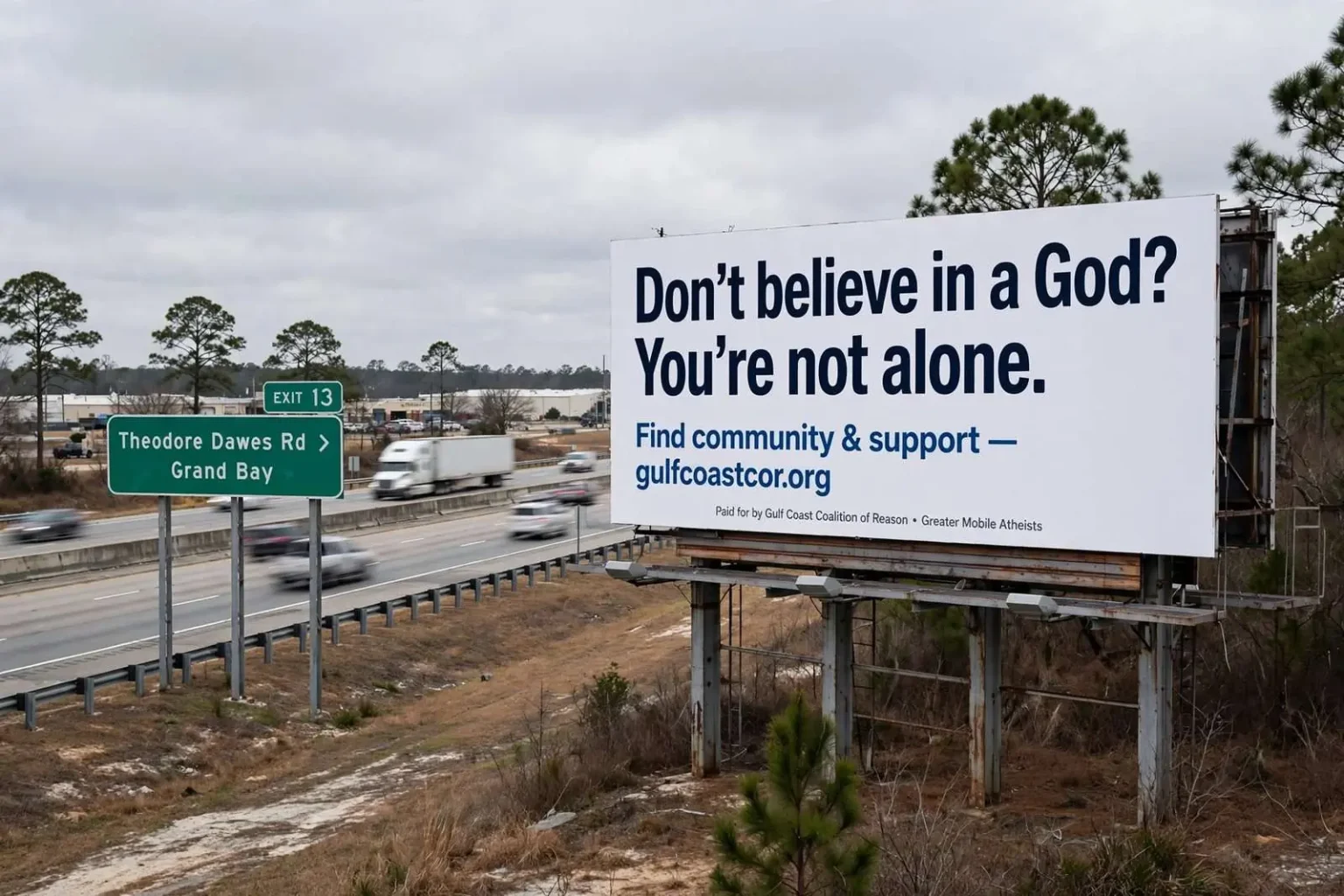
A billboard erected near Interstate 10 in Mobile earlier this month to reach out to people who don’t believe in God has already come down, and the group behind it says the advertising company owes them more time on display. The dispute has turned a routine advertising arrangement into a disagreement over contract terms, community reaction and who decides how long a paid message stays on the roadside.
The sign was one of four billboards put up across three Southern states in early January by the Gulf Coast Coalition of Reason, an effort funded in part by the Greater Mobile Atheists. The message read, “Don’t believe in a God? You’re not alone,” and pointed readers to a website, gulfcoastcor.org, offering information and community for nonbelievers. The campaigns of this kind are typically designed not to attack religion but to let atheists, agnostics and other nonbelievers know that organized communities exist for them in regions where such groups are less visible than places of worship.
The Mobile billboard was posted on the west side of Interstate 10 near Theodore Dawes Road, a stretch of highway that carries a heavy volume of commuter and commercial traffic between Mobile and the communities of western Mobile County. Billboard locations along that corridor are among the most visible advertising positions in the region, which is precisely why the coalition wanted its message there and why the sign drew attention quickly once it went up.
A Delayed Start and a Contract Clock
According to Troy Tatum, vice president of Lamar Advertising in Mobile, the original contract for the billboard was supposed to begin the week of Christmas, but the installation was delayed after the company asked the group to add a disclaimer identifying who paid for the sign. Jason Heap, representing the United Coalition of Reason, said it was the first time his group had been asked to include such a disclaimer, but they agreed to the request, and the billboard finally went up during the first week of January.
The complication is that the advertising company’s internal contract clock had apparently continued running from the original date. Rather than restarting the four-week period when the sign was actually installed, the contract counted from the week of Christmas, meaning the display window was already partially spent before the billboard ever reached the panel near Theodore Dawes Road. On Jan. 18, the Coalition of Reason was notified that the billboard had already been taken down, well short of what the group believed it had purchased.
Heap said he was told Lamar had received a large number of complaints about the sign, and he questioned whether that, rather than the contract terms, was the real reason for its early removal. “By contractual obligations, they are required to give us a full four weeks,” Heap said, arguing the group was owed roughly two more weeks of display time given the delay in getting the billboard installed in the first place. From the coalition’s perspective, the sequence of a delayed start, an already-running clock and an early removal added up to far less than the four weeks it had contracted for.
Lamar Responds to the Complaint
Tatum said Lamar has a plan to resolve the dispute with the Coalition of Reason, though he said the advertising company had not yet heard back from the group. He characterized some of the pushback as an attempt to escalate the disagreement rather than resolve it, suggesting the company saw a path to making things right without the matter becoming a broader public fight. What form that resolution will take — additional display time on another panel, a credit toward future advertising, or some other remedy — remained to be worked out between the two sides.
The organization has run into friction with billboard companies elsewhere before. In 2009, Lamar relocated a similarly worded Coalition of Reason billboard in Cincinnati, Ohio, after community reaction to that sign as well, a precedent the coalition points to when it argues that nonbeliever campaigns are sometimes treated differently than other paid advertising. Billboard companies generally reserve the right in their contracts to relocate or remove displays, but groups that pay for campaigns expect those provisions to be applied evenhandedly across all types of content.
For its part, the coalition has consistently described its billboards as outreach rather than provocation. The Greater Mobile Atheists and the broader Coalition of Reason network use campaigns like the one near Theodore Dawes Road to reach people who may feel isolated in their lack of belief, particularly across the Deep South, where religious congregations are a visible and central part of community life. The message on the Mobile sign was deliberately simple, offering a website and an invitation rather than commentary on any faith.
Billboards, Disclaimers and Public Reaction
The request that the group add a disclaimer identifying who paid for the sign reflected standard practices that have become common in political and issue advertising, where disclosing the sponsor of a message is often required by law or company policy. The coalition agreed to the addition, but the episode added friction to an installation that was already behind schedule and narrowed the display window the group ultimately received.
Billboard campaigns on topics of religion reliably generate strong reactions on both sides, and outdoor advertising companies find themselves managing not only the commercial relationship with the advertiser but also the stream of calls and complaints that a controversial panel can produce. I-10 near Theodore Dawes Road sees thousands of vehicles a day, so the Mobile sign was seen by a large audience in a short time, which is exactly what an outreach campaign hopes for and also why a disputed sign in that spot draws quick attention.
Whether the dispute ends with the coalition made whole depends on the resolution Lamar has said it is preparing. The group’s position remains that it paid for four full weeks, that installation delays and the early takedown left it with far less, and that the remedy should reflect what it was promised when the contract was signed rather than what the sign’s critics may have wanted.
What the Campaign Was Meant to Do
The Gulf Coast Coalition of Reason’s four-state, four-billboard push in early January was part of a familiar playbook for secular organizations across the region. Campaigns of this kind pair a short, memorable message with a website where newcomers can find meeting information, discussion groups and social events. For people who have left a faith tradition or never held one, organizers say, the hardest step is often discovering that others nearby share the same outlook, and a billboard on a major highway is one of the few mediums that can reach that audience all at once.
The funding structure behind the Mobile sign also reflected that networked approach. The United Coalition of Reason coordinates campaigns in multiple cities, while local groups such as the Greater Mobile Atheists contribute support and lend the effort a hometown presence. That division of labor lets national coordinators handle media buys and messaging while local members serve as the community the billboards point toward, which is why the loss of display time in Mobile mattered to both levels of the organization.
The Broader Questions the Dispute Raises
Beyond the specifics of one contract, the episode touches on questions that outdoor advertising companies and advocacy groups of every stripe face: how complaints about a sign’s message should weigh against a paying advertiser’s contract, and whether the answer changes when the message involves religion or its absence. Companies typically describe placement decisions as business matters, while advocacy groups watch closely for any sign that unpopular viewpoints are held to a different standard than mainstream commercial messages.
For Mobile residents who saw the sign during its brief run, the episode was a small flashpoint in a much longer national conversation about belief, nonbelief and public space. The coalition’s message never appeared on the panel for the full four weeks it paid for, and the group has made clear it considers the matter unresolved until Lamar follows through on the resolution its Mobile office has described. Until then, the billboard near Theodore Dawes Road stands as the latest example of how a single roadside sign can become the center of a dispute over fairness, faith and the fine print of an advertising contract.
As of the most recent statements from both sides, the billboard remained down, the coalition had not yet responded to Lamar’s proposed resolution, and neither party had ruled out further display time for the campaign somewhere in the Mobile market. What began as a straightforward media buy now ends, at least for the moment, with both sides describing the same four weeks very differently.