Hundreds of Unmarked Graves at Old Searcy Hospital in Mount Vernon Slowly Fading From History
A forgotten cemetery on the grounds of the former Searcy Hospital in Mount Vernon holds hundreds of unnamed graves and almost no surviving records.
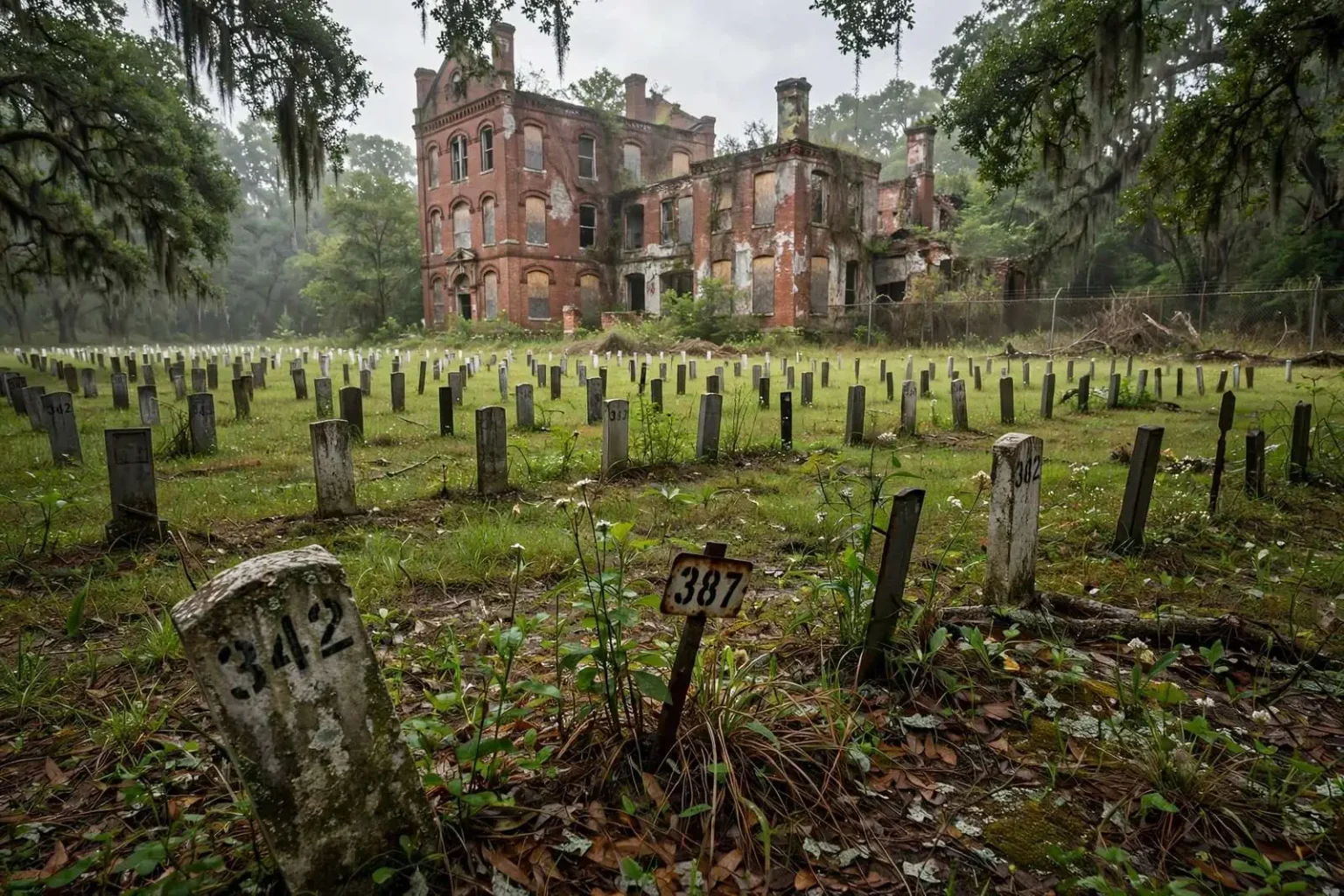
Tucked away on the sprawling, mostly abandoned grounds of the former Searcy Hospital in Mount Vernon, a small town in north Mobile County, sits a cemetery that few people even know exists. Hundreds of graves, many marked only with numbered concrete or metal stakes instead of names, hold the remains of patients who spent their final days at the state mental institution before it closed a little more than two years ago. The burial ground is the last stop of hundreds of institutional lives, and it is disappearing twice over — once from the landscape, as its markers weather, and once from memory, as the paper trail that could identify its residents proves thinner than anyone hoped.
Records in the attic
Retired Mobile County Probate Court records keeper Collette King has spent years trying to piece together who is buried there. She stumbled onto a trove of decades-old death certificates stored in wooden boxes in the attic of the old Mobile courthouse, some documents dating back well over a century. It was an archivist’s accidental discovery — the kind of find that changes a career — and King, who spent her professional life among the county’s probate records, understood immediately what the boxes might unlock for a cemetery full of numbers without names.
Cross-referencing those records with insanity case files has been slow, painstaking work, since most patients were listed with only a first and last name, no birthplace, no next of kin, and no clear paper trail connecting them to living relatives searching for answers today. The admission paperwork that committed patients to the state institution captured the minimum the law required and little more, and for the families of those patients — many of whom only learned decades later that an ancestor died in state custody — the gaps have turned simple questions into genealogical dead ends.
How many rest there
A survey of the property suggests there could be at least 740 graves, arranged in tight, deliberate rows across a remote section of the roughly 150-acre hospital campus, part of a larger 1,800-acre tract still owned by the Alabama Department of Mental Health. The rows’ discipline suggests the burials were recorded in at least a rough sequence — patients buried by order of death, their positions corresponding to a register — but the registers that would confirm it have not surfaced in the department’s files.
A local archaeologist who examined the site with university students years ago estimated the true number of burials could exceed 1,000, though only a couple hundred markers were ever formally catalogued before the fieldwork stopped. Records and interviews with former hospital employees suggest no one has been buried there since sometime in the 1940s, which means the cemetery’s population has been fixed for some eighty years — and its markers have had eight decades of Gulf Coast humidity, storms, and vegetation to erase themselves.
A layered history
The land itself carries a long and layered history. Originally home to a Civil War-era arsenal and barracks, it later held the Apache leader Geronimo as a prisoner in the late 1880s, a chapter that makes Mount Vernon one of the improbable footnotes of the American West — the Plains Wars’ most famous captive passing his confinement on a river bluff above Mobile Bay, decades before the first asylum patient was buried nearby. The military installation’s masonry buildings and parade grounds became the bones of the institution that followed.
Before becoming a mental health facility that served Black patients under segregation, the site’s institutional role was defined by the racial architecture of Alabama’s public systems: the state maintained separate psychiatric hospitals by race, and Mount Vernon’s became the destination for Black patients from across Alabama, whose families were often distant, impoverished, and powerless to claim them. It was not fully integrated until 1969 — the civil rights era’s reach extending even to the state’s asylum system, more than a decade after Brown v. Board of Education.
When the 34 historic structures on the property were added to the National Register of Historic Places in 1986, the cemetery was left off the listing entirely. The Mobile Historic Development Commission’s director, who helped prepare that original nomination decades ago, has said no one told him the burial ground existed at the time. The omission captures the site’s central problem in miniature: an institution that even its own neighborhood, its own staff, and its own historians could walk past without seeing.
Even people with direct ties to the hospital say the cemetery remained largely unknown. A Mount Vernon town councilman who worked at Searcy for more than three decades, starting in the early 1970s, said he never once visited the burial ground during his career there, though he recalled hearing about it and estimated no more than a few hundred people were laid to rest on the site. His guess — off by hundreds, if the surveys are right — shows how completely the cemetery had dropped out of the institution’s own institutional memory: a workforce of hundreds, passing within sight of the grounds for thirty years, carried only a rumor.
Access and preservation
State law guarantees public access to cemeteries in Alabama, but reaching the Searcy grounds is far more complicated than visiting a typical graveyard. The property sits behind a gate patrolled by a security guard, and state officials have said access is generally limited to family members with legitimate requests, in part because of liability concerns tied to the property’s deteriorating buildings. The tension is a familiar one for state agencies that inherit abandoned institutional campuses: the same hazards that make the buildings dangerous make the state reluctant to let the public wander among them, and the cemetery — legally public, practically sequestered — sits inside the perimeter.
Mental health department officials have acknowledged that detailed burial records simply were not kept during much of the hospital’s operation, leaving the identities of most of those buried there likely lost for good. That admission is what gives King’s attic discovery its weight: whatever the state failed to record, the probate court’s death certificates may still hold, name by name, box by box. The matching work proceeds one document at a time, in an attic, on the labor of a retired records keeper rather than a funded research project.
For researchers and local historians who have taken an interest in the site, time is a growing concern. The concrete and metal markers used to identify individual graves are weathering and deteriorating, and without a more complete survey, advocates worry the physical evidence of who rests at Searcy could disappear before anyone finishes the work of matching names to numbers. Every Gulf Coast hurricane season accelerates the countdown — falling limbs, flooding, and the slow chemistry of concrete in wet clay all pull at markers that are, in many cases, the only monument a person has.
The stakes are more than archival. For the descendants now tracing grandparents and great-grandparents through probate files and insanity case records, each numbered stake that survives is a potential place to stand and grieve; each one that crumbles erases a location no record can restore. Historians of Alabama’s mental health system see the cemetery as evidence in a larger story about how the state institutionalized its poorest and most vulnerable residents — most of them Black, most of them committed by courts rather than admitted by choice, and most of them buried without so much as a surname on a stone. Preserving the ground, advocates argue, is the last chapter of care the hospital can still provide.
The story of the cemetery also sits inside a national pattern. Across the country, the grounds of closed state psychiatric hospitals have become subjects of preservation battles — former asylums whose cemeteries held thousands of patients buried under numbers, their identities scattered across ledgers, federal census schedules, and courthouse files. Advocacy groups formed around specific campuses have won access agreements, memorial services, and in some cases full archaeological surveys, and the Mount Vernon effort has drawn on the lessons those campaigns produced: catalogue first, negotiate access early, and involve descendants before the paper trail closes.
Searcy itself carried a long institutional life before its closure. Generations of north Mobile County families supplied its workforce — nurses, attendants, farmers, maintenance workers — and in a small town with few large employers, the hospital’s payroll propped up local businesses the way a mill or a military base does elsewhere. Its closing removed an economic anchor even as it opened questions about what should become of the campus, and the cemetery sits at the center of that debate: any future use of the 150-acre core must account for the ground that holds the institution’s dead.
The Alabama Department of Mental Health has faced those questions on other campuses, and the pattern of its responses — selling surplus acreage, mothballing historic buildings, deferring maintenance — is what preservationists fear for Mount Vernon. The 34 National Register structures cannot be replaced, and neither can the graves; both are the kind of assets that cost nothing to keep until the day they are gone. For now, the department holds the keys, the gate stays guarded, and the work of identifying the dead continues one death certificate at a time in the attic of an old Mobile courthouse.