Steeling Up: Mobile Wins the Mill and Discovers It Has No Workers
With a German steel giant headed for north Mobile County, local executives warned that the region's real crisis had shifted from recruiting industry to finding and training the people to staff it.
The steel mill was won. That was the easy part.
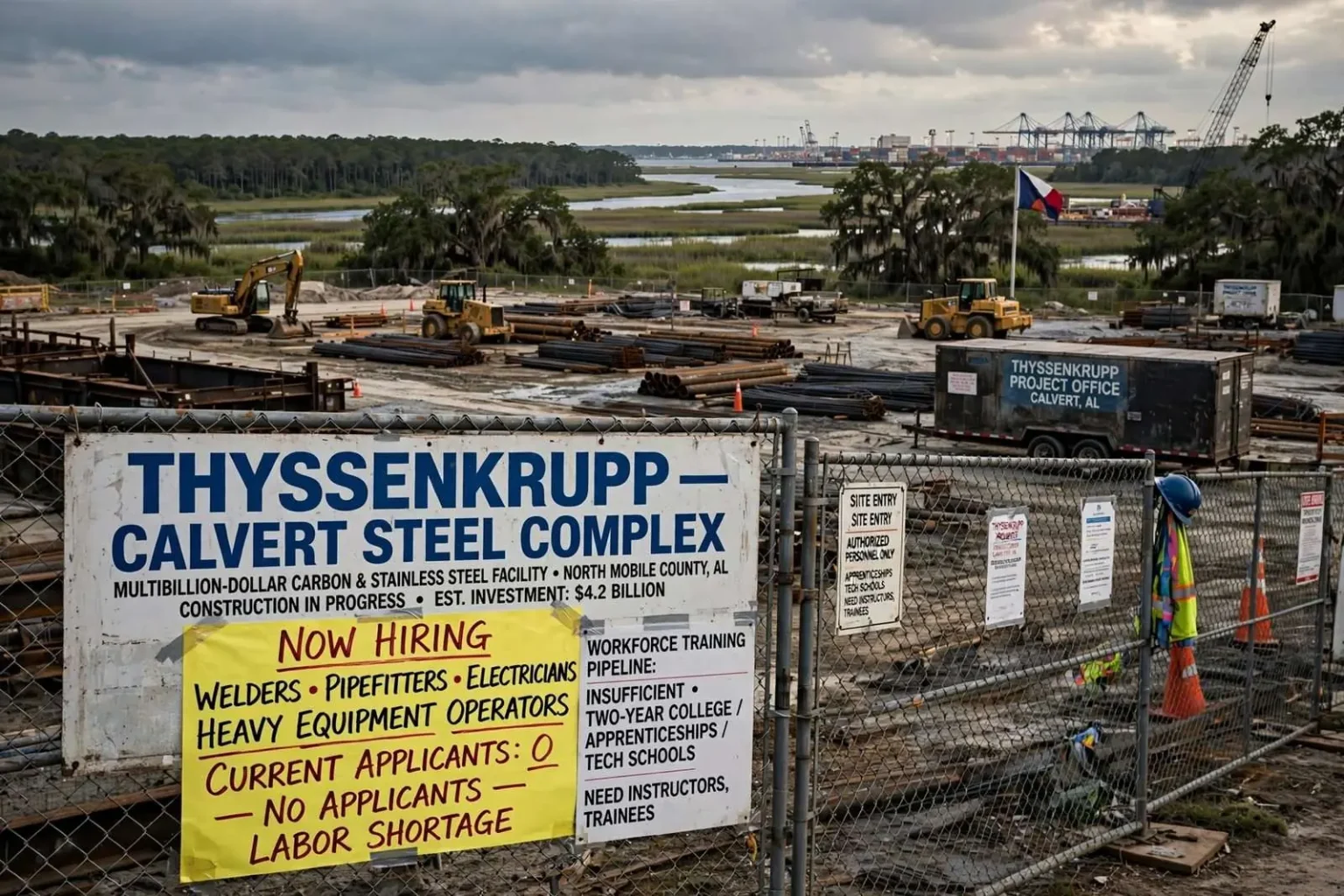
In the weeks after ThyssenKrupp chose north Mobile County for a multibillion-dollar carbon and stainless steel complex, the mood among the people who had chased the project was not simple triumph. It was something closer to vertigo, and the reason was labor.
The German industrial giant’s decision to build on the Tombigbee River north of Mobile was the largest single industrial announcement in Alabama since the automobile plants, and it immediately changed the arithmetic of the regional labor market. A steel complex of that scale would need thousands of construction workers to build it and a permanent industrial workforce to run it, drawn from a metropolitan area that had never before been asked to supply labor on that order. The very size of the victory created the problem: the region had won a project big enough to expose every weakness it had.
“The juggernaut must turn”
One executive deeply involved in the region’s economic development effort put the problem in terms that admitted no comfort.
Before ThyssenKrupp, he said, the Mobile area already had a serious shortage of qualified workers. With the mill coming, that shortage had become critical, and it would remain critical even if the region never landed the Air Force aerial refueling tanker contract that Mobile was then chasing with equal intensity.
The tanker competition, in which Mobile was bidding to become the assembly site for the next generation of Air Force refueling aircraft, hung over every economic forecast in the city that year. But the executive’s point was that the mill alone had already consumed the region’s slack. Whatever the Air Force decided, the supply of qualified welders, pipefitters, electricians and heavy-equipment operators in the area was insufficient for what was already under way, and the pipeline that produced those workers — the two-year colleges, the union apprenticeship programs, the high school technical tracks — had been allowed to thin out during the decades when Alabama recruited plants without asking where their workers would come from.
The conclusion he drew was a repudiation of the past twenty years of local strategy: “The economic development juggernaut must turn from recruiting industry to recruiting and training workers.”
His summary of the moment was less genteel, and more memorable, than anything a chamber of commerce would print. Momentum, he observed, cuts both ways. The same energy that had landed the biggest industrial prize on the Gulf Coast would now be tested by the plainer, slower work of building a workforce, and a region that had grown expert at incentive packages found itself needing to become expert at classroom schedules, welding booths and instructor pay.
Alabama, in fact, already had an instrument for that work: the state industrial training program that had prepared workers for the Mercedes plant in Tuscaloosa County and the Hyundai plant near Montgomery, recruiting and screening trainees and equipping them company-specific skills before a plant ever opened its doors. Applying that model at ThyssenKrupp’s scale, while also feeding the construction trades that would build the mill, was the task the region now faced, and nobody pretended it would be easy.
A city about to be rearranged
A Mobile real estate attorney offered a forecast that extended past the mill gates. Between the steel plant and the new container terminal at the state docks, he argued, Mobile was going to change tremendously over the next five years, and so was the practice of law in it.
The container terminal, under construction at the Alabama State Port Authority’s docks on Mobile Bay, was meant to make the city a true deepwater container port, the first on the Gulf, capable of handling the largest box ships afloat. Combined with the steel complex upriver, it promised to multiply the amount of cargo, contract work, financing and land deals moving through the city’s professional offices.
He expected the larger Birmingham firms, and possibly firms from outside Alabama, to arrive and buy or merge with small and medium-sized Mobile practices. They had watched what Mercedes-Benz did for Tuscaloosa and what Hyundai did for Montgomery, and they intended to be positioned when the same thing happened on the coast. In both of those cities, the arrival of an auto plant had pulled an ecosystem of suppliers, lawyers, bankers and commercial brokers into its orbit, and the firms that had been there first had often ended up selling to or merging with larger players who wanted a local footprint.
His central point deserves underlining, because it was the argument local boosters made repeatedly in that period: the spin-off growth from the container facility and the steel mill would exceed the direct employment numbers, possibly by a wide margin. The mill’s own payroll was never the whole prize.
The direct jobs at a steel complex, however well paid, are only the visible layer of the economic effect. Around such a plant gather contractors, maintenance firms, trucking companies, industrial suppliers, environmental consultants and the service businesses that follow any large payroll. A port terminal generates the same multiplier in a different shape: every additional ship call means drayage drivers, warehouse workers, customs brokers, freight forwarders and the warehousing and distribution buildings that developers rush to build near the water. The argument for spending public money on both projects had always rested on that multiplier, and 2007 was the year the region found out whether it was true.
The plane that could have gone to Baton Rouge
One detail from the announcement itself circulated among people close to the process, and it captured how narrowly the region’s fortunes had turned.
On the morning of the decision, ThyssenKrupp officials were waiting in Jackson, Mississippi, with flight plans filed for two destinations: Montgomery and Baton Rouge. They were awaiting word from Dusseldorf as to which way the plane would fly. Alabama and Louisiana had both bid aggressively, and the company’s executives on the ground did not know the answer until headquarters told them.
Louisiana had pursued the mill with its own package of incentives and its own advantages along the Mississippi River industrial corridor, and Baton Rouge had been genuinely in the running until the final hours. The bidding between the two states had stretched over months, with both delegations refining offers on land, tax abatements, infrastructure and training while the company weighed access to deepwater shipping for the raw materials and finished product that define the steel trade.
When the word came back that it was Alabama, according to a source familiar with the process, the team on the plane broke into applause.
The anecdote became a small piece of Mobile’s civic folklore, retold because it made vivid how contingent the region’s good fortune was. A different word from Dusseldorf — the company’s home city, where its executive board made the call — and the mill, the terminal boom it would reinforce, and the labor problem that came with them would have belonged to Louisiana.
Ham hocks and quality of life
A government executive who spent time with the visiting German contingent reported that the delegation’s interest in the region was not confined to port access and electricity rates. They were, he said, entirely taken with the food and the quality of life. Beyond the obvious appeal of Gulf seafood, they had developed a serious appreciation for Southern cooking, and at least one member of the group could prepare a ham hock that would hold its own anywhere in the South.
The detail sounds trivial. It was not. Site selection decisions of that magnitude turn partly on whether executives believe they and their families can live somewhere, and the Mobile delegation understood that it was selling a place as much as a set of incentives.
Months of courting had included visits to the proposed site, tours of the port, briefings on schools and hospitals, and dinners where the region’s culture was put on display alongside its spreadsheets. The German executives who would be asked to move their families to coastal Alabama for years of construction and plant leadership needed to be persuaded that the schools would serve their children, that the community would welcome them, and that life on Mobile Bay offered something beyond an industrial address. The ham hock story survived because it captured the moment when the sales pitch stopped being a pitch and became a genuine acquaintance.
What came after
The complex was built at Calvert, and it opened. It also proved a punishing investment for ThyssenKrupp, which ultimately sold the carbon steel operation to a partnership of ArcelorMittal and Nippon Steel and the stainless operation to Outokumpu. The plant at Calvert remains one of the largest industrial employers in the region.
The history of the site did not end the way the announcement-week coverage implied it would. Global steel prices, startup costs and the difficulty of ramping a new complex to full production turned the investment into a loss for its original owner, and the German parent that had chosen Alabama eventually exited the American steel business it had entered here. But the facility itself endured under new ownership, and the jobs, the tax base and the riverfront industrial complex stayed in north Mobile County.
The workforce warning sounded in the spring of 2007 also proved durable. The shift from recruiting plants to producing skilled workers became the central preoccupation of economic development along the coast, and it has never stopped being one. Every project the region has chased since — shipbuilding expansion, aircraft assembly, aerospace suppliers and the industries that feed the port — has been won or lost on the same question the mill raised first: whether the people of the region can be trained fast enough to fill the jobs the region can win.