Appeals Court Declines to Rehear Former Sheriff Jack Tillman’s Case
The Alabama Court of Criminal Appeals turned down a rehearing petition from the former Mobile County sheriff, whose lawyers argued his rights were violated when his own former attorney testified to a grand jury.
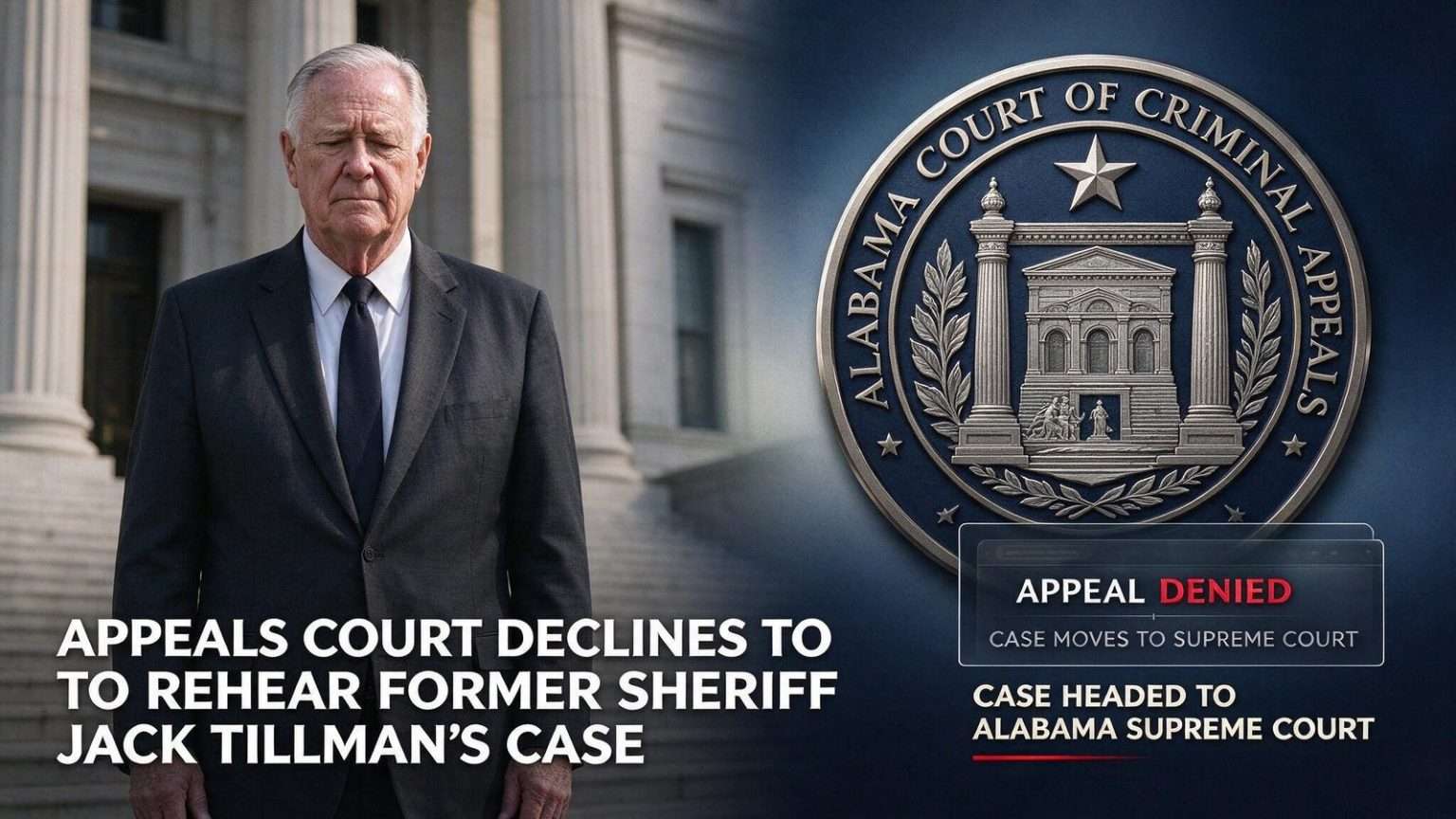
The Alabama Court of Criminal Appeals declined to rehear the appeal of former Mobile County Sheriff Jack Tillman, a procedural setback his attorneys had largely expected and one that pushed the case toward the Alabama Supreme Court. Tillman’s lawyers had regarded the petition for rehearing as a formality, the sort of motion filed chiefly because it must be filed before the next step is available. Its rejection cleared the way for them to take the matter up with the state’s highest court.
In Alabama’s appellate structure, the Court of Criminal Appeals handles felony appeals below the Supreme Court, and a denied petition for rehearing is the ordinary gateway to the next level. The rehearing stage rarely changes outcomes — the same five judges reread the same briefs — but the rules require the attempt, and Tillman’s counsel had filed theirs knowing the probability and the protocol in equal measure.
How Tillman Left Office
Tillman had departed the sheriff’s office the previous year after pleading guilty to two misdemeanor counts. The charges arose from two threads of a broader investigation.
The first concerned the Mobile County jail’s food fund. Under a long-standing arrangement in Alabama, sheriffs were permitted to keep as personal income whatever money was left over from state and county allowances for feeding inmates, an arrangement that persisted in various forms for decades and produced periodic scandals across the state. The handling of Mobile County’s fund drew the attention of investigators.
The practice traced to an old provision of Alabama law that treated the sheriff as the jail’s keeper and compensated him through the food allowance rather than a straightforward salary. In the rural counties of an earlier century, the system functioned as intended — a sheriff bought provisions, fed his prisoners, and kept any savings as part of his compensation. In a modern county jail housing thousands of inmates, the same rule produced sums far larger and a standing temptation that prosecutors had periodically pursued. The state allowance per inmate had also failed to keep pace with food costs, creating pressure on sheriffs to scrimp even as the surplus rule promised them any savings.
The second concerned Tillman’s own testimony in a matter involving his sister-in-law, a sheriff’s department administrator who had been charged in connection with a law enforcement seminar. The guilty pleas ended his tenure as sheriff but not the legal proceedings, because Tillman continued to challenge the process that produced the charges.
That distinction — between the end of an office and the end of a case — defined the post-resignation years. Tillman had already surrendered the position his defense sought to protect; what remained in dispute was the legality of how the prosecution had been assembled, and with it the precedent his situation might set for every public official whose attorney later appeared in a grand jury room.
The Privilege Question
The core of the appeal was an unusual claim about attorney-client privilege. Tillman’s attorneys contended that his rights were violated when his former attorney, Bob Campbell, testified before the grand jury investigating him. In their view, a defendant’s own lawyer appearing before the grand jury that indicted him represented a fundamental breach.
Attorney-client privilege protects the confidences a client shares with counsel, and its breach by the client’s own lawyer ranks among the gravest accusations in legal ethics. But the privilege is narrower than the public imagines: it covers communications made in confidence for legal advice, not a lawyer’s observations of public events, and not the identity of documents the client handled openly. The grand jury, which hears evidence in secret and decides only whether charges are warranted, is precisely where prosecutors summon witnesses to lay documentary foundations — and defense attorneys-turned-witnesses are not exempt from subpoena.
Campbell, who appeared under subpoena, took a different position. His testimony, he maintained, did not violate the privilege at all. Its purpose, he said, was narrow and technical: to authenticate public records. Records custodians and the lawyers who handled them are routinely called for exactly that purpose, and authenticating a document is not the same as disclosing a client’s confidences.
The disagreement between those two characterizations was the whole case. If Campbell was doing no more than confirming that documents were what they purported to be, the privilege was untouched. If he strayed into anything he had learned in confidence from Tillman, the defense had a genuine grievance.
The appellate court’s refusal to rehear the case meant it had reviewed the question and settled for itself where that line fell — or at least that a majority saw no basis to disturb the original ruling. For the Alabama Supreme Court to take the case, the defense would have to persuade that court the intermediate judges had erred on a question of privilege with implications beyond one defendant.
The grand jury setting amplified the stakes. Unlike a trial, where a judge screens testimony and the defense sits present with counsel, a grand jury proceeds in secret, without a defense attorney in the room, and witnesses answer questions in an environment designed for the prosecution’s convenience. A client’s former lawyer testifying in that setting — even on the narrowest of subjects — raised the appearance of imbalance in a way the courts had to weigh against the equally established rule that no profession exempts its members from answering a lawful subpoena.
Why It Mattered Locally
The Tillman prosecution was among the more consequential public corruption matters in Mobile County in that period, involving as it did the county’s chief law enforcement officer and the administration of its jail. The office of sheriff in Alabama carries broad autonomy and, at the time, a set of financial arrangements that invited exactly this kind of scrutiny.
The sheriff’s office sits in an unusual position among Alabama’s elected offices. It operates the county jail, serves civil process, and enforces the law across unincorporated territory, all under a constitutional officer who answers to no county commission’s hiring or spending decisions. That autonomy was the tradition the food fund rule grew out of — and the same tradition made oversight difficult, since the man responsible for policing the jail was also the man whose personal finances depended on its operation.
The jail food fund practice in particular would remain a live controversy in Alabama for years afterward, drawing lawsuits, legislative attention and eventually reform efforts aimed at ending sheriffs’ ability to pocket the surplus. Newspapers across the state documented sheriffs whose supplement from the food allowance dwarfed their official salaries even as jail menus drew complaints, and the pattern became a standing example in good-government arguments about compensation that hides in the budget.
The reform impulse eventually caught up with the practice, moving sheriffs onto a fixed supplemental payment and requiring that food money actually be spent on food — a change that came too late to affect Tillman’s case but that his prosecution helped bring into the open. For a county that had watched its own sheriff plead guilty over the fund’s handling, the statewide fix was the episode’s lasting meaning: an anachronism that survived because no one had been forced to defend it, exposed once someone finally had to.
The privilege dispute, meanwhile, carried its own institutional weight. Grand jury practice depends on the cooperation of lawyers, records custodians and former confidants who appear under subpoena, and a ruling that a former attorney’s authentication testimony breached privilege would have reshaped how prosecutors document cases involving public officials. The appellate court’s decision — whatever the Supreme Court later made of it — preserved the routine use of such testimony.
The Road to the Supreme Court
For Tillman, the immediate consequence of the appeals court’s decision was simply that the fight moved up one level. His attorneys had never expected the rehearing petition to succeed. What they wanted was the Alabama Supreme Court, and the denial gave it to them.
Petitions to the state’s highest court are discretionary in effect: the court selects the cases it will review, favoring questions of broad legal significance over disputes whose stakes are confined to one litigant. Tillman’s counsel had to argue that the privilege question qualified — that whether a defense lawyer’s grand jury authentication testimony can ground a dismissal mattered to more than one sheriff’s case.
The procedural posture also shaped the timing. Every stage — the rehearing petition, the certiorari application, the briefing that follows a grant — consumed months in which the underlying convictions stood and the political aftermath of the resignation continued to settle. An appeal does not reopen an office already surrendered; at most it could erase the convictions and, with them, the formal record of why the office came open.
Until the Supreme Court said otherwise, the appellate court’s ruling stood, the guilty pleas held, and Mobile County’s still-recent experience of a sheriff’s courtroom exit remained the reference point for every conversation about the office’s powers, its finances, and the limits of the law that governed both.