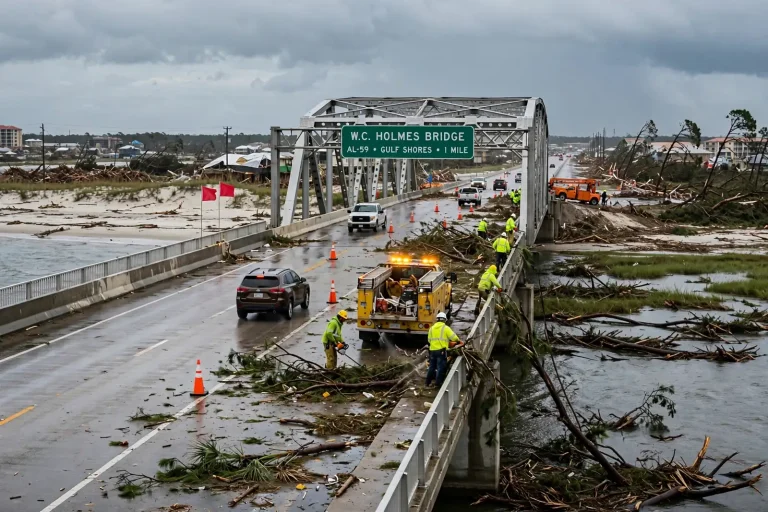
Ethics Charges Loom for Mobile County Commissioner as Death Inquiry Widens
Sources said Commissioner Stephen Nodine could face ethics charges within days, even as Baldwin County detectives searched for a missing bullet in the shooting death of Angel Downs.
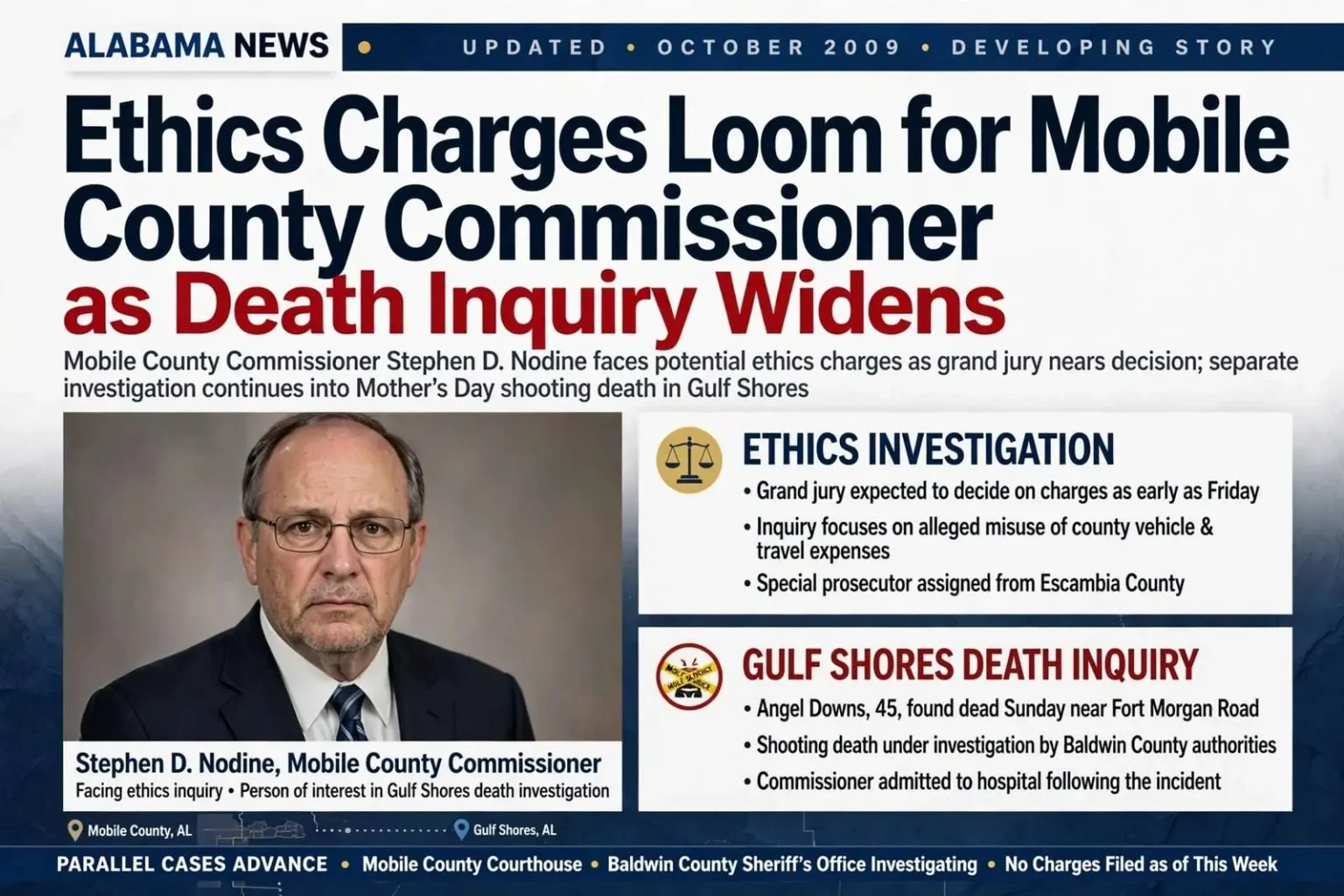
Mobile County Commissioner Stephen D. Nodine could face ethics charges as early as Friday if a grand jury reported as expected, according to sources in the area’s law enforcement and legal communities. The ethics inquiry was separate from the Mother’s Day shooting death in Gulf Shores of Angel Downs, 45, the woman with whom the married commissioner had a longstanding relationship. That death was under investigation by authorities in Baldwin County.
The parallel investigations put Nodine at the center of two separate legal processes at once — one examining his conduct in office, the other examining how a woman connected to him died on a holiday Sunday in another county. Neither had produced charges as of this week, but sources described both as advancing quickly, with the ethics case appearing closer to resolution.
How the ethics investigation began
The Mobile County investigation was launched late in 2009 after a marijuana-like substance was found in Nodine’s county pickup truck during a service visit to the county garage. Escambia County District Attorney Stephen Billy was assigned as special prosecutor after Mobile County District Attorney John Tyson Jr. recused himself to avoid any appearance of political bias, given that his office works alongside the commission in county government.
Over the following months the inquiry moved away from the marijuana and prescription pills found in the truck and toward ethical questions about the misuse of county property and travel-related expenses. County records were subpoenaed roughly two months earlier, and investigators have been reviewing mileage logs, expense reports and vehicle records to establish how the commissioner used county assets — the kind of paper trail that grand juries can convert into indictments without the complications of a criminal drug case.
The appointment of an outside prosecutor underscored the political sensitivity of the case. Tyson’s recusal handed the file to Billy, whose Escambia County post in Brewton puts him outside Mobile County politics, and legal observers noted that ethics charges against a sitting county commissioner would be unusual in Alabama — and would hinge on documentation of personal use of public resources rather than any single incident.
County sources said the grand jury’s work had been expected to conclude by week’s end, and the timing of any ethics charges would depend on that panel’s schedule. A person charged with an ethics violation in Alabama faces a felony prosecution handled like any other criminal case, with the potential for additional counts if the investigation documents a pattern of misuse.
The Gulf Shores investigation
Nodine had been admitted to the psychiatric ward on the fifth floor of Mobile Infirmary, reportedly distraught after Downs was shot outside the townhouse she rented on Fort Morgan Road. Neighbors reported seeing a red Ford F-150 pickup leaving the scene shortly after the 7:55 p.m. gunshot that left Downs dying in her driveway with a head wound.
Authorities described Nodine as “a person of interest.” He had not been charged as detectives and forensic scientists worked to establish whether the death was an accident, a suicide or a homicide — a triage of possibilities that forensic evidence, rather than suspicion, would ultimately have to resolve.
With his attorney, Matt Green, present, Nodine met with Baldwin County authorities late Sunday night and into Monday morning. The extended session gave investigators their first detailed account from the person at the center of the case, though officials cautioned that any statement from a distraught subject must be weighed against the physical evidence still being processed.
The missing bullet
In what sources described as a potentially critical gap, investigators had not recovered the bullet that passed through Downs’ temple and exited without lodging in her skull. A through-and-through wound leaves the projectile somewhere — in a wall, a floor, the ground — and finding it is essential to matching the round to a weapon, since rifling marks on a recovered bullet are the most direct physical link between gun and shooting.
A handgun reportedly registered to Downs, believed to be a Kel-Tec PF-9, was found at her side. It was not clear whether that weapon had been fired. The compact pistol, a model common among concealed-carry owners, will be examined for discharge residue, magazine state and ballistic compatibility with the wound — tests that in cases like this determine whether the registered weapon is the source or an irrelevance.
The missing round therefore carries most of the case’s forensic weight. Until it is found and compared against the Downs pistol and any other candidate weapon, investigators cannot say whose gun fired the shot that killed her, and the distinction between the three theories of the death — accident, suicide, homicide — may rest on that single piece of metal.
A sheriff’s gun recovered
A Mobile County Sheriff’s Office-owned .40-caliber Glock handgun had been issued to Nodine in 2004, not long after he joined the county commission. Sheriff Sam Cochran said he moved to recover the weapon as soon as he heard reports of Nodine’s mental distress, only to learn that the gun had already been retrieved and was in the custody of Baldwin County authorities.
Cochran declined to say how the transfer occurred. The sheriff’s account confirmed that the department weapon was out of Nodine’s possession within hours of the shooting, an administrative step that both protected the chain of custody and headed off any question about the commissioner having access to a county firearm while under investigation.
Cochran and former Sheriff Jack Tillman both said county commissioners have legitimate grounds to carry a firearm in the course of their duties. “It’s better to have a gun and not need one than to need a gun and not have one,” Tillman said. The practice of issuing weapons to county commissioners — elected officials with no law-enforcement authority — drew renewed attention after the shooting, though both sheriffs defended it as a longstanding custom rooted in the officials’ travel and constituent-contact duties.
The issuance also explained why the Baldwin County investigation had more than one firearm to account for. Any weapon associated with Nodine, county-issued or personal, becomes evidence in the inquiry, and the Glock’s recovery meant investigators could at least eliminate it as an unsecured loose end while the forensic work on the Downs pistol and the missing bullet proceeded.
A pattern of concern
Friends and political associates said Nodine’s mental state was “not good.” Sources in Mobile’s political and legal circles said his use of prescription painkillers for hip and back pain had escalated to a dependence they described as 25 to 30 pills a day, and that efforts to persuade him to seek treatment were rebuffed by the commissioner and some allies as politically motivated.
The account of escalating dependence, relayed by people who had watched his behavior change over months, framed the portrait of an official whose private struggles were widely known in political circles even as his public schedule continued. Those sources said intervention attempts had ranged from family appeals to conversations arranged through colleagues, all turned aside with the argument that the concern was a political attack.
Baldwin County authorities were expected to disclose their thinking on the death within roughly 36 hours, sources said, though they cautioned that an announcement could take longer given the attention on the case. District attorneys in Alabama can present evidence to a grand jury, file charges directly, or close a case as accidental or self-inflicted, and each path carries different evidence demands in a death without an recovered bullet.
Billy, the special prosecutor in the Mobile inquiry, did not return calls, but was reported to have been at the Mobile County Courthouse on Wednesday — his presence fueling speculation that the grand jury’s ethics presentation was nearing its conclusion.
What comes next
The convergence of the two cases was expected within days. If the grand jury returned ethics counts on the Mobile County side, Nodine would face the prospect of defending his conduct in office while Baldwin County’s decision on the Downs death remained pending — a sequence that would place the commissioner’s political career and personal freedom under scrutiny simultaneously.
For county government, the immediate questions were procedural. The commission operates with three members, and an indictment would raise questions about Nodine’s ability to participate in votes and executive sessions while the case proceeded. Alabama law provides for removal of county officials upon conviction of certain offenses, but the process is slow, and a commissioner under charge continues to hold office until it runs its course.
For the communities on both sides of the bay, the case had already become the region’s dominant story: a county commissioner hospitalized after a holiday shooting, a special prosecutor closing in on ethics counts, and two investigations running in parallel toward decisions that would answer — at least in part — what happened on Fort Morgan Road on Mother’s Day, and what a decade in office had cost the county that elected him.