Impeachment, Divorce and a Murder Inquiry: A Commissioner’s Long Friday
In a single day, Mobile County Commissioner Stephen Nodine left a psychiatric ward, was impeached by a grand jury, was named the sole suspect in a murder investigation and was sued for divorce.
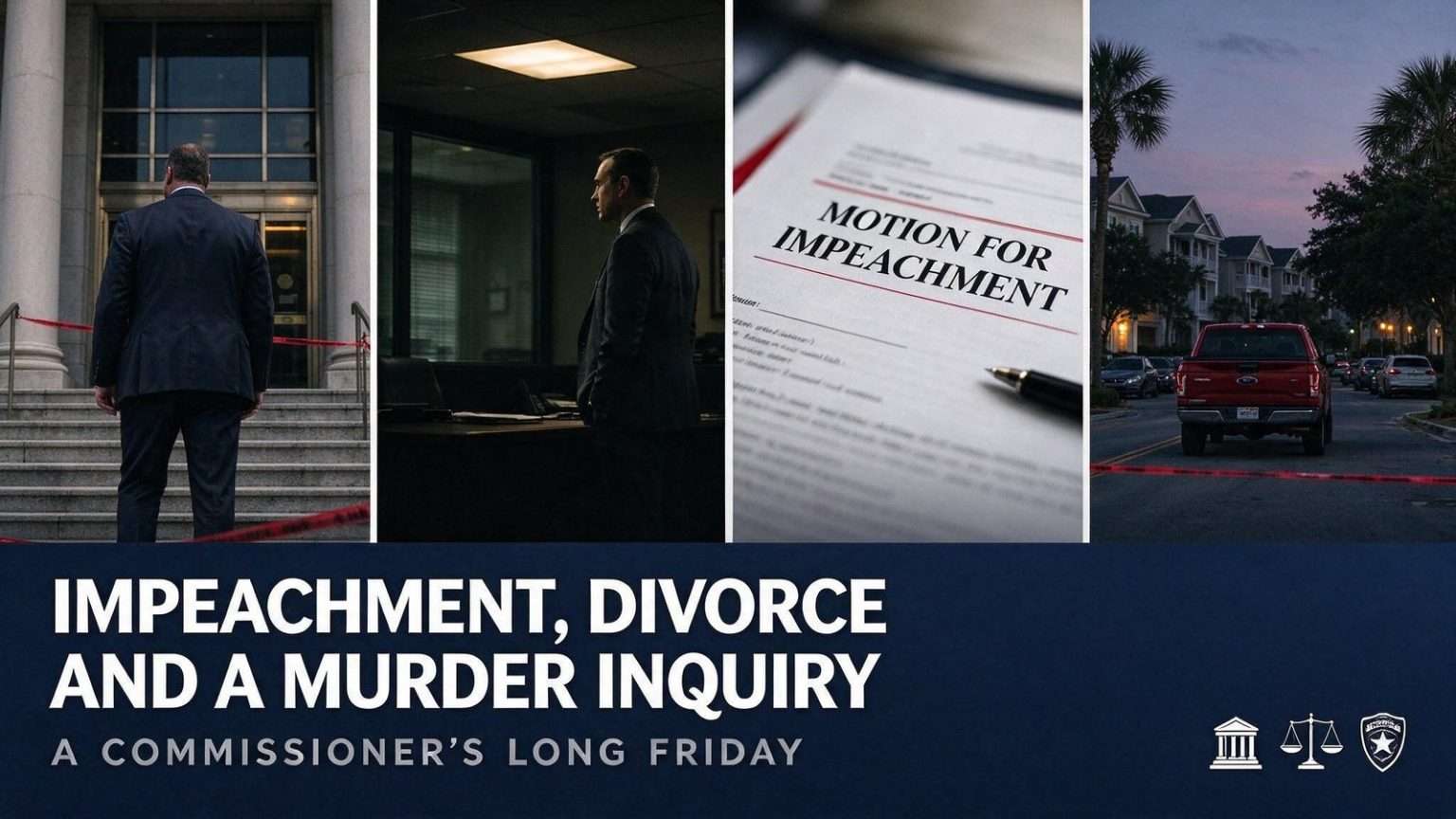
Few days in the modern history of Mobile County government have crowded as much consequence into a single afternoon as Friday did for County Commissioner Stephen Nodine.
By the close of business, the 46-year-old Republican had been released from psychiatric care, impeached by a Mobile County grand jury, identified by Baldwin County authorities as the only suspect in what they now called a murder investigation, and sued for divorce by his wife.
A day in four acts
Morning: Nodine was released from the fifth-floor psychiatric unit at Mobile Infirmary, where he had been admitted days earlier. Early afternoon: A grand jury returned a bill of impeachment charging him with ethical and pharmacological infractions. Afternoon: Baldwin County authorities cited him as the sole suspect in the Mother’s Day evening shooting death of Angel Downs, 45, his longtime girlfriend, in Gulf Shores, a case they now treated as a murder investigation. Late afternoon: Nodine returned to county government offices, where he told stunned county workers that he had been lost to the Lord for eight wayward years but now was found, and that there was work to be done.
Each of the four acts would, on its own, have led the local news. Together they produced a day without precedent in recent memory at Government Plaza, where veteran employees struggled to recall anything comparable in the county’s modern era. The sight of a commissioner reporting to his own offices hours after being named the sole suspect in a homicide investigation left even longtime courthouse observers searching for comparison.
The divorce case
Kimberlee Nodine filed for divorce from the commissioner on the same day. The case was assigned to Judge Rosemary Chambers. Her attorney was Donald Briskman, a name familiar to anyone who had followed Mobile County’s last impeachment fight: Briskman handled the defense of former School Board Commissioner David Thomas Jr.
The choice of Briskman signaled that the family intended to litigate with experience. Thomas’ impeachment case a decade earlier had been the defining political-legal fight of its era in Mobile County, and Briskman’s familiarity with the mechanics of impeachment — the evidence, the procedural motions, the pressures on witnesses — made him an unusual and formidable hire for a domestic docket. Judge Chambers, meanwhile, drew a case that would put a county commissioner’s marriage and finances under public scrutiny at precisely the moment the commissioner faced removal from office.
What impeachment means in Alabama
Impeachment of a county officer in Alabama is not a legislative proceeding of the kind familiar from Congress. It is a court case, brought in circuit court, in which a jury or a judge determines whether an official should be removed from office on grounds such as corruption in office, incompetency, intemperance in the use of alcohol or narcotics, offenses involving moral turpitude, or willful neglect of duty.
The impeachment action against Nodine was expected to draw an assigned judge the following week, most likely a jurist from outside Mobile County. Court observers anticipated that an impeachment trial could begin as soon as early June, immediately after the June 1 party primary elections.
The timing created a political paradox. Nodine’s name would remain on the June 1 ballot for renomination to the District 2 seat even as the machinery for his removal moved through the courts. Alabama law provides few mechanisms for removing a candidate from a primary ballot, meaning voters could nominate someone to a seat that a circuit court jury or judge might strip from the incumbent days later — or leave in his hands.
The grounds charged — ethical and pharmacological infractions — track the statutory language Alabama courts have construed in prior impeachment fights, and the pharmacological allegations connect directly to the criminal track: the discovery of drugs in the commissioner’s county-issued pickup truck, the matter behind the Mobile County investigation running alongside the Baldwin County homicide inquiry.
Three tracks, one official
The events of the day left Nodine facing three simultaneous proceedings, each with its own timetable and its own standard of proof: an impeachment case that could strip him of the District 2 seat he had held since 2004; a criminal inquiry in Mobile County that grew out of the discovery of drugs in his county-issued pickup truck; and a homicide investigation in Baldwin County in which he had not been charged but had been publicly identified as the only suspect.
The three tracks move at different speeds by design. An impeachment trial can be convened in weeks and requires a civil standard of proof; a criminal prosecution must clear an arrest, an indictment and a trial that could take a year or more; and a domestic case runs on its own calendar entirely. Each track also exposes a different slice of the record — the county’s payroll and contract records in the impeachment, the truck and its contents in the criminal case, and the family’s private history in the divorce — giving investigators, litigants and reporters three separate avenues into the same public official’s life.
The investigation in Baldwin County
Downs was found shot in the head in the driveway of her townhouse off Fort Morgan Road on the evening of Sunday, May 9. Neighbors reported seeing a red Ford pickup with government plates leaving the area shortly after the shot was fired.
The Fort Morgan Road corridor, lined with townhouse developments and rental communities a few minutes from the Gulf Shores beachfront, is not a place accustomed to homicide scenes, and the discovery drew an immediate and heavy law enforcement presence. Baldwin County investigators — led by the District Attorney’s office and the major crimes units that handle the county’s rare killings — spent the following days processing the scene, canvassing neighbors and tracing the government-plates sighting that pointed across Mobile Bay.
Baldwin County authorities took the unusual step of publicly identifying Nodine as the only suspect before any arrest or charge, a move that reflects both the evidence they believed they held and the pressures of a case drawing daily coverage on both sides of the bay. Naming a suspect without charging him is a line prosecutors rarely cross; doing so to a sitting county commissioner announced that the customary courtesies between the two counties’ governments would not apply here.
A county commission in limbo
The Mobile County Commission has only three members, and the absence or distraction of any one of them is felt immediately across a government that manages roads, public works, the county budget and a broad slate of contracts. With the primaries less than three weeks away and an impeachment trial looming, county officials and courthouse regulars alike were left to speculate about how long Nodine could remain in office and what would happen to his seat if he did not.
A three-member commission leaves no room for a recusal to go unnoticed. District 2 takes in a large share of the county’s fastest-growing territory, where road and drainage projects stack up in the agenda, and every contract, bid award and resolution touching the district passes through the vote of its commissioner. With Nodine’s participation in doubt, county staff faced the practical question of who speaks for the district’s constituents — a question with no clear answer under Alabama law for a commissioner who remains in office but diminished.
Nodine had not been charged in connection with the death of Angel Downs as of this report, and he had entered no plea in the impeachment case.
What happens next will be decided in three courtrooms and at the ballot box, on timetables that overlap but do not match. For the county’s 400,000 residents, the immediate question is simpler: how long a three-member government can function with one seat suspended between an election, an impeachment and an investigation that has now crossed the bay.
County employees, for their part, spent the week processing more than the news. Nodine’s afternoon appearance — the declaration that he had been lost and now was found, delivered to workers he had supervised for six years — became the talk of Government Plaza, relayed in the hushed tone usually reserved for news of a death in the family. Whatever the coming months hold in the courts, the human moment in the county offices was its own fact of the story: an elected official returning to the building that employed him, speaking of redemption, on the day he was impeached and named a suspect.
The last impeachment fight in Mobile County, the one that made Donald Briskman’s name familiar in this story, ended with a school board commissioner removed from office, and it taught the county’s legal community how the process actually unfolds: an assigned judge, evidence fought motion by motion, and a public trial in which the officer’s personal conduct becomes the county’s official business. Veterans of that case expect the Nodine proceeding to move faster, given the grand jury’s bill and the June calendar, but they caution that impeachment trials have a way of generating their own delays — witnesses who are also witnesses in criminal matters, discovery disputes, and questions about what evidence crosses between the three tracks.
For now, the commission’s two remaining members carry the agenda, the June 1 primary approaches with Nodine’s name on it, and Baldwin County investigators continue building the case that began with a report of a shot fired off Fort Morgan Road on a Sunday evening. The Friday that packed four crises into one day may prove, in hindsight, to have been the quietest day of the summer.