A Plain Room on Hillcrest Road, and Some of the Best Food in Mobile
Tucked into a strip center north of Grelot, Zorba the Greek offered no ambience and no pretensions, only Middle Eastern cooking that stood comparison with anything in the city.
Zorba the Greek was, in 2008, among the lesser-known restaurants in Mobile. It was also among the best, and the gap between those two facts is the whole story.
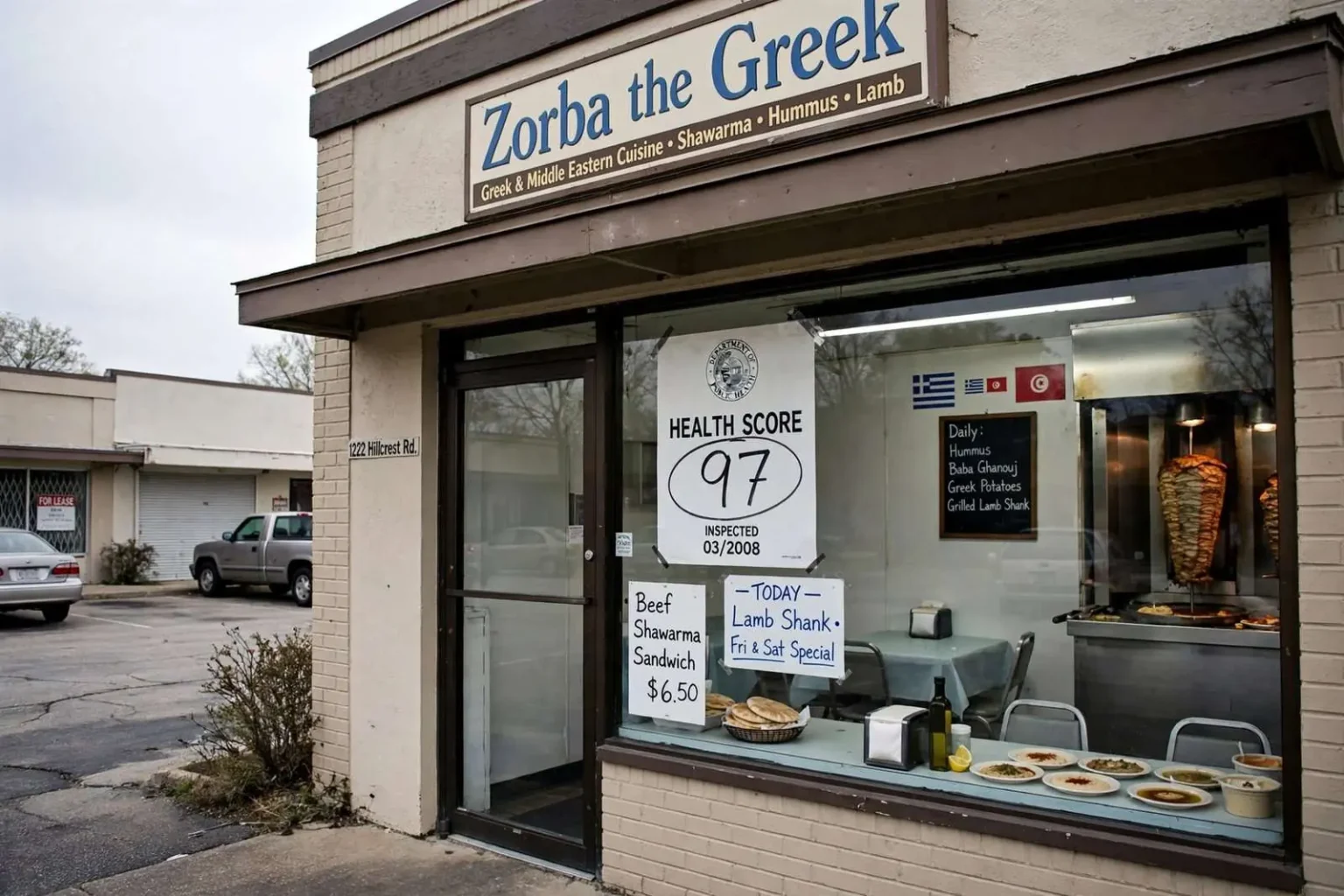
The restaurant sat at 1222 Hillcrest Road, just north of Grelot, in a small and unremarkable strip shopping center. The interior was plain. There was no ambience to speak of, and no attempt to manufacture any. What there was, in abundance, was food.
The Kitchen
The cooking was Middle Eastern and Greek, prepared by a gracious Greek woman working with obvious skill. The owner was Tunisian. He had worked at the Jericho Café on Old Shell Road before venturing out to open his own place a couple of years earlier — a decision that, for anyone who ate there, was Mobile’s gain.
The pairing was itself a small lesson in the region’s foodways. Middle Eastern kitchens and Greek kitchens overlap enough — the grilled meats, the lemon and olive oil, the mezze table of dips and breads — that a partnership between a Tunisian proprietor and a Greek cook could cover the whole map without either cuisine bending out of shape. The Jericho Café, where the owner had learned the local trade, was itself a fixture of Mobile’s Middle Eastern dining scene, and the move from a well-known Old Shell Road kitchen to a modest Hillcrest Road storefront followed a pattern familiar across the city: cooks who worked in established restaurants long enough to learn what a Gulf Coast audience would order, then opened their own rooms.
The beef shawarma sandwich was the standout: perfectly prepared, seasoned with real confidence, and better than the versions available at other Middle Eastern restaurants in west Mobile and downtown. It ranked among the best sandwiches in the city.
Shawarma is an unforgiving test of a kitchen. The meat marinates for a day or more in yogurt, lemon, garlic and spice, roasts slowly on a vertical spit, and is shaved to order — and every stage is visible in the sandwich, which has nowhere to hide an underseasoned batch or a slice carved too thick. Zorba’s version passed the test consistently enough to earn a claim on the title of best in Mobile, a city that in 2008 had no shortage of places turning out respectable versions of the dish.
Friday and Saturday nights brought lamb shank, which had developed a quiet following among local professionals who turned up on weekends specifically for it. The kitchen would also prepare a lamb dish with Greek-style potatoes on request. The lamb was Australian, which the owner insisted was the finest available.
The insistence was not eccentric. Australian lamb — grass-fed, consistent in size and age at slaughter — had by the late 2000s become the default import for American restaurants that wanted dependable quality at a workable price, and American and Gulf Coast production could not have supported a weekend lamb special at a small restaurant’s volume. The shank itself, braised until it gave up from the bone, was the kind of dish a small kitchen could execute to a very high standard: one cut, one method, done carefully every Friday and Saturday until word of mouth did the marketing.
The appetizers deserved attention on their own. The hummus and the baba ghanouj were both very good — the kind of dishes that are easy to make adequately and hard to make well.
Hummus and baba ghanouj reduce to ingredients and technique: chickpeas or eggplant, tahini, lemon, garlic, olive oil, and the judgment of when each element has gone far enough. A kitchen that takes shortcuts produces a bland paste; a kitchen that cares produces something diners order again on the next visit. Zorba’s passed that test, which told regulars most of what they needed to know about the rest of the menu.
One more detail, offered without apology: the health rating was posted conspicuously, and it was a 97.
The Argument Beneath the Review
What made the restaurant worth writing about was less the shawarma than what it revealed about the city’s appetite.
Mobile in 2008 was a place where the celebrated restaurants were, more often than not, celebrated for portion size. The prevailing taste ran toward quantity, and toward a handful of long-established institutions whose reputations had outlived their kitchens. A small, plain, immigrant-run restaurant serving carefully seasoned food in a strip mall was never going to win that competition, and Zorba’s made no attempt to.
The establishments the review took aim at — the overrated place on Halls Mill Road, the equally overrated one on Old Shell — were the kind of restaurants that survive on decades of accumulated goodwill: banquet rooms, regulars who had celebrated every anniversary of their lives in the same booths, and menus calibrated to the assumption that bigger would be read as better. Diners who worshipped at those altars were unlikely to enjoy Zorba’s. They would more likely end up at the Waffle House across the street. Anyone who valued food that was properly and adequately seasoned would find something worth returning for.
There was nothing snobbish in the argument. The review’s point was that Mobile already had the audience for careful cooking — the professionals who drove out for weekend lamb shank, the regulars who understood what a 97 health score posted in the window actually attested — and that the city’s restaurant conversation was failing to connect that audience with the kitchens serving them best. A strip mall address and a plain dining room cost Zorba’s the casual traffic that a glossier room would have harvested; what it kept was the diner who came back for the food.
What the Review Captured
Read now, the piece is a snapshot of a food scene in transition. Mobile’s dining culture in the late 2000s was still dominated by Gulf seafood houses and old-line steakhouses. The city’s Middle Eastern, Greek and Southeast Asian restaurants — many of them opened by immigrant families in exactly this kind of unglamorous suburban retail space — were beginning to build the reputations that would eventually make them destinations in their own right.
The Hillcrest and Airport Boulevard corridors, then regarded as somewhere to drive through, were where much of that cooking was happening. It took a while for the city to notice.
The geography matters. Airport Boulevard and its cross streets carried the postwar growth of west Mobile — shopping centers, schools, the hospitals and office parks that pulled the city’s center of gravity away from downtown — and the strip centers along those corridors became the natural, cheap habitat for family-run restaurants. Rent that a destination restaurant could not justify made a modest kitchen possible, and the car-dependent pattern of the corridors meant success came from regulars rather than foot traffic. The same economics produced both the anonymity and the quality: nothing spent on décor, everything spent on the plate.
The health score deserves its place in that story. Alabama’s restaurant rating system posts a numerical score from each health department inspection where diners can see it, and a 97 — posted conspicuously, as the review noted — placed Zorba’s near the top of the scale at a time when the strip-mall category was more often assumed to run the other way. The score was a small, public, verifiable piece of evidence for the review’s larger claim: that the unassuming room was run with more care than several of the institutions with the city’s affection.
Zorba the Greek has since closed, one of the many small restaurants that came and went along that stretch of west Mobile. But the standard it set — good ingredients, real seasoning, no pretense and a posted health score of 97 — was the right one, and the review that praised it holds up better than most.
Why It Still Matters
The restaurant’s disappearance did not disprove the argument; it completed it. The small independent restaurant is the most fragile institution in any food economy, exposed to rent, labor, the health of its founders and the sheer accident of location, and west Mobile’s corridors have absorbed and released dozens of them over the years. The ones that lasted did so on the loyalty of regulars, and a following built on a weekend lamb special and a shawarma sandwich could sustain a kitchen only while its founder chose to run it.
What the review preserved is the record that the standard was met. In a city whose dining reputation would, over the following decade, grow around exactly the qualities the piece praised — care, seasoning, value, rooms without pretense — the plain storefront at 1222 Hillcrest Road stands as an early proof of concept. The best food in Mobile, the review argued, was in a strip mall, and the argument has aged well.
The closure also says something about how such restaurants are remembered. Mobile’s food history lives less in its celebrated institutions than in kitchens like this one: family-run rooms that opened quietly, fed a neighborhood well for a few years, and vanished when their founders moved on. The Jericho Café lineage that produced Zorba’s — cook learns the trade in a respected kitchen, opens a plainer one, does the cooking better — repeated itself across Old Shell Road, Airport Boulevard and Government Street in every cuisine the city’s immigrant families brought with them.
For diners reading today, the practical lesson survives the restaurant. The signals that marked Zorba’s — a posted inspection score near the top of the scale, a menu short enough to execute with care, specials that follow the calendar rather than the marketing plan, and a room the owner can greet you from — remain the most reliable predictors of good cooking anywhere in the city. The review’s lasting claim was not that Zorba’s was Mobile’s best restaurant, but that Mobile had a way of overlooking its best when they came in that shape. It still does, which is why a plain room on Hillcrest Road earned the ink in the first place.