Could Surplus FEMA Trailers House the Steel Mill’s Construction Army?
With 29,000 construction workers expected for a $3.7 billion steel mill in north Mobile County, a former Mobile mayor floated an unusual fix: haul surplus FEMA trailers to a planned motorsports park near Prichard.
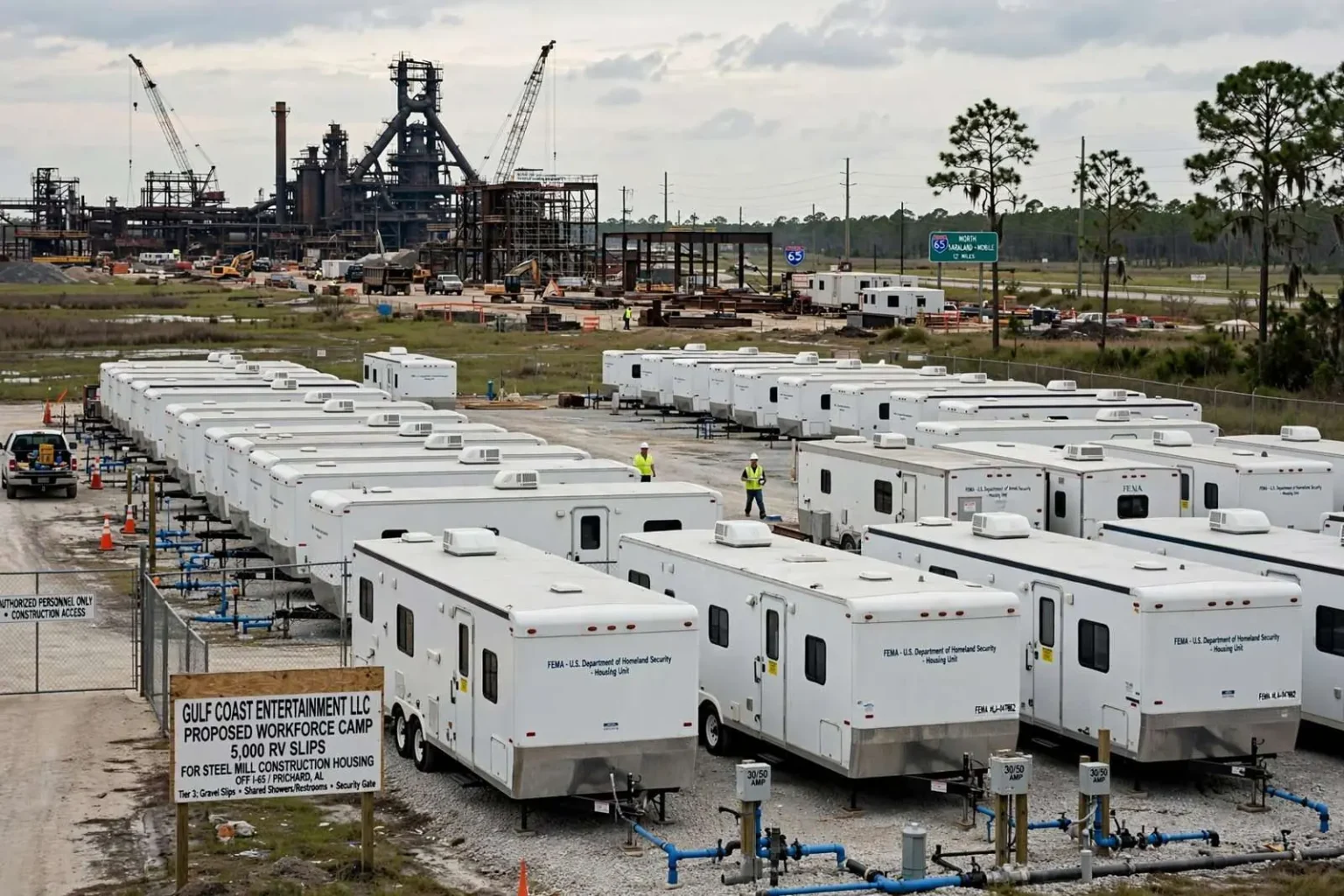
The arithmetic was daunting. A steel plant valued at $3.7 billion was headed for north Mobile County, and building it was expected to require some 29,000 construction workers. The region had nowhere near enough beds for them. Hotels could absorb executives and visiting engineers, and a scattering of apartment complexes could take a few hundred, but nothing in the Mobile area was built to shelter a temporary city the size of Prichard itself, deployed at once along the county’s northern edge.
Former Mobile Mayor Mike Dow, serving as spokesman for the proposed Alabama Motorsports Park, offered an idea with a certain scavenger’s logic to it: move a few thousand of the now-surplus Federal Emergency Management Agency trailers from the Katrina-battered Louisiana and Mississippi coast to the park’s planned site off Interstate 65, at Prichard near Saraland. “It’s a great idea,” Dow said, while cautioning that nothing was definite. The image was striking — emergency housing born of one disaster repurposed for the demands of an industrial triumph — and in the housing-strained Mobile of that moment, it sounded less like a gimmick than like the only plan on the table scaled to the actual need.
A park with 5,000 RV slips
The motorsports park, envisioned on roughly 3,000 acres and expected to open in 2009, was to be anchored by a Dale Earnhardt Jr. Speedway. The racetrack was the headline attraction, a facility its promoters believed could draw national events and put the north Mobile County site on the map. Less discussed, but central to the trailer proposal, was its plan for a 5,000-slip recreational vehicle lot — a small town’s worth of parking places, each one a potential bed for a construction worker who needed somewhere to sleep between shifts.
Plans called for three tiers of accommodation: 500 pull-through concrete slips, each with 30/50-amp electric service, water and sewer, gated and fenced for security and privacy, with a picnic area and grill and a shower house provided; 500 traditional concrete slips, likewise with 30/50-amp electric, water and sewer, gated and fenced; and 4,000 traditional gravel RV and camper slips with shared water and electric service, served by common bathrooms and shower areas. The tiering mattered. Race fans would come for a weekend and want the premium amenities; a welder on an eighteen-month project would take the gravel slip and a shared shower house and count himself lucky to have it.
The park also anticipated a convenience store, a clubhouse, a grassy outdoor common and a recreational lake, stocked with fish and large enough, developers hoped, to host national fishing tournaments. The lake in particular reflected the Gulf Coast habit of doubling every asset — a retention pond becomes an attraction, a parking lot becomes a campground. In the developers’ vision, the site would not sit empty between race weekends; it would hum year-round as a destination of its own.
Timing was everything
The steel plant was targeted to become operational in 2010, which meant the heaviest construction employment would fall in the years immediately ahead. If the park’s recreational vehicle sections could be built out on roughly the same schedule, Dow argued, the trailers could bridge the gap between housing demand and supply until the area’s market caught up. “With the start of this mill and the need for workers, sure, we’ve had discussions,” he said. “Obviously, it is an idea that could work and has a lot of merit.”
The obstacle was not enthusiasm but permitting. The park’s developers, Gulf Coast Entertainment LLC, had filed for U.S. Army Corps of Engineers permits, and Dow was candid that much of the schedule hinged on how quickly those came through, and on the excavation and engineering work needed to create the site. “A lot of our ability to do that type of thing depends on the timing of the Corps’ permit,” he said. “So much of this depends on the timing of permitting and the excavation work going on, the engineering work going on to create the site. We have to answer those questions first.”
Wetlands permitting along the Gulf Coast is rarely quick. A 3,000-acre development off Interstate 65 would touch creeks, drainage and habitat that federal regulators review inch by inch, and every month the permits waited was a month the RV lot could not be graded, piped or wired. The steel mill’s hiring timeline would not adjust itself for the park’s paperwork, and that mismatch — a fixed industrial deadline against an unpredictable federal calendar — was the quiet risk underneath the whole scheme.
The trailers themselves
The supply Dow had his eye on was the residue of an enormous federal purchase. In the aftermath of Hurricane Katrina, federal authorities spent some $2.6 billion on roughly 144,000 trailers and mobile homes to shelter displaced families and house relief workers along the Gulf Coast. The trailers had become one of the most visible and most criticized artifacts of the recovery — rows of white units parked beside ruined neighborhoods, occupied for months and years longer than anyone intended. By 2007 many of those units were no longer needed, and the General Services Administration had spent the previous year auctioning them off at steep discounts.
The government averaged $7,367 apiece on 2,665 trailers sold, against an average new price of $18,620. For any buyer with an eye on workforce housing, the arithmetic was as compelling as the region’s own housing shortage was severe: units built to federal standards, available at a fraction of replacement cost, sitting within a half-day’s drive of the site that needed them. The units had become, in effect, a national surplus problem, and Dow’s suggestion was to convert one region’s leftover emergency housing into another region’s industrial workforce housing.
A region straining at its own good fortune
The scale of the steel project had itself been moving. Initially pegged at $2.9 billion, its projected value was revised upward to $3.7 billion when company officials announced an expanded plan, citing exchange rates that made higher capacities and extended plant configurations feasible and economical. In plain terms, the dollar’s position against foreign currency meant the company could buy more plant for the same money — and build it in north Mobile County, where the site, the port access and the labor market all lined up.
That expansion was welcome news for a county that had spent years chasing industrial recruitment. It also sharpened a problem that would define the local conversation for the rest of the decade: the Mobile area had won the sort of investment it had long sought, and now had to figure out where to put the people who would build it. Roads, schools, sewer capacity and apartment supply all felt the pressure of a project that would employ tens of thousands before it employed anyone permanently.
The FEMA trailer proposal never became the region’s answer. But it captured the moment precisely, a Gulf Coast still sorting through the physical wreckage of one disaster while scrambling to accommodate the consequences of an economic windfall. The same interstate that had carried relief trailers west after Katrina would, in the proposal’s logic, carry them back east to house the builders of a new economy — a tidy circle that the region, for better or worse, never quite got to close.
Why the idea made sense to locals
For residents of Prichard and Saraland, the proposal cut both ways. Thousands of workers arriving in a community overnight would strain water, sewer and law enforcement, but they would also spend money at restaurants, stores and gas stations along the Highway 158 and Interstate 65 corridors. A managed campground — gated, fenced and operated by a single owner — was an easier proposition for local officials to evaluate than the alternative: the same workforce scattered into improvised housing across the county, in motels already full and lots where campers would park wherever a landlord allowed.
The episode also illustrated how Mobile leaders had learned to think after Katrina. The hurricane had taught the Gulf Coast that housing is infrastructure — that a region without beds cannot respond to emergencies or absorb growth, no matter how many big projects it wins. Dow, who had spent his mayoral years managing the city’s recovery politics, understood that lesson from the inside, and his pitch for the trailers was essentially Katrina’s surplus meeting Mobile’s deficit. That the two problems could solve each other seemed, for one news cycle at least, almost elegant.
Whether any version of the plan could have satisfied federal rules for the trailers’ use was never fully tested. Surplus federal property does not simply change hands on a handshake, and converting emergency units into commercial workforce housing would have raised procurement and standards questions of its own. But as a measure of how tight the region’s housing market had become before the first concrete pour, the proposal said more than any study could: Mobile was prepared to consider parking thousands of disaster trailers beside a racetrack because the alternative was a $3.7 billion project building itself without anywhere for its builders to live.