Shelby Vowed to Block Union Card-Check Bill, Citing Alabama’s Factories
Pointing to Mercedes, Honda, Hyundai and the new EADS facility in Mobile, Alabama's senior senator said he had cosigned a letter with enough signatures to stop the Employee Free Choice Act in the Senate.
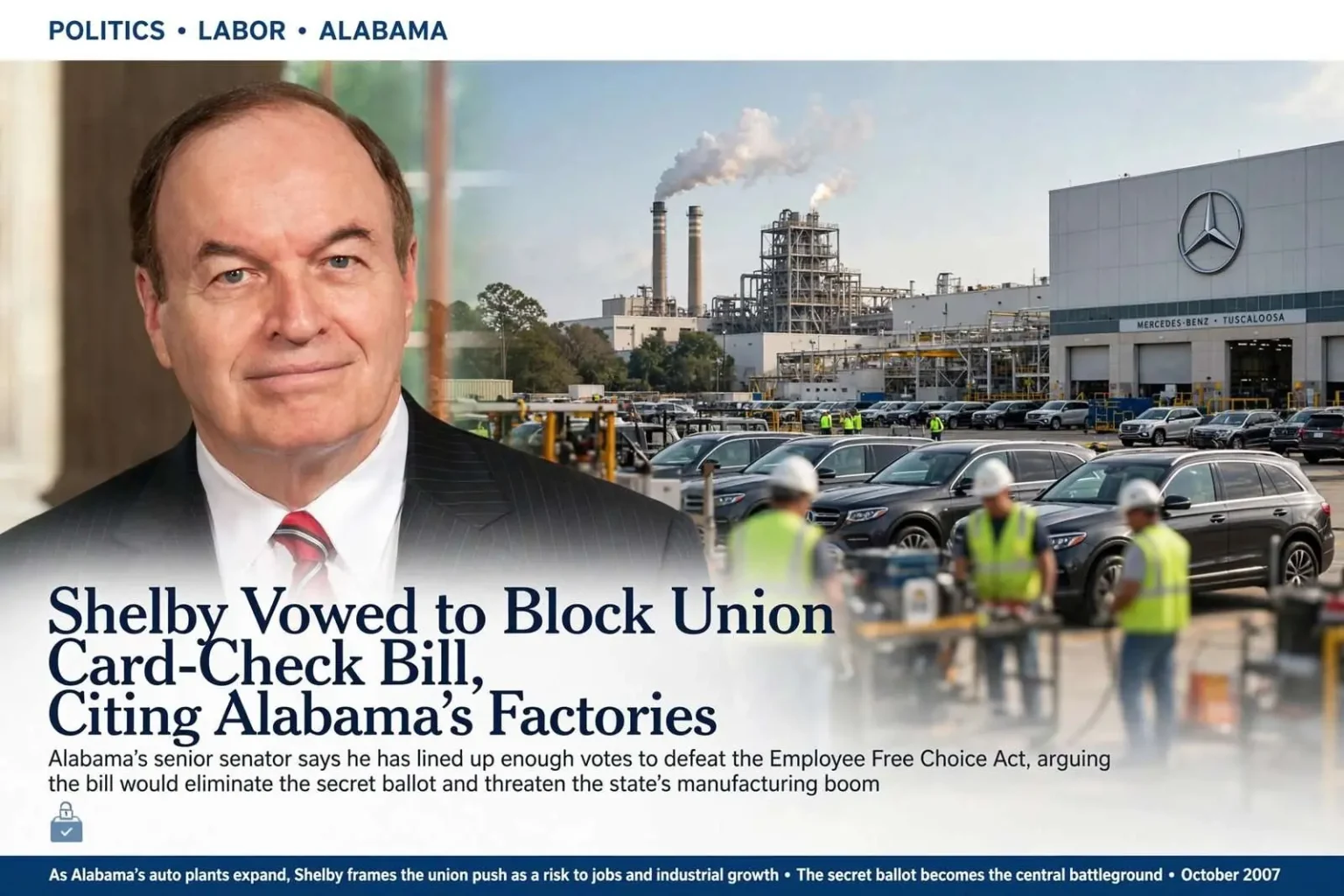
Alabama’s senior U.S. senator declared that he would not support the Employee Free Choice Act, the union organizing bill that had passed the U.S. House, and said he had already helped assemble enough Senate opposition to kill it. Sen. Richard Shelby framed his position around a single word: the secret ballot. The declaration put Alabama’s senior senator at the center of one of the most consequential labor fights in modern American politics, and it tied the fate of the bill — a top legislative priority for organized labor — to the economic story Alabama was then telling the world about its own factories.
Under the existing system, Shelby wrote, workers form unions through a process similar to how citizens vote for political candidates. Organizers may speak with workers and ask for their support in bringing about a vote to unionize, but employers and workers retain the ability to insist that the final decision be made by secret ballot. “This process removes any outside pressure from the ultimate outcome,” he said. The analogy to the voting booth was the heart of his case: whatever else divided the two parties on labor law, Shelby argued that the privacy of the ballot — a principle Americans extend to every other consequential vote — should govern the workplace as well.
The proposed legislation, commonly known as card check, would allow union organizers to ask workers to sign authorization cards in the open. Once a majority of a company’s employees signed, the union would automatically be certified as the bargaining agent for all workers, without a further election. “This legislation takes away workers’ voting privacy and exposes them to the outside pressure of the union organizers who are the distributors and collectors of the vote cards,” Shelby said. “Eliminating the right to a secret ballot is the antithesis of democracy and not an appropriate way for labor to organize.”
Supporters of the bill, it should be noted, made the mirror-image argument: that the existing election process gives employers weeks in which to campaign against a union, hold mandatory meetings and, in the view of organized labor, intimidate or dismiss union supporters, and that card check simply removes that window. Under this view, the long pre-election campaign period — with supervisors holding captive-audience meetings and, occasionally, illegally firing pro-union workers, penalties notwithstanding — is itself the pressure, and the signed card is the honest expression of worker preference. The two sides were not merely arguing about a mechanism; they were arguing about where coercion actually happens in an American workplace.
The Alabama economic case
Shelby anchored his opposition in the state’s manufacturing boom, which he said was the best he had ever seen. “Numerous new businesses have chosen Alabama to base operations over the past several years, bringing thousands of new jobs and keeping Alabama’s unemployment rate at or below the national average,” he argued, framing unionization policy as a question of economic competitiveness rather than workers’ rights alone. The boom was real and visible across the state: Mercedes-Benz’s Tuscaloosa County plant had grown from its 1990s debut into a full vehicle-making campus, Honda opened its Lincoln plant, Hyundai built its Montgomery assembly operation with a supplier network ringing the capital, and thousands of jobs flowed through the auto parts suppliers, steel processors and distribution operations that clustered around them.
Alabama’s appeal to those manufacturers rested partly on its right-to-work law, in place since 1953, which prohibits forcing workers to join a union or pay dues as a condition of employment, and on a labor climate that had delivered the state its largest industrial expansion in a generation. Shelby’s argument was that the Employee Free Choice Act threatened that formula: a law making union certification dramatically easier, in the view of its opponents, would raise the perceived risk of locating a plant in Alabama and chill the next decade of industrial recruitment. In a state where economic developers had spent two decades courting exactly the large manufacturers the bill’s critics most worried about, the argument carried weight with the state’s business community and its congressional delegation alike.
The senator’s positioning also reflected his own history. Shelby, a Democrat-turned-Republican who had built his career on federal spending for Alabama’s universities, infrastructure and defense installations, had long positioned himself as a guardian of the state’s economic interests in Washington, and labor law was a front where Alabama’s economic consensus — business-friendly, right-to-work, recruitment-focused — aligned cleanly with his party’s national position. His vow to block the bill in the Senate was a promise of legislative arithmetic: without cloture-proof support, no card check bill could reach a president’s desk, and Shelby said he had the votes assembled to see that it never did.
What the Employee Free Choice Act would have done
Beyond card check, the Employee Free Choice Act contained two other provisions that made it the most ambitious labor law rewrite in decades. It would have imposed binding arbitration on first contracts: if a newly certified union and an employer could not agree on a contract within a set period, an arbitrator would impose one, eliminating the tactic — common in union campaigns — of indefinite negotiations that never produce a first agreement. It would also have increased penalties on employers who violated workers’ organizing rights, raising the cost of the illegal firings and threats that organized labor said had become a routine feature of election campaigns. The bill, in other words, addressed the whole life cycle of a union drive: certification, first contract, and employer conduct during the fight.
The political history explains the bill’s shape. A version passed the U.S. House in 2007, but it stalled in the Senate, and labor leaders spent the following years pressing for stronger versions. Business organizations countered with a national campaign of their own, warning that card check would let organizers pressure workers into signing in public what they would never vote for in private. The phrase “secret ballot” became the battleground: polls consistently showed the public reacted strongly in favor of ballot privacy, which is why opponents centered their messaging there and why Shelby’s public case leaned so heavily on that single principle rather than on the arbitration or penalty provisions.
For Alabama specifically, the stakes were framed in factory terms. The state’s new manufacturing economy — the automotive campuses and their supplier webs, the expanding ports and aerospace work, the steel and paper operations that had anchored industrial Alabama for generations — represented billions in investment made under a known set of labor rules. Employers argued that changing the certification mechanism would make every future site-selection decision riskier, not just for new plants but for expansions. Union advocates replied that Alabama’s manufacturing wages and injury records showed exactly why workers needed the option of collective bargaining, regardless of what recruiters promised. The debate, in short, ran straight through the state’s self-image as a place where work was coming back.
The Senate arithmetic
Shelby’s claim that he had helped assemble enough opposition to kill the bill was a statement about Senate procedure as much as conviction. Major legislation needs 60 votes to overcome a filibuster, and the card check bill’s opponents counted enough senators — from the Republican caucus and from moderate Democrats in business-leaning states — to keep it from reaching that threshold. The senior senator’s role as a whip-counter for the opposition fit his seniority: on the Appropriations Committee and in the chamber’s Republican leadership circle, Shelby had both the standing and the relationships to help hold a caucus together on a vote of this magnitude.
The bill’s opponents did not have to defeat it outright; they had to prevent it from ever coming to a final vote, and public declarations of that intent were part of the strategy. A senator announcing in advance that a bill cannot pass shifts the calculations of wavering colleagues, who are then free to oppose a measure they never expect to have to defend on the floor. By stating publicly that the votes were already assembled, Shelby was both committing himself and giving cover to others — a routine but effective piece of Senate statecraft.
Organized labor’s counter-strategy was to shift the battlefield: if the Senate would not pass card check, unions would pursue administrative changes that could be made without Congress — narrower election windows, quicker certification votes, stiffer enforcement through the National Labor Relations Board — and would concentrate organizing resources on the sectors and regions where elections were already winnable. Alabama, with its right-to-work law and its recruitment-driven economy, sat on the difficult end of that map, which is precisely why the state’s senior senator made a public example of the fight.
Why it mattered in Alabama
The debate reached beyond the Senate into every Alabama community that had chased a factory in the previous twenty years. In Tuscaloosa County, where the Mercedes campus and its suppliers had transformed the local economy; in Lincoln and Montgomery, where Honda and Hyundai had done the same; in Mobile, where aerospace and shipbuilding anchored the industrial hopes of the Gulf Coast — local officials had staked their growth strategies on the state’s labor climate. A fundamental change to federal organizing law, either side’s version of it, would have been measured locally in payroll and property taxes long before it was measured in Washington.
Shelby’s vow, and the Senate arithmetic behind it, meant the Employee Free Choice Act would not become law in that Congress — and it did not. But the argument he crystallized outlived the bill: every subsequent federal labor-policy fight, from NLRB election rules to state constitutional amendments affirming the secret ballot, has replayed the same contest between the privacy of the vote and the conduct of the campaign that precedes it. Alabama’s position in those fights has remained where its senior senator planted it — defended at the national level, anchored in the factories the state spent a generation attracting, and framed, in the end, around that single word: the secret ballot.