First-Ever Alabama Manatee Rescue Ends in Loss, But Sparks Hope for Others
Volunteers and scientists carried out what is believed to be Alabama's first manatee rescue on the Magnolia River, though the animal later died.
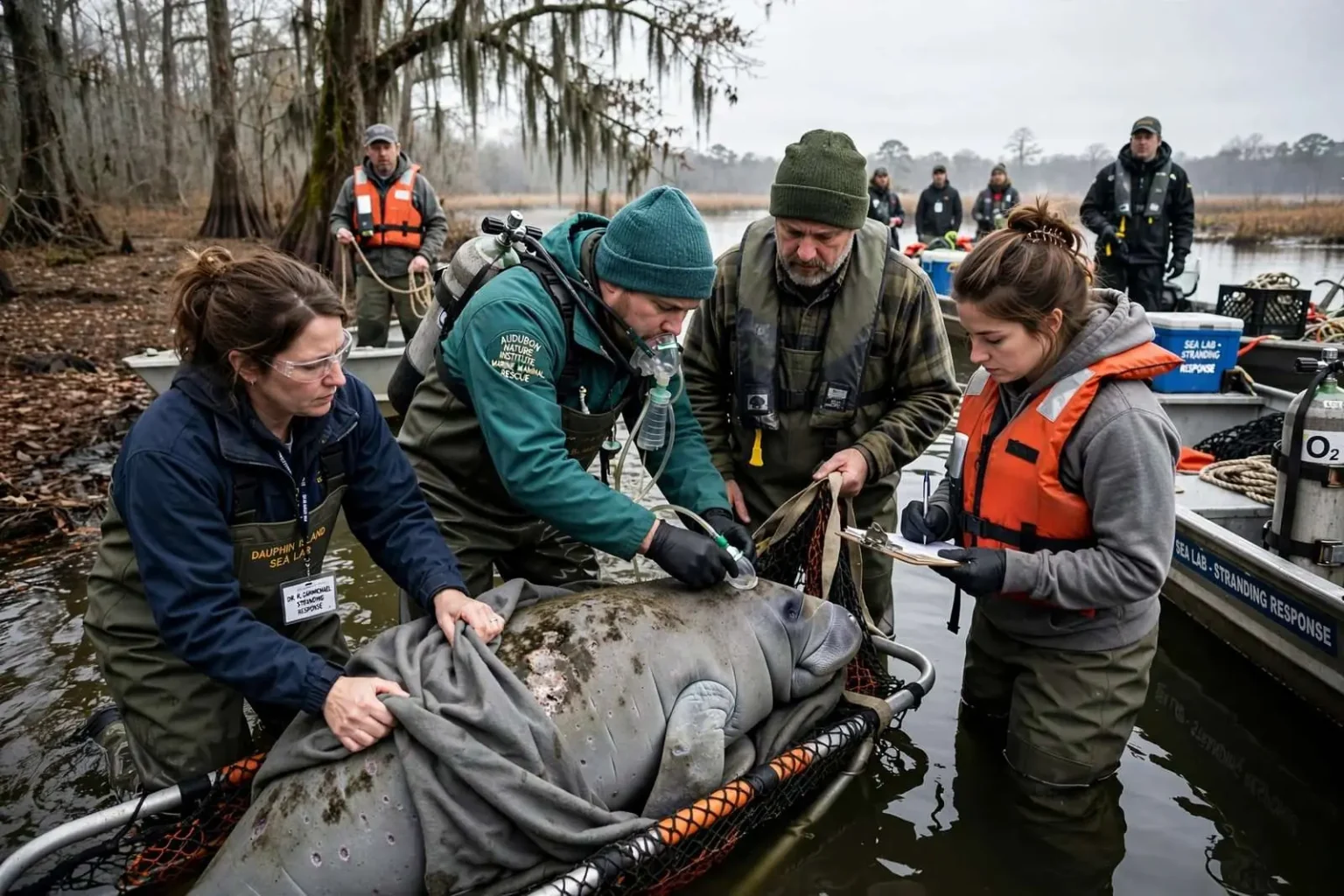
MAGNOLIA SPRINGS, Alabama — What is believed to be the first successful manatee rescue ever attempted in Alabama waters played out on New Year’s Day along the Magnolia River, drawing together marine scientists, veterinarians and dozens of local volunteers even though the rescued animal ultimately did not survive.
Residents in this quiet Baldwin County river community had noticed stranded manatees showing signs of cold stress — pitted, discolored skin — near a spring-fed area of the river known locally as the “Cold Hole” in the weeks before Christmas. Unlike most years, when manatees migrate to warmer Florida waters by mid-November, these animals lingered through the winter for reasons that remain unclear.
The sighting reports from the neighborhood along the river grew increasingly urgent as the calendar moved toward the new year, and they set in motion a response unlike anything local residents had witnessed on their waterway. Manatees are warm-water animals, and winter in south Alabama falls well outside the temperatures the species can tolerate for long. When the animals failed to head south with the season, the risk to them grew by the day.
Scientists and a Community Mobilize
Dr. Ruth Carmichael, who leads manatee sighting and stranding response for the Dauphin Island Sea Lab, said New Year’s Eve marked the first time the animals stayed still long enough near shore for a rescue attempt. The following day, a team that included sea lab technicians, an aquatic veterinarian and a marine mammal specialist from the Audubon Nature Institute in New Orleans worked alongside more than 20 community volunteers to net one of three manatees spotted in the area.
The rescue operation required coordination across state lines and institutions. The Dauphin Island Sea Lab, located on the eastern end of Dauphin Island, serves as Alabama’s marine education and research consortium and houses the state’s primary stranding response capability for marine mammals. The Audubon Nature Institute in New Orleans brought additional expertise in treating distressed marine animals, filling a gap for a species that Alabama rarely has occasion to rescue.
Just as important were the volunteers from Magnolia Springs itself, who provided the manpower, boats and local knowledge that made a netting operation possible in a narrow, spring-fed stretch of river. Residents had been tracking the animals’ movements for weeks and relaying sightings to scientists, turning an entire riverside community into an informal observation network.
A second rescue attempt hours later was unsuccessful after the net snagged on debris in the Cold Hole, a spring-fed basin roughly 30 feet deep, allowing that manatee to escape back into open water. The setback was a reminder of how difficult these operations are even under favorable conditions — dark water, submerged obstacles and an animal that can dive and evade make every attempt a race against time.
A Rescue That Ends in Loss
The first animal, meanwhile, was wrapped in blankets, given supplemental oxygen and loaded into a truck for transport to a Florida rehabilitation facility, but it died shortly after crossing the state line.
The loss underscored how far along the illness already was. Cold stress develops over days and weeks as a manatee’s body temperature drops: metabolism slows, the immune system falters, and the skin begins to show the pitted, discolored lesions that residents had observed on the Magnolia River animals. By the time a cold-stressed manatee is sick enough to be caught, the disease is often advanced, and even prompt treatment at a rehabilitation facility cannot always reverse it.
A necropsy performed back at the Dauphin Island Sea Lab confirmed severe cold stress, including open lesions across the animal’s underside consistent with a prolonged, serious illness. The examination gave scientists a clearer clinical picture of what the Magnolia River animals had been enduring and confirmed that the rescue team’s decision to intervene had been warranted — the animal they netted was gravely ill regardless of how the capture went.
Carmichael said the sea lab planned to continue monitoring the Magnolia River for the two remaining manatees in hopes of coordinating another rescue before conditions worsened. Each additional cold night, researchers knew, worked against the animals, and the team treated the remaining rescues as a matter of urgency rather than an open-ended watch.
Manatees in Alabama Waters
The episode highlighted both the vulnerability of manatees that stray into south Alabama’s cooler winter waters and the willingness of Baldwin County residents to mobilize on short notice to help protect wildlife long associated with Florida’s coastline rather than Alabama’s.
While Florida remains the heart of the West Indian manatee’s range, sightings in Alabama have become an established part of the species’ seasonal pattern. Manatees regularly enter Mobile Bay in the warm months, travel up the Mobile-Tensaw Delta and the rivers that feed it, and appear in the bays and rivers of Baldwin County, including the Weeks Bay system into which the Magnolia River flows. Researchers with the sea lab have documented the animals’ movements in Alabama waters for years, and Carmichael’s program has built the state’s response framework around the reality that manatees are now a regular presence on the Gulf Coast’s northern shore.
What winter presents is a different problem. Florida’s manatees survive the cold by gathering at natural springs and the warm-water outfalls of power plants, refuges that keep water temperatures well above what open Gulf or bay waters provide. Alabama lacks comparable numbers of known warm-water refuges, so manatees that linger here past autumn have few options when cold fronts push water temperatures down. Some individuals find their way to industrial outfalls or deep spring-fed pockets like the Cold Hole, but such spots offer only marginal relief in a sustained cold snap.
The species’ protected status adds another layer to any response. Manatees are protected under federal law, and handling a distressed animal requires trained personnel, specialized permits and coordination with wildlife agencies. That framework is what brought scientists from two states to a Baldwin County river for the New Year’s Day operation — and why residents’ reports, rather than any attempt at a DIY rescue, were the critical first step. Scientists regularly urge the public to report manatee sightings and strandings rather than attempt to help the animals directly, since improper handling can worsen injuries and delay professional care.
For Magnolia Springs, a community built around its river and best known for the springs that bubble up along its floor, the rescue effort became a shared civic experience. Dozens of neighbors gave up a holiday to haul nets, shuttle equipment and stand watch along the banks, working alongside scientists who had traveled from Mobile and New Orleans. The animal they helped capture did not survive, but the operation established something new: proof that a manatee rescue can be organized and carried out in Alabama waters, with local residents playing an essential role.
Sea lab researchers planned to keep watching the river in the days ahead, hoping the two remaining manatees could be reached in time. Whatever the outcome, the New Year’s Day effort is expected to shape how Alabama responds the next time manatees linger too far north, too far into winter — an event scientists consider less a matter of if than when.
The Magnolia River itself is a small, slow-moving waterway in southeastern Baldwin County, winding through the unincorporated community of Magnolia Springs before joining the Fish River and eventually emptying into Weeks Bay, a National Estuarine Research Reserve on Mobile Bay’s eastern shore. The area’s springs feed groundwater into the river year-round, keeping stretches of the channel cooler in summer — and, in winter, slightly warmer than the surrounding shallows. That characteristic almost certainly explains why the stranded manatees gravitated to the Cold Hole, hovering over one of the few sources of comparatively stable water temperature available to them in the river system.
Cold stress is among the leading threats to manatees, and it is the danger most closely tied to their northern wanderings. The condition is progressive: early signs include lethargy and the characteristic skin lesions, followed in severe cases by emaciation and secondary infections. Veterinarians treating cold-stressed manatees typically work to warm the animal gradually, restore its weight and address the lesions, a process that can take weeks at a dedicated facility. Florida’s network of rehabilitation centers, staffed by zoos, aquariums and marine parks, regularly admits such patients, which is why the rescue team’s plan called for truck transport across the state line rather than treatment in Alabama, which has no manatee rehabilitation facility of its own.
The New Year’s Day operation is expected to become a reference point for future responses. Every detail — how the netting went, what equipment worked, how the transport went, where the operation lost time — feeds into the growing playbook for manatee response in Alabama. What was once an improvised, first-of-its-kind effort is now a documented procedure that researchers can refine and repeat the next time manatees linger too far north into a Baldwin County winter.