Suspect Tied to Pensacola Woman’s Death Found in Baldwin County Dies in Prison
A man investigated in a Pensacola woman's 2012 disappearance, whose remains were later found in rural Lillian, has died in a Florida prison.
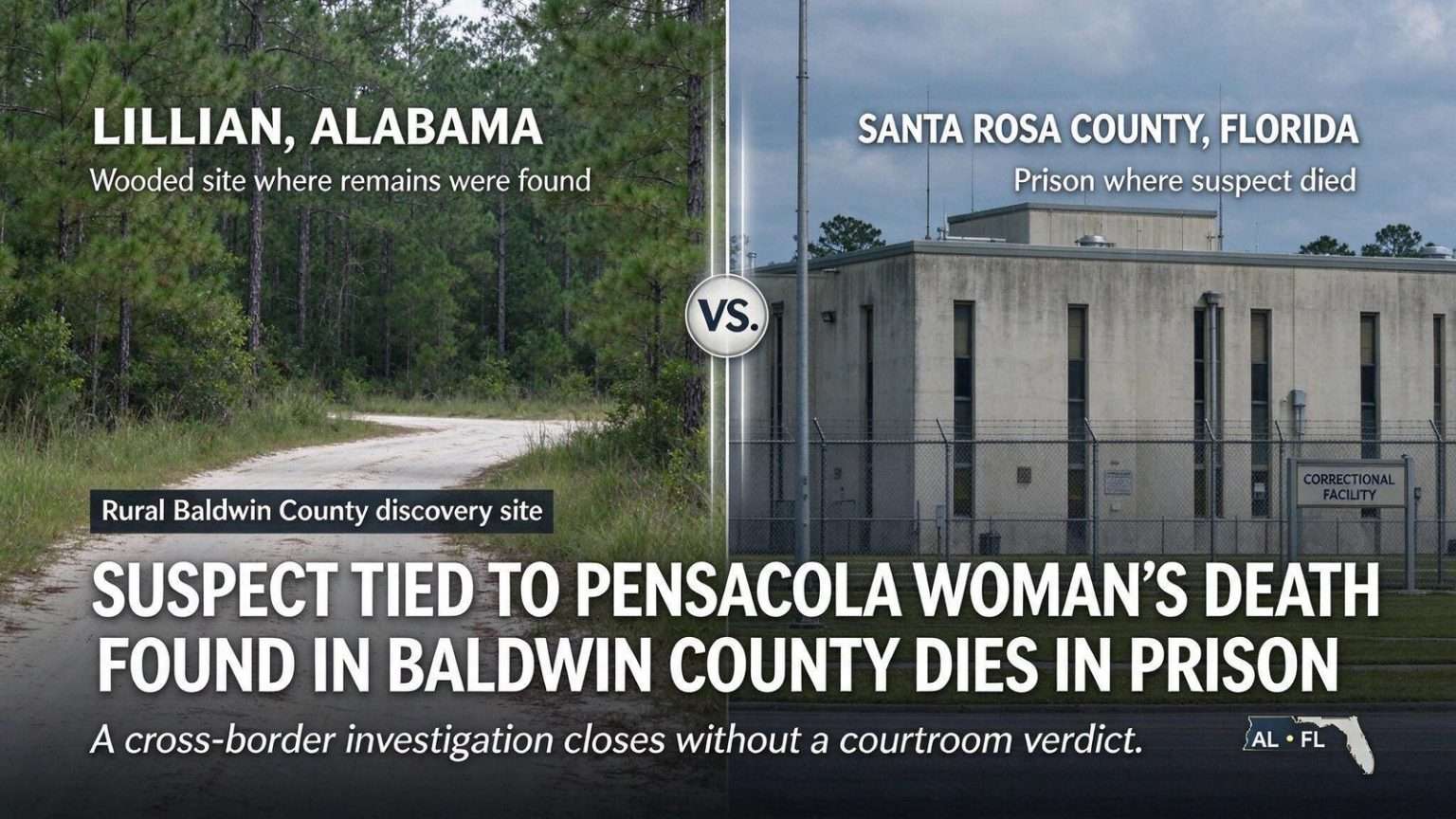
LILLIAN, Alabama — A man investigated in connection with a Pensacola woman’s death, whose remains turned up in a remote part of Baldwin County, has died by suicide while serving an unrelated prison sentence in Florida, closing out a case that had unsettled the community for more than two years. The death means the questions that haunted both sides of the state line will now be answered by a case file rather than a courtroom.
Archie Hauck had been serving a 20-year sentence in a Santa Rosa County, Florida, prison for violating probation tied to a 2009 aggravated assault case. His record with Florida authorities extended beyond that conviction: he had also pleaded no contest in 2011 to charges including aggravated assault, sexual battery, drug possession and impersonating a law enforcement officer. Officials confirmed his death in custody in late December but released few additional details, citing standard prison policy and the pending disposition of records.
Hauck had been under investigation by the Baldwin County and Escambia County, Florida, sheriff’s offices in connection with the 2012 disappearance of 55-year-old Nancy Craycraft. The case had stretched across two states from its first hours, drawing on investigators from both counties and keeping a list of open questions that neither agency could close alone.
The disappearance
Craycraft was last seen leaving a Pensacola nightclub with Hauck in October of that year. From the beginning, the timeline centered on that night: where the two went after leaving the club, what was said, and why Craycraft never resurfaced among the people who knew her. Investigators said Hauck later told them he had dropped her off elsewhere and had not seen her since — an account that never fully matched the evidence as it developed.
The disappearance went unsolved through the following year, with Craycraft’s family pressing for answers and detectives keeping the file active across jurisdictional lines. Cases like this one occupy difficult ground: no crime scene, no body and no confirmed sighting after a single night in a busy nightlife district. What the investigation had was a last companion, an account from him, and a family unwilling to let the case go quiet.
The discovery in Lillian
Two years later, two boys riding four-wheelers in Lillian, an unincorporated Baldwin County community near the Florida line, discovered skeletal remains in a wooded area. The find transformed the missing-person file into a death investigation almost overnight. The remains were later identified as Craycraft’s, according to authorities, and the wooded tract off the beaten path became the focal point for forensic work on both sides of the state line.
Lillian sits in the rural southern reach of Baldwin County, where dense pine woods, sandy cut-through roads and acreage parcels stretch toward Perdido Bay and the Florida border. That terrain can conceal what suburbs cannot, and investigators from both counties converged on the site, treating every detail of the discovery as potential evidence linking the location to the night Craycraft vanished.
The identification answered one question and sharpened the rest. If Craycraft had died in a wooded corner of Baldwin County, the account Hauck gave Pensacola investigators — that he had simply dropped her off and driven on — could not be squared with the location easily. Evidence recovered at the site, officials said, strengthened the connection between Hauck and Craycraft’s death, though what could actually be proved in court remained an open question.
A family’s push for a grand jury
Craycraft’s family had been pushing prosecutors to bring the case before a Baldwin County grand jury, hoping for a formal indictment against Hauck. For families in unsolved homicide cases, the grand jury request is often the last procedural lever — a way to force the accumulated evidence into a room where jurors can weigh whether charges should issue. The family’s campaign kept the case visible in both Pensacola and the Baldwin County communities along the line.
His death effectively ends the criminal case without a trial. Prosecutors cannot pursue charges against a deceased defendant, and no indictment now would have anywhere to go. The news landed with a particular weight for the family, who had spent more than two years pushing for a proceeding that will now never convene — a resolution that answers the question of guilt for no one but themselves, and only in their own minds.
The case drew attention on both sides of the Alabama-Florida line, illustrating how Baldwin County’s rural, wooded terrain near the coast has occasionally become tied to crimes connected to communities across the state line. The border counties function as a single region in daily life — shared commutes, shared nightlife, shared waterways — and criminal investigations follow the same geography. Pensacola’s courts and Baldwin County’s sheriff’s office each held pieces of this file.
How cross-border cases work
Investigations that span the Alabama-Florida line depend on cooperation between sheriff’s offices that answer to different states. Evidence collected in Baldwin County must be usable in Florida courts and vice versa; search warrants, forensic submissions and witness interviews all get duplicated across systems. In practice, the Escambia County and Baldwin County sheriff’s offices have long-standing working relationships, and multi-jurisdiction cases are common enough that each knows the other’s procedures well.
The border region’s geography explains the pattern. Perdido Bay, the Perdido River and the highway corridors between Pensacola and Baldwin County make crossing the line a matter of minutes, not hours. When a case involves people from both states — as this one did from its first night — investigators must build a single timeline out of records from two jurisdictions, and prosecutors must decide early where charges, if any, would be filed.
Prison deaths are investigated separately by the state agency that operates the facility, with an autopsy and review of circumstances that can take months to produce findings. The details released in this case were limited to the confirmation of death in late December, and further information would depend on the completion of those internal procedures and any public records that follow.
What closure can mean without a trial
When a suspected perpetrator dies before trial, families are left with a form of justice that stops short of adjudication. There is no verdict, no sentencing hearing and no public accounting of the evidence in a courtroom. Advocates for victims’ families say that absence can be its own burden — the record exists, but no official body ever declares what it means. Support resources for families of missing and murdered persons, including counseling and legal guidance, become the practical path forward.
The case file, however, does not disappear. Local investigators say the file will remain part of the record even though no trial will proceed, preserved with the evidence logs, forensic reports and interview summaries gathered over years of work. That matters for several reasons: files of this kind can answer questions for surviving family members through formal request, can inform other investigations that touch the same individuals or locations, and stand as the authoritative account if questions resurface later.
For Lillian itself, the episode was a reminder of the community’s place in the region’s broader story. The wooded land where the remains were found is characteristic of southern Baldwin County, where growth presses against undeveloped acreage and old family tracts. Residents who ride the cut-through roads and four-wheeler trails know that terrain intimately; it was two local boys, out riding, who ended a two-year search that professional investigators had been unable to close.
The case also joined a long regional pattern that investigators know well: people move fluidly between Pensacola’s entertainment districts and the Baldwin County communities across the line, and so do the problems that follow them. Sheriffs on both sides have built their cooperative procedures on exactly that reality, sharing intelligence on missing-persons reports that might cross the border within hours of being filed.
What remains now is the record. Two sheriff’s offices, a family that never stopped pressing, a wooded parcel off a Lillian road, and a file that will not be destroyed — that is the residue of a case that began with a nightclub door in Pensacola and ended in a Florida prison cell. For Nancy Craycraft’s family, it is less than a trial would have given them. It is, at least, no longer a mystery about where she was: the evidence recovered in Lillian had, as officials said, strengthened the connection between Hauck and her death, and that evidence stays on the record even as the case closes.
Missing-person cases that end in discoveries like the one in Lillian follow a hard timeline that families live through in real time. The first days are search and publicity; the months that follow are interviews, records pulls and dead ends; and a discovery of remains years later restarts the process under harsher circumstances. Detectives in such cases typically re-interview everyone from the original file, because the story each person tells must be reconciled with physical evidence that was never available before.
Forensic work on skeletal remains depends on condition and terrain. Recovery teams work the site methodically, mapping the location of every item before removal, because the position of remains and associated objects can support or undercut accounts given years earlier. Laboratory analysis of what is recovered can take additional months, and only then can investigators say with confidence what the site does or does not show.
The grand jury mechanism the family sought exists for exactly this stage. A Baldwin County grand jury hears the evidence in closed session and decides whether probable cause exists to indict. It does not decide guilt — only whether a trial should happen — but for families it is often the first moment the case is formally weighed by citizens rather than by prosecutors acting on their judgment about what can be proved.
His death removed the last step in that sequence. Under long-standing legal principle, the death of a defendant ends criminal prosecution; there is no one to charge, no one to try, and no judgment that could attach. Civil remedies against a deceased person’s estate are theoretically available in some circumstances, but they cannot substitute for a criminal verdict, and families in these situations rarely pursue them.
Regional investigators will tell you the border cases are among the most demanding they handle, and this one showed why. It began with a Pensacola nightclub, moved through a Florida prison system that held the only suspect, crossed into a Baldwin County pine stand for its decisive evidence, and ended with two sheriff’s offices holding a file that will never see a courtroom. The cooperation that carried it this far is the part of the story that will outlast the case itself.