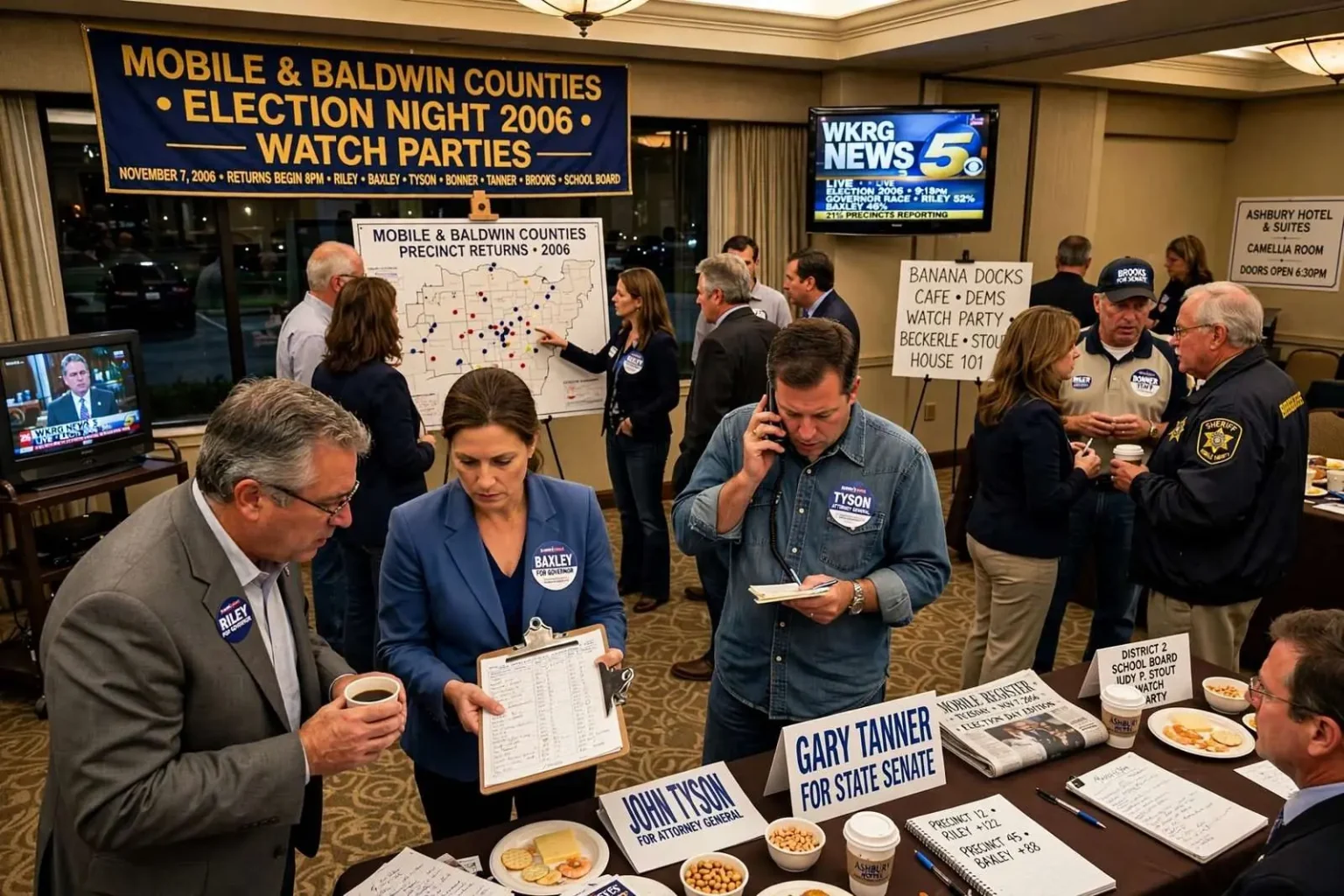
As voters across Mobile and Baldwin counties prepared to decide a full ballot of state and local contests on Election Day 2006, candidates finalized plans for the ritual that follows every campaign: the election-night watch party. Here is where the region’s hopefuls intended to gather as the returns rolled in on Tuesday night, from downtown icons to hotel ballrooms to a riverside restaurant south of the city.
Watch parties are a fixture of Alabama politics, part celebration, part command center and part support-group for exhausted campaign staffs. Volunteers who have spent months phone banking, block walking and waving signs at intersections gather with candidates to watch precinct-by-precinct totals come in, usually on televisions tuned to local news, with the mood shifting between cautious optimism and quiet dread as the map fills in.
Top of the ticket
Gov. Bob Riley scheduled a victory party for 6 p.m. at his local headquarters at 3702 Airport Blvd., next to the Lone Star Steakhouse. Riley, a Republican completing his first term, was seeking a second four-year term in a race that topped a statewide ballot that also included races for attorney general and a slate of down-ticket constitutional offices.
His Democratic challenger, Lt. Gov. Lucy Baxley, planned to gather with supporters at Wintzell’s downtown at 7 p.m. Wintzell’s Oyster House, a Mobile institution famous for its oysters and its walls papered with decades of folksy aphorisms, gave the Baxley gathering one of the most recognizable backdrops of any watch party in the state that night, and a fitting one for a candidate whose career in state politics stretched back decades.
Mobile County District Attorney John Tyson, a Democrat seeking to unseat Republican Attorney General Troy King, reserved the Camellia Room at the Ashbury Hotel & Suites on South Beltline Highway, with doors opening around 6:30 p.m. Tyson’s bid for attorney general was one of the most closely watched local angles on the statewide ballot, pairing Mobile’s longtime top prosecutor against the incumbent in a race with resonance for drug enforcement and public corruption cases across south Alabama.
Incumbent U.S. Rep. Jo Bonner, the Republican who represented southwest Alabama’s First Congressional District, planned a reception in the Mobile ballroom at the Riverview Hotel after the polls closed. The Riverview, overlooking the Mobile River and the city skyline, put Bonner’s gathering within sight of the port district his constituents watched him work on issues ranging from funding for the Port of Mobile to coastal priorities in Washington.
Mobile Democrats, meanwhile, organized a returns party at the Banana Docks Cafe at Hillcrest and Old Shell roads, where congressional nominee Vivian Beckerle and House District 101 hopeful Amy Beckerle Smith were expected. The gathering gave the county party a single venue where supporters of several Democratic candidates could watch results together rather than scattering across the city.
A bipartisan twist
In an unusual arrangement, Republican District 2 school board incumbent Judy P. Stout planned to mingle with Democrats at the Banana Docks, where her husband, Democratic Circuit Judge Rick Stout, would celebrate an unopposed re-election. With the judge facing no opposition on the ballot, the family’s election night effectively belonged to the school board race, and the couple’s choice to share one venue put a rare bipartisan stamp on the evening.
Judy Stout’s District 2 seat on the Mobile County school board covered a politically mixed stretch of the county, and school board contests in Mobile had carried extra weight in those years as the board navigated funding pressures, growth in the county’s suburbs and the ongoing demands of operating one of the largest school systems in the state. Sharing space with the county party’s gathering underscored the cross-party relationships that school board races tend to depend on.
Rep. Jamie Ison, defending House District 101, chose the home of Debbie and David White on Rochester Road from 7 to 9 p.m. Ison’s district took in a portion of Mobile, and her watch party followed the time-honored Alabama tradition of the house party, where a candidate’s closest supporters crowd around a television, trade precinct-level gossip and wait for the county’s totals to post.
The Senate and county races
State Sen. Gary Tanner planned to watch returns beginning at 6:30 p.m. at the Ashbury alongside Tyson’s team, giving the hotel’s meeting rooms a shared Democratic presence on a night when their fates were partly intertwined. Tanner, who represented a district anchored in Mobile County, faced a challenge from Mobile City Councilman Ben Brooks, a Republican.
Brooks gathered supporters at the Mariner Restaurant on Dog River, south of the Dog River Bridge, from 7:30 to 10 p.m. The Mariner, a longtime waterfront dining spot along the river’s western bank, gave the Brooks camp a scenic venue west of the city, in the heart of the Mobile neighborhoods his council district had made familiar ground.
Sheriff Sam Cochran, who had been appointed earlier in the year after Sheriff Jack Tillman’s resignation and was now seeking a full term, chose the Marriott on Airport Boulevard for his gathering. Cochran’s path to the ballot was itself a story of the year in Mobile County law enforcement: elevated from within the department to lead the county’s largest law enforcement agency, he now had to win the office in his own right within months of taking it over.
Tillman’s resignation earlier in 2006 had shaken the department and put the sheriff’s race under an unusually bright spotlight, with voters effectively deciding whether to ratify the appointment or turn to a challenger. Watch parties for sheriff’s races traditionally draw the department’s rank and file, deputies and investigators whose own workplaces are on the ballot in a way few professions experience.
What the map looked like statewide
The 2006 general election in Alabama carried national texture as well. It was a midterm year, with every one of the state’s congressional seats on the ballot along with the governorship and the full slate of constitutional offices. Mobile and Baldwin counties together formed the backbone of the First Congressional District, and turnout along the Gulf Coast was expected to matter in statewide totals as much as in local contests.
For candidates, the placement of a watch party is a small but telling piece of campaign craft. Venues signal identity: a candidate rooted in the business community gravitates toward a hotel ballroom, a candidate courting old Mobile chooses a landmark like Wintzell’s, and a candidate with a suburban base hosts at a supporter’s home. The spread of venues across Airport Boulevard, Beltline Highway, Dog River and downtown mapped the geography of the county’s politics in a single evening.
The night’s routine, from polls closing to the last precinct
Polls in Alabama close at 8 p.m., and the first hour after closing is usually the quietest, as curbside and absentee ballots are tallied and early precincts report. In statewide races, the early returns from north Alabama typically give way to the wiregrass and the coast as the night wears on, and Mobile County’s large precinct count means its totals arrive in waves well past 9 p.m.
Campaign staffs at watch parties track those waves closely. Volunteers refresh screens and printouts, operatives monitor competing campaigns’ public events, and local reporters work the room between phone calls to their editors. Candidates usually step out only once or twice — sometimes to thank supporters when the outcome is clear, sometimes to urge patience when the margin sits inside the range of provisional and absentee ballots still to be counted.
The venues themselves spent the day preparing. Hotels such as the Ashbury and the Marriott staged ballrooms with televisions and buffet lines, restaurants like Wintzell’s and the Mariner set aside rooms for private parties, and headquarters offices along Airport Boulevard cleared out folding tables to make room for crowds that had last gathered months earlier at campaign kickoffs.
Why watch parties matter
For all their social texture, watch parties serve practical purposes. They concentrate a campaign’s core supporters in one place for the announcement of victory or concession speeches, they give local television stations a ready-made backdrop for live hits, and they let candidates control the imagery of the night — the crowded room, the family on stage, the banner with the campaign’s colors — at the moment when public attention peaks.
They also close the loop on the volunteer effort. Canvassers who knocked doors in summer heat, students who staffed phone banks after class and retirees who stuffed envelopes for weeks get to see, in a single room, the scale of the operation they joined. Campaign veterans in Alabama will say the energy in a watch party room by 10 p.m. — triumphant, resigned or still waiting — is the truest reading of the night a candidate gets.
By the time the last precincts reported, the watch parties of Election Night 2006 would have sorted the region’s political future: a governor’s second term, an attorney general’s race with a Mobile prosecutor at its center, a sheriff’s office won in its own right, and a handful of legislative seats that would shape school boards, courts and county government for years to come. For one Tuesday night in November, all roads in Mobile politics led to one of these rooms.