Fallen Heroes Memorial at Battleship Park Nears Completion, Still Needs Funding
A long-planned 9/11 memorial at Battleship Park is on pace for a September dedication, but organizers say roughly $50,000 more is needed to finish it.
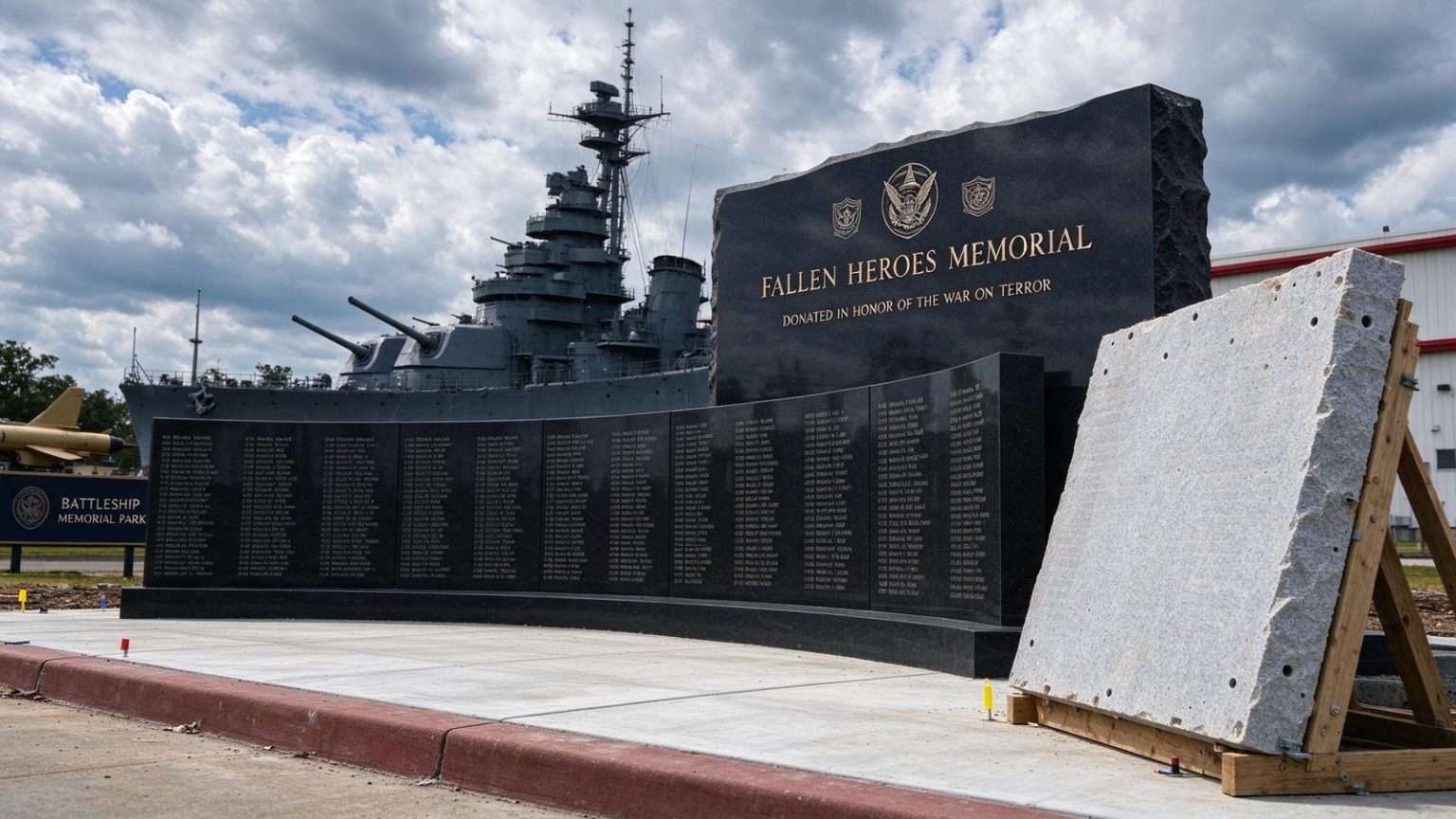
A memorial honoring those lost in the years since the September 11 attacks is taking shape at Battleship Memorial Park, with organizers aiming for completion in time for a dedication ceremony on the anniversary itself. Ground was broken on the Fallen Heroes Memorial in April, and construction is on track to wrap up by late August, according to the volunteer overseeing the project, leaving a narrow but workable runway between the last stone set and the September date the organizers have circled from the start.
As of mid-July, though, organizers said the effort still needed roughly $50,000 to close the funding gap, with the bulk of support so far coming from private donors rather than public sources. The fundraising shortfall is the last obstacle between a design conceived years ago and a permanent monument on one of the Gulf Coast’s most visited patriotic sites, and the volunteers behind it have been working both problems at once: construction by day, donations by every other means available.
The idea for the memorial dates back to 2007, when a local veteran and longtime advocate first approached the project’s lead organizer about creating a monument dedicated to those who have died during the War on Terror. At the time, it seemed premature to move forward. The conflicts in Iraq and Afghanistan were still active, the full scope of American losses was unknowable, and a monument built too early risked being incomplete the day it was unveiled.
As the conflict continued year after year, that calculus changed. “Coming to the realization that this is a war that will never end” shaped the design, the organizer said, explaining that the memorial was built with the ability to add names over time, even though no one wants to see that need arise. The concession to an open-ended war is written into the memorial’s physical form: a structure intended from the beginning to grow, should the fallen it honors continue to multiply after the dedication ceremony has ended.
The project’s lead organizer has personal ties to military service, having deployed to Iraq in the mid-2000s along the Syrian border. He has said he lost a Marine under his direct command during that deployment, along with several others he trained alongside earlier in his military career. For the volunteer overseeing the memorial’s construction, the work is therefore something more than a civic project: it carries the names and the memory of men he served with, led and lost, and the standard he holds the finished product to is the one set by the people it honors.
That personal stake runs through the decisions that have defined the project, from the choice of site to the design’s allowance for future names. A memorial organized by veterans tends to be judged by veterans first, and the Fallen Heroes Memorial has been built with an audience in mind that includes the families of the fallen, the service members still deploying, and the generations who will visit the park without having lived through the era the monument marks.
A Setting Among Heroes
Once complete, the memorial will stand as a permanent tribute at Battleship Park, one of the region’s most visited historic sites, alongside the USS Alabama and other military exhibits. The park on Mobile Bay already holds one of the most storied ships of the Second World War, the submarine USS Drum, aircraft from across the last century of American air power, and the memorials of earlier generations, which makes the ground the new monument occupies part of a continuum of remembrance reaching back to World War II.
Placing the Fallen Heroes Memorial in that company was a deliberate choice. The veterans of the War on Terror and their families will visit a site where the service of their parents and grandparents is already honored, and the school groups and tourists who come to see the battleship will encounter the newest chapter of American military history recorded in granite beside the oldest. The park’s administrators have long framed it as a living memorial rather than a museum, and the new monument extends that mission to the conflicts of this century.
The Final Push to September
Organizers say they hope the dedication ceremony this September will draw veterans, families of the fallen and members of the public from across the region. September 11 anniversary ceremonies already bring crowds to the park each year, and the dedication is designed to fold into that tradition, giving the annual observance a permanent centerpiece and giving the families of the War on Terror’s fallen a place of their own in the ceremony’s program.
Those interested in contributing to the memorial’s completion can donate through the USS Alabama Foundation, which is coordinating fundraising efforts alongside the project’s organizers as the September deadline approaches. The Foundation’s involvement ties the memorial’s fundraising to the same organization that maintains the battleship and the park’s other exhibits, and it gives donors a channel with the standing of an institution that has managed the site’s remembrance mission for decades.
The roughly $50,000 remaining as of mid-July represents the gap between what private donors have given and what the completed memorial costs, and the organizers’ reliance on private support rather than public funding has shaped the project’s pace as much as its design. Volunteer-led memorials rise on donated labor, donated services and the accumulated gifts of individuals and families, which makes every contribution in the final weeks directly visible in the finished work.
The schedule leaves little margin. Construction that wraps in late August must then survive the inspections, cleanups and small adjustments that always attend a finished monument, and the dedication ceremony on the September 11 anniversary requires the site to be presentation-ready, not merely complete. The volunteers managing both tracks, construction and fundraising, have been working toward the same date from opposite directions.
What the dedication will deliver is a promise kept twice over: to the local veteran who first proposed the idea in 2007 and was told it was too soon, and to the families whose names the memorial will carry, in a design built to carry the ones that follow. At Battleship Park, where the USS Alabama has anchored the memory of an earlier generation’s sacrifice since 1965, the newest memorial will take its place among the exhibits and monuments that make the site a destination for veterans and civilians alike, and the War on Terror’s fallen will finally have a permanent home on the Gulf Coast.
The design’s capacity to grow is its most consequential feature. Monuments to concluded wars can be sized to their casualty lists, but the War on Terror has produced American losses across two decades and multiple theaters, from Iraq and Afghanistan to deployments in Africa and the Middle East that continue today. A memorial that cannot expand would freeze its purpose in time; one that can accept new names acknowledges that the last full accounting has not yet been written, however much everyone connected to the project hopes it has.
The decade between the idea and the groundbreaking is itself part of the story. In 2007, the proposal asked a community to memorialize a war still being fought, an act that many considered an impossibility and others considered a discourtesy to battles still underway. By the time ground was broken this April, the intervening years had resolved the question differently: the war’s duration had become the argument for building, since a conflict without an end required a monument without a finished roll of honor.
Battleship Memorial Park draws visitors from across the Gulf Coast and beyond, school groups studying the Second World War, veterans returning to ships and aircraft they knew, and families spending a day among the hardware of American military history. The new memorial will join that landscape at the point where the park’s historical arc meets the present, and its presence will ask every visitor a question the battleship’s exhibits answer only for a earlier generation: what did the wars after September 11 cost, and who paid it.
The organizers’ hope for September is therefore both a ceremony and a beginning. A dedication on the anniversary of the attacks, on a site that already anchors the region’s observance, would make the Fallen Heroes Memorial part of how south Alabama marks September 11 for years to come, with the names of local fallen read in the shadow of a monument built to receive the ones that come after. Donations through the USS Alabama Foundation remain open as the deadline approaches, and the volunteers who have carried the project from a 2007 conversation to a construction site on Mobile Bay intend to see it finished by the date they chose: the anniversary itself.