University of South Alabama Mobile
Hundreds Gather at Fort Conde for Mobile’s Colorful Holi Festival
As many as 600 people covered each other in powdered color at Fort Conde during Mobile's celebration of the Hindu spring festival Holi.
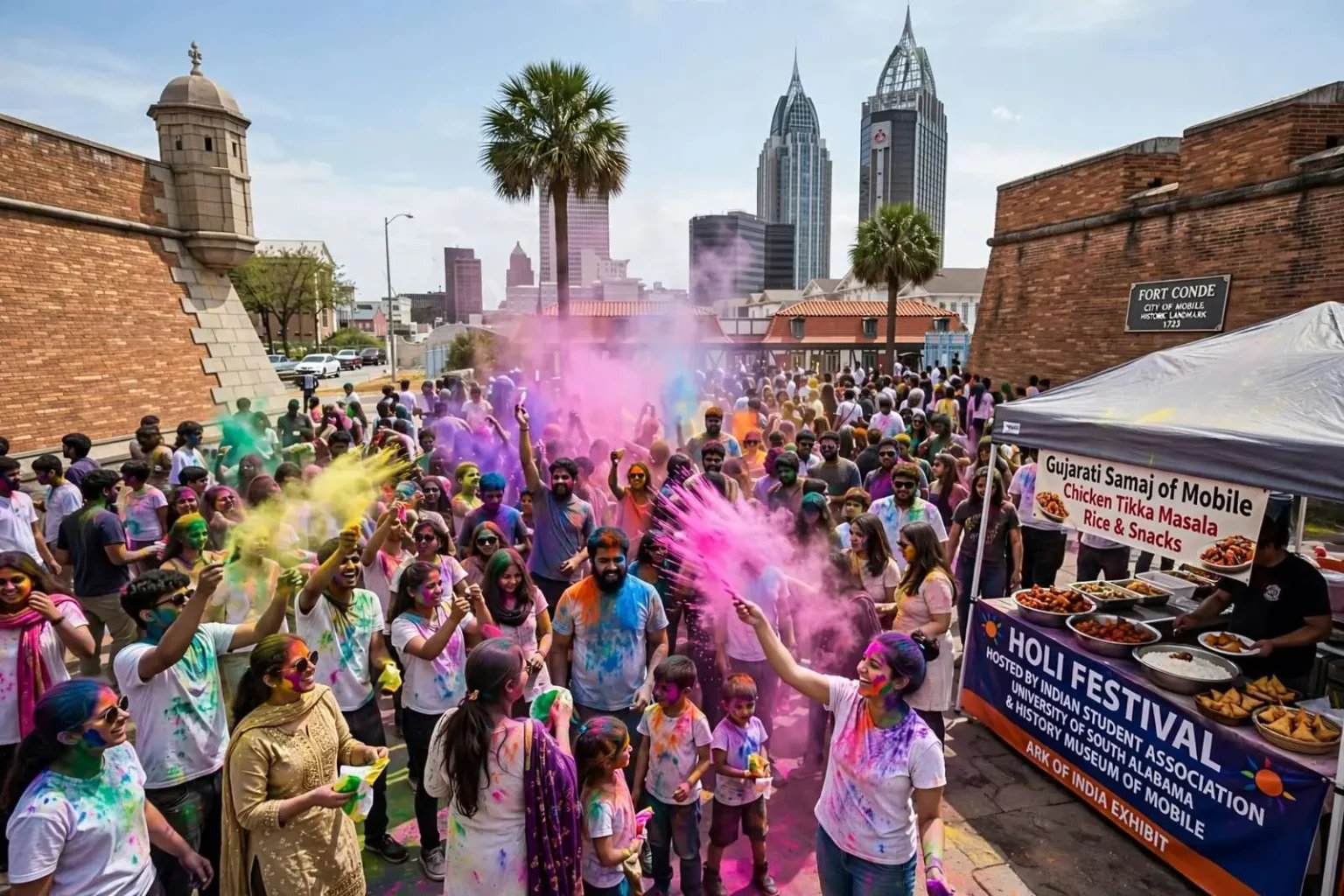
A burst of pink mist drifted through the air at Fort Conde on Saturday as an upbeat Indian song blared from speakers and a crowd of mostly young participants smeared each other with brightly colored powder to celebrate Holi, the Hindu festival of color. For a few midday hours, the reconstruction of Mobile’s colonial fort — the city’s most recognizable downtown landmark — was awash in green, blue, purple, orange and yellow, as a festival rooted in ancient India played out against a Spanish-era palm and a skyline of Springhill Avenue traffic.
The Festival and Its Meaning
Several dozen people gathered at the downtown Mobile landmark around midday, where organizers had set out containers of powdered paint in shades of green, blue, purple, orange and yellow. In India and other parts of South Asia, Holi traditionally marks the arrival of spring and the triumph of good over evil, drawn from an ancient Hindu parable, and the Mobile event aimed to bring that same spirit to the local community. The festival’s roots run deep in Hindu tradition — the story of Prahlad and the demoness Holika, in which devotion survives the fire that was meant to destroy it — and its modern form, with bonfires on the first night and color-throwing on the second, has become one of the world’s most recognizable celebrations.
The powder — traditionally called gulal — is the festival’s signature. What began as naturally derived colors has become, in the diaspora, a joyful free-for-all in which clothes are expected to be sacrificed, faces are tinted in every shade, and social distinctions that govern the rest of the year are briefly suspended. Holi’s opening-night bonfires carry the symbolic weight: the burning of Holika’s effigy represents the destruction of evil, and the color play that follows represents the renewal that comes after.
A Mobile Celebration With Deep Local Roots
The festival was organized by the Indian Student Association at the University of South Alabama along with the History Museum of Mobile, which used the event to help promote its “Ark of India” exhibit. Organizers said the celebration drew support from several local groups, including the Gujarati Samaj of Mobile and the Indian Association of Greater Mobile. The pairing was natural: the museum’s exhibit brought the history and artistry of India indoors, while the fort grounds outside hosted the living, colorful version — food, music and the crowd itself as exhibit.
Mobile’s South Asian community, anchored by families drawn to the city’s hospitals, university and engineering sector, has built a network of cultural organizations over the decades — the Gujarati Samaj and the Indian Association of Greater Mobile among them — that keep festivals, language classes and community meals on the calendar year-round. Holi has become one of the community’s most public events precisely because it invites participation: unlike a temple ceremony or a family dinner, the color-throwing is open to anyone willing to be tinted.
One returning attendee said this was his second year taking part in Mobile’s Holi celebration, and he described it as a welcome contrast to more commercialized color-themed events that have become popular around the country in recent years. For him, the festival was less about spectacle and more about a shared sense of hope and renewal tied to the changing season. The distinction matters to organizers of traditional celebrations: color runs and paint parties borrowed Holi’s most visible element, but the festival’s meaning — the arrival of spring, the renewal of relationships, the forgiveness of old grievances — is what the community’s version aims to preserve.
A Tradition Spreading Across the Country
The event’s president said Holi has grown into a tradition celebrated by multiple organizations throughout the Mobile area, reflecting the broader trend of Holi celebrations popping up in cities across the United States each spring, typically held in late February or March. What began as gatherings in campus quads and temple grounds has become a fixture on city calendars from coast to coast — large enough in some cities to require permits, stages and police details, and familiar enough that local news covers the color-throwing as a seasonal feature rather than a novelty.
That spread tracks the growth of the South Asian diaspora itself, but also the festival’s particular accessibility. Holi requires no tickets, no membership and no fluency in the tradition — only a white shirt and a willingness to join in. For second-generation families, the public celebration is a way to hand the tradition to children in a form they can share with classmates; for neighbors of other backgrounds, it is often their first direct experience of a Hindu festival, framed in colors and music rather than explanation.
Newcomers, Locals and the Meaning of Inclusion
One attendee, a relative newcomer to Mobile from San Francisco, said she learned about the event through a city newsletter and was surprised, though not disappointed, that turnout wasn’t larger than she expected. Snacking on chicken tikka masala served at the gathering, she reflected on what the event represented for a city like Mobile, saying it demonstrated that space for inclusion and cultural celebration exists locally. Her path to the fort — a city newsletter, a museum exhibit, a plate of food she recognized from the West Coast — traced the exact circuit organizers hope newcomers will follow into the community’s cultural life.
The food itself was part of the draw. Vendors and volunteers served the staples of North Indian cooking — the tikka masala, rice, and the fried snacks that accompany every Holi gathering — giving attendees a second way to participate alongside the color throwing. For the student organizers from the University of South Alabama, the meal and the music were as much the point as the powder: a campus association’s event succeeds when it feels like a celebration rather than a presentation.
The choice of Fort Conde reflected the same logic. The fort reconstruction — built in the 1970s on the footprint of Mobile’s original 18th-century fortification — sits at the gateway of the city’s museum district, within walking distance of the History Museum of Mobile and the city’s other cultural institutions. Hosting an Indian festival at a colonial Spanish fort, with a French-name city and a museum exhibit inside, made a quiet argument about Mobile’s layered history: the city that was French, British and Spanish before it was American is now, in its own way, a little bit Indian as well.
A Growing Fixture on the City’s Calendar
Organizers ultimately estimated that as many as 600 people took part in the festival throughout the day, filling the grounds of the historic fort with color, music and food as the celebration unfolded under the spring sun. The event has become one of several ways Mobile’s South Asian community shares its traditions with the wider city each year. Six hundred participants at a public cultural festival is a significant draw by any local standard — on par with the city’s established downtown happenings — and the estimate suggested the celebration has outgrown the “several dozen” who gathered at midday, with the crowd building through the afternoon as word of the color throwing spread across downtown.
The growth mirrors a pattern visible across the Gulf Coast. As universities, hospitals and industry have drawn international professionals and students to South Alabama over the past three decades, their communities have moved from private celebrations to public ones — Deepavali lighting ceremonies, cultural nights at civic auditoriums, food festivals that draw thousands. Each event that succeeds publicly makes the next one easier to stage, and the partnerships behind this one — a student association, a history museum, and the city’s cultural associations — represent the formula that works: campus energy, institutional space, and community sponsorship.
What Participants Took Away
For the students who did much of the organizing, the day was the culmination of weeks of preparation — securing the fort grounds, ordering powder and sound equipment, arranging food, and coordinating with the museum on the exhibit’s promotion. Campus cultural associations operate on modest budgets and volunteer labor, which makes a festival of this scale a considerable achievement, and one whose success will shape what next year’s version looks like.
For the attendees — the students in tinted white shirts, the families who came downtown for the afternoon, the newcomer from San Francisco with her plate of tikka masala — the festival delivered what its organizers had promised: a shared sense of hope and renewal tied to the changing season, staged in the heart of a city that has made celebration part of its identity. Mobile is a city that knows festivals — Mardi Gras is, after all, a Hindu parable away from being a similar story of community renewal — and on Saturday, Fort Conde hosted one more of them, this time in every color at once.
The pink mist will wash out of the fort’s brickwork with the next rain, and the containers of powder will be packed away until next spring. But the event’s place in the city’s calendar — as an annual gathering organized by the Indian Student Association and the History Museum of Mobile, supported by the Gujarati Samaj of Mobile and the Indian Association of Greater Mobile — looks increasingly permanent, one spring at a time.