Foley Parade Rallies Support for Baldwin County School Tax Vote
A Foley parade and rally drew school supporters ahead of a March 31 vote on an 8-mill property tax increase for Baldwin County schools.
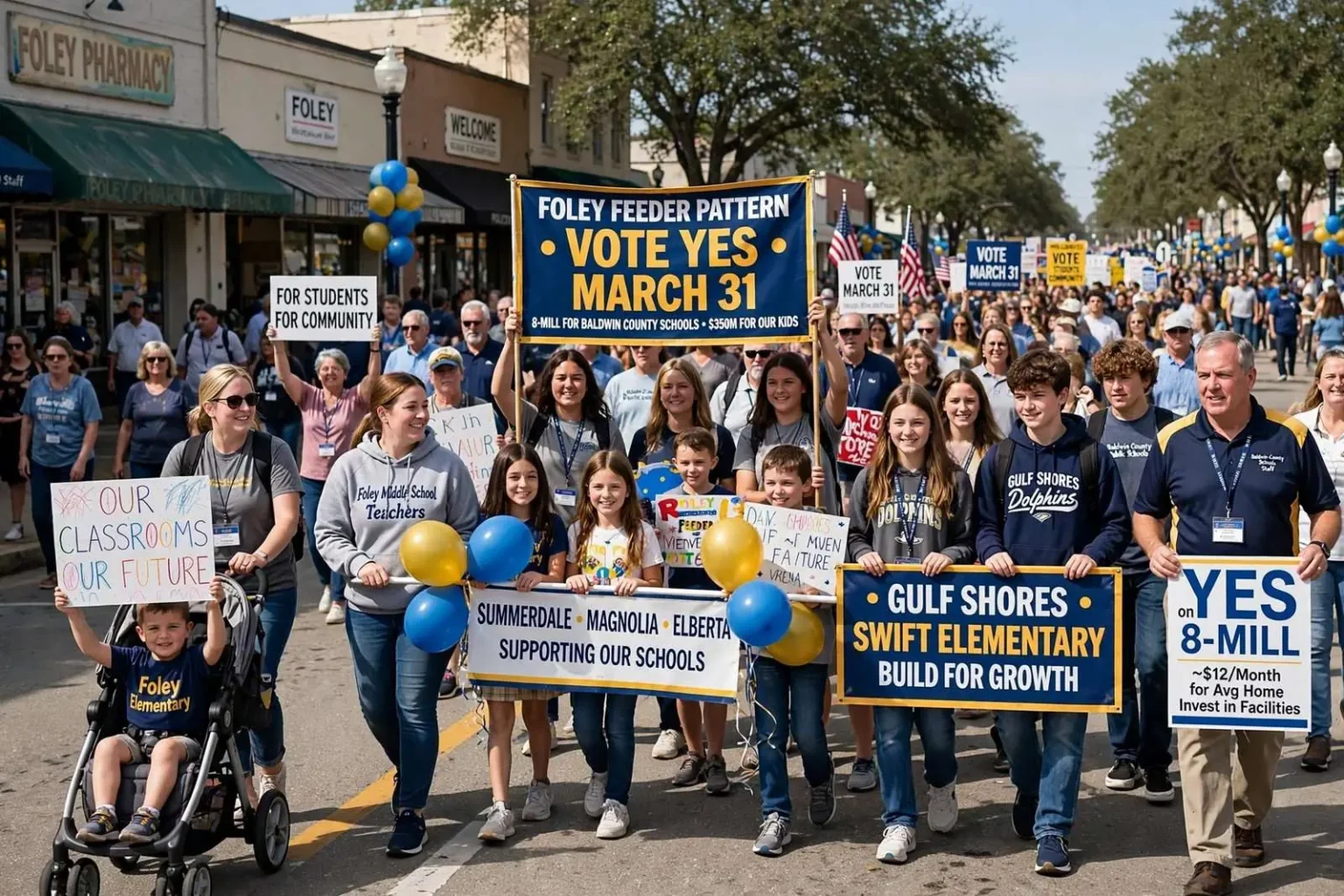
South Baldwin County residents took to the streets of Foley on Sunday for a parade and rally aimed at building support for an 8-mill property tax increase headed to voters on March 31, a measure designed to fund a $350 million capital campaign for Baldwin County Public Schools. The event brought the tax debate out of meeting rooms and into public view in one of the county’s fastest-growing areas, where school leaders say crowded campuses and aging facilities have struggled to keep pace with waves of new residents arriving along the Gulf Coast.
Students, parents, and school staff from across the Foley feeder pattern marched together, representing Foley Elementary, Intermediate, Middle and High schools, along with Magnolia School, Summerdale School, Elberta Elementary and Middle schools, Gulf Shores Elementary, Middle and High schools, and Swift Elementary School. The turnout gave the parade a distinctly local character: families pushing strollers beside teachers carrying school banners, and administrators walking alongside the same students whose classrooms the ballot measure would ultimately affect.
Baldwin County Public Schools Superintendent Robbie Owen said the event was designed to bring together supporters across south Baldwin County ahead of the vote. “We just want to pull together the Foley feeder pattern schools and supporters, parents and all other community members that want to promote the changes that we propose for the south Baldwin area,” Owen said, describing himself as “cautiously optimistic” about the outcome.
Owen’s caution reflected the uncertainty that has shadowed school tax measures across Alabama, where property tax increases require voter approval and historically face steep odds even in communities whose schools are visibly strained. School officials in Baldwin County have argued that the district’s rapid enrollment growth has outstripped the local tax base, leaving the system to choose between portable classrooms, rezoning, and new construction it cannot currently pay for.
Foley, sitting inland from Gulf Shores and Orange Beach along the U.S. 98 and Alabama 59 corridors, has become one of the centers of that growth. The city’s schools draw students from a wide swath of south Baldwin County, and the feeder pattern that stretches from Swift Elementary in the north down through Gulf Shores High near the coast is among the largest in the district. Organizers of Sunday’s event said they hoped that geographic reach would translate into votes on March 31.
The parade route and rally gave supporters a chance to make their case face to face with neighbors rather than through campaign mailers. For many of the students who marched, the event doubled as a civics lesson of sorts, showing them how a school funding question moves from a boardroom budget spreadsheet to a ballot question that their own parents will answer.
The price tag for homeowners
Baldwin County Board of Education President Norman Moore framed the tax increase as a modest ask for most homeowners. He said the owner of an average-priced Baldwin County home, valued around $185,000, would pay roughly $150 a year, or about $12 a month. “It’s a pizza,” Moore said. “It’s not very expensive. For those who have more pricey homes, God has blessed them and they should be able to pay a little bit more than the average.”
The arithmetic behind Moore’s figure follows the way Alabama taxes owner-occupied homes. Residential property is assessed at a fraction of its appraised value, and each mill of property tax equals one dollar for every $1,000 of assessed value. An 8-mill levy applied to the assessed value of a home in the range Moore described lands close to the $150-a-year figure supporters have been quoting at public events, which is why the board has leaned on the monthly framing in its pitch to voters.
Supporters say the money would flow directly into classrooms and campuses rather than administration, with the $350 million capital campaign directed at brick-and-mortar needs that accumulate quietly: additional classroom wings, new schools in growing corridors, roof and systems replacements on older buildings, and land purchases that expanding districts must make years before a campus opens. School leaders have described the campaign as the largest facility push the system has attempted, sized to match the growth projections the district has tracked for years.
Moore and other board members have emphasized that the burden rises with property value, meaning owners of higher-end homes and commercial property would shoulder a larger share of the revenue than the average homeowner. That structure, they argue, spreads the cost across the entire tax base — including the beachfront and retail properties that anchor the county’s tourism economy — rather than concentrating it on the families least able to pay.
Not everyone on the route agreed
Not everyone in the crowd agreed. Richard Medicus, a 63-year-old Foley resident, stood along the parade route holding a sign urging a “no” vote. He argued that even a modest dollar increase represents a 67 percent jump in the tax rate at a difficult economic moment for many families.
“There are a lot of people out of work that can’t pay for it, they can’t afford it,” Medicus said, adding that higher taxes tend to push businesses to raise prices as well. He said most people he had spoken with, particularly longtime residents, opposed the increase, though he acknowledged he was only one voice in the debate.
Medicus’s presence along the route underscored the political reality facing the measure: Alabama voters have historically been reluctant to raise their own property taxes, and the state’s reputation for low property taxation runs deep in communities like Foley, where many retirees and fixed-income residents settled precisely because the cost of living is comparatively low. Opponents of school tax measures in Baldwin County and elsewhere have repeatedly argued that school systems should redirect existing revenue or seek state and federal grants before asking homeowners for more.
The 67 percent figure Medicus cited reflects how even small-sounding millage increases can dramatically expand a rate that starts low. Because Alabama’s baseline property taxes are among the lowest in the nation, an 8-mill addition to an existing levy represents a proportionally enormous increase even though the dollar impact on a typical home remains modest. Both sides have used that same arithmetic to their advantage — supporters pointing to the pizza-a-month framing, opponents to the percentage jump.
For his part, Medicus said his objection was less about the schools themselves than about the economic moment. Rising insurance costs, grocery prices, and utility bills, he argued, had already squeezed household budgets across south Baldwin County, and a tax increase — however small on a monthly basis — would land hardest on the residents with the least room to absorb it.
A 30-year commitment to growth
Moore said the tax, if approved, would remain in place for 30 years and fund a 10-year school building plan, with the board anticipating continued growth in Baldwin County that will require new schools well beyond the current plan’s scope.
“We will continue to grow, and will need new schools 10, 15 or 20 years from now that we can’t even predict right now,” Moore said, calling it a long-term investment rather than a short-term fix.
The 30-year horizon is among the most debated features of the measure. Supporters say long-term financing is the only realistic way to pay for campuses, which take years to plan, buy land for, and build, and which are expected to serve students for generations. Long timelines also let the district borrow at better rates, since bonds backed by a dedicated tax stream carry lower costs than short-term borrowing. Critics counter that committing taxpayers for three decades locks in a levy that future boards could redirect, regardless of how conditions change.
District officials have pointed to the pace of rooftops rising across south Baldwin County — subdivisions filling in along the Foley, Summerdale, Elberta and Gulf Shores corridors — as evidence that the growth the plan anticipates is not hypothetical. Every new roof, they note, brings new students, and new students bring the same choice every fast-growing district eventually faces: build ahead of the wave or scramble behind it with portable classrooms and rezoning fights that divide neighborhoods.
Elementary campuses in the feeder pattern have felt that pressure first, since enrollment surges typically show up in the earliest grades before rippling upward through intermediate, middle and high schools. By planning a decade out, board members argue, the system can sequence construction so that capacity arrives before the crowding does, rather than after parents have already watched class sizes climb.
If voters say no
Board members have said that if voters reject the tax increase on March 31, the school board plans to regroup and seek input, including from opponents, on alternative solutions to the district’s facility needs.
That pledge amounts to an acknowledgment that the underlying problem — too many students, too little classroom space — will not disappear with a failed vote. District leaders have not detailed what those alternatives would look like, but the options typically available to Alabama systems in that position are limited: shift students through rezoning, extend the use of portable classrooms, redirect operating money away from instruction and toward construction, or return to voters later with a revised ask shaped by the feedback of those who said no the first time.
Inviting opponents into that conversation, as Moore and the board have promised, is a less common step. It suggests campaign leaders recognize that the opposition is not a fringe but a substantial bloc of the county’s electorate, including longtime residents like Medicus who turned out along the parade route to make their case in public rather than simply marking a ballot in private.
The March 31 election will be decided by voters across Baldwin County, though the campaign event in Foley underscored where much of the early organizing energy sits. School officials have spent the weeks leading up to the vote making the same basic argument at civic clubs, school events and public forums: the county is growing, the schools are the county’s largest public responsibility, and the cost of building for that growth only rises the longer the decision is deferred.
For the students, parents and staff who marched Sunday, the message of the day was simpler. The parade was staged not as a celebration of a completed project but as the opening argument in a campaign that will run until Election Day — a visible reminder that behind the millage figures and salary-line budgets are the campuses where south Baldwin County’s children spend their days, and a community being asked to decide how those campuses should look for the next thirty years.