Baldwin County School Tax Referendum Draws Heated Debate at Commission Meeting
Baldwin County residents clashed over a $350 million school tax referendum during a heated county commission meeting.
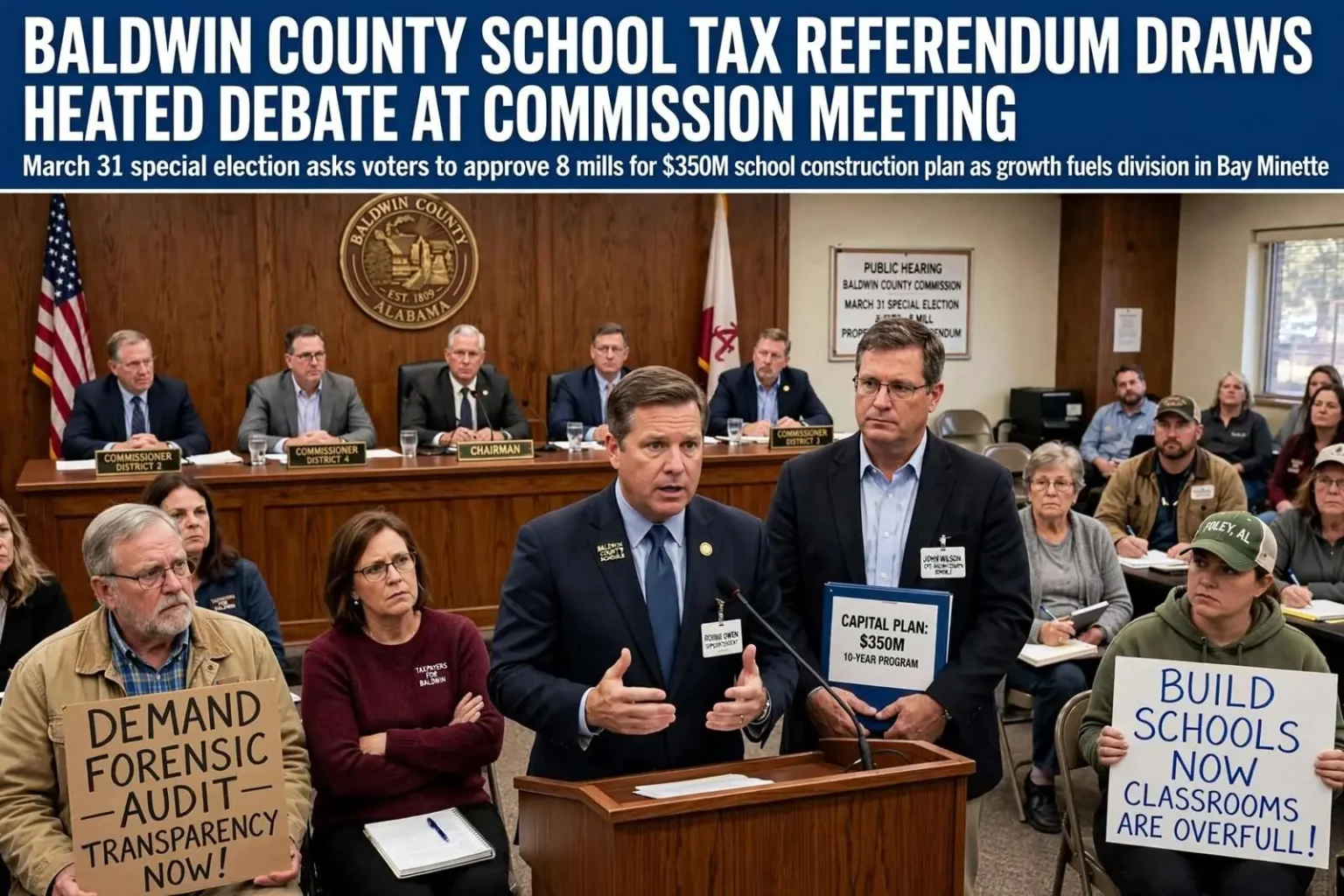
A proposed property tax increase to fund a major expansion of the Baldwin County School System drew sharp disagreement at a recent county commission meeting, with opponents accusing school officials of withholding financial information and supporters warning that classrooms can’t keep pace with the county’s growth. The public hearing in Bay Minette turned into a preview of the campaign ahead, with both sides making their cases in front of the county commissioners who called the session.
The March 31 special election asks voters to approve an additional 8 mills of property tax, along with renewing an existing 7 mills, to help fund a $350 million, 10-year school construction and expansion program. The combined measure represents the largest school funding ask in Baldwin County history, aimed at building new schools and expanding existing ones across a county whose student population has been climbing for years.
Baldwin County Schools Superintendent Robbie Owen and Chief Financial Officer John Wilson defended the plan during the hearing, arguing that enrollment growth in one of Alabama’s fastest-growing counties leaves the district little choice but to build. The school system, which stretches from Spanish Fort and Daphne on the Eastern Shore to Gulf Shores and Foley on the coast and westward to communities along the Mobile Bay causeway, has watched residential development fill in formerly rural areas and bring thousands of new students with it.
Portables have become a familiar sight on Baldwin County campuses, and school officials have used them — along with rezoning and shifting attendance lines — to buy time as classrooms overflow. The district’s argument is straightforward: the county can either build schools ahead of the growth, or continue to absorb it in temporary classrooms while costs rise and the overcrowding spreads from the fast-growing Southern Athletic and coastal zones into previously stable ones.
Critics who spoke during the hearing said they don’t trust school system leadership and called for a halt to the referendum until more financial details are shared publicly. Some residents asked commissioners to request a forensic audit of the school system before any vote takes place, a demand that reflects a broader strain of skepticism toward public institutions that has colored local politics across the county in recent years.
The opposition’s case
One Foley resident said solutions should include pausing the process entirely and giving the public a fuller picture of the proposal’s costs and benefits. The comment captured a recurring theme from opponents: not necessarily a rejection of school construction itself, but an insistence that voters see detailed budgets, project lists and financing plans before being asked to approve a decade-long tax commitment.
Several opponents voiced frustration over the tax burden itself, arguing that virtually everything they own is already taxed and that they feel pressured to approve more spending in the name of their children’s education. Speakers described fixed incomes, rising assessments and a steady accumulation of fees and levies at every level of government, pushing back against the suggestion that Baldwin County’s relative affluence makes additional taxation painless.
Others pushed back on comparisons to counties with higher millage rates, arguing it isn’t fair to point to places like Jefferson County or Huntsville, where property tax rates run considerably higher than Baldwin County’s. The comparison debate has become a fixture of the referendum discussion: school officials cite the county’s low rates relative to the rest of the state, while opponents counter that Baldwin homeowners pay substantial absolute amounts because of rising property values and that comparisons to Birmingham’s historic industrial tax base miss the point.
The forensic audit demand puts the county commission in a delicate position. Commissioners have no direct authority over the school board’s finances, but they control the mechanism for calling the special election, and speakers made clear they expect the commission to use whatever leverage it has to extract greater transparency from the school system before the March 31 vote.
Wilson, the chief financial officer, has been the district’s chief messenger on the numbers, and he told the commission that the school system’s millage remains among the lowest in the state even with the proposed increase factored in. The district’s financial presentation walks through the revenue the combined 15 mills would generate and the capital program it would fund, from new school construction in the county’s fastest-growing districts to renovations of aging campuses elsewhere.
How the millage math works
Baldwin County’s current rate of 12 mills would rise to 20 mills if the referendum passes, still below Mobile’s city tax rate of 29.5 mills and the county’s rate of 21.5 mills, according to officials. A mill is one dollar of tax per thousand dollars of assessed value, and in Alabama, property is assessed at a fraction of market value for most owners, which is why millage comparisons across county lines require careful reading.
The structure of the ballot question matters as much as the headline numbers. The 7 mills on the table for renewal are already being collected, meaning their continuation does not add to current tax bills; the new 8 mills represent the actual increase. District officials have stressed that the renewal portion funds existing obligations, and that letting it lapse would force cuts or borrowing even before any new construction begins.
The $350 million program would be spread over ten years, with projects sequenced according to where growth is landing hardest. The Eastern Shore communities of Daphne and Spanish Fort, the Gulf Coast corridor through Foley and Gulf Shores, and the rapidly developing central areas around Fairhope and Robertsdale have all seen the kind of residential build-out that translates directly into school enrollment, while schools in slower-growing parts of the county need renovation rather than expansion.
What’s at stake for the county
Baldwin County has been one of the fastest-growing counties in Alabama and, by some measures, in the Southeast, drawing retirees, families and workers attracted by the coast, the beaches, and proximity to Mobile’s job market. That growth fuels the county’s economy, but it also delivers bills — for roads, public safety, water and sewer, and schools — that arrive years before the tax base fully catches up. The referendum has become the defining test of how the county chooses to pay for that growth.
Business leaders have largely lined up behind the measure, arguing that the quality of the school system is inseparable from the county’s ability to keep attracting the employers and residents who drive its prosperity. Companies weighing relocations routinely ask about school capacity, and industrial recruiters note that a district operating in portable classrooms sends a different message than one building modern campuses ahead of demand.
Opponents, for their part, question whether the district has pursued alternatives: impact fees on new development, partnerships with municipalities, phasing the construction program rather than committing to a decade at once. Those questions have not produced a unified alternative plan, but they have kept pressure on school officials to justify the scope of the ask.
Between now and the March 31 vote, both sides will take their cases into civic clubs, church halls and social media across a county that spans dramatically different communities — from the wealthy Eastern Shore subdivisions to the fishing towns of the bay and the farm country of the north. The county commission’s hearing offered the first full airing of the arguments, and the tone of the exchange suggests a campaign that will be fought hard on both sides.
Enrollment data underlies the entire debate, and both sides cite it. District officials point to the steady climb in student counts across the system and projections showing continued growth as Baldwin County’s population expands, while skeptics note that some individual campuses have stable or declining numbers and ask why building cannot be targeted more precisely. The district’s capital plan assigns projects by zone, but opponents want that breakdown published in greater detail before the vote.
The special election timing itself has drawn comment. A March 31 ballot, coming at a date set by the county commission rather than a general election, means turnout will likely be driven by the most motivated voters on each side — school supporters organized through parent networks and business groups, and tax opponents activated through property rights and taxpayer associations. Both campaigns are expected to invest heavily in turnout operations as much as persuasion.
Whatever the outcome, the hearing in Bay Minette established the lines of the fight: a district citing growth and low millage against a coalition demanding audits, transparency and restraint. Baldwin County voters will decide on March 31 whether their school system gets the largest building program in its history — and how a county growing as fast as any in Alabama chooses to pay for its own success.