Hundreds Turn Out for Mobile’s First Comprehensive Planning Forum in Two Decades
More than 400 Mobile residents attended the first public forum for Map for Mobile, the city's first comprehensive plan in over 20 years.
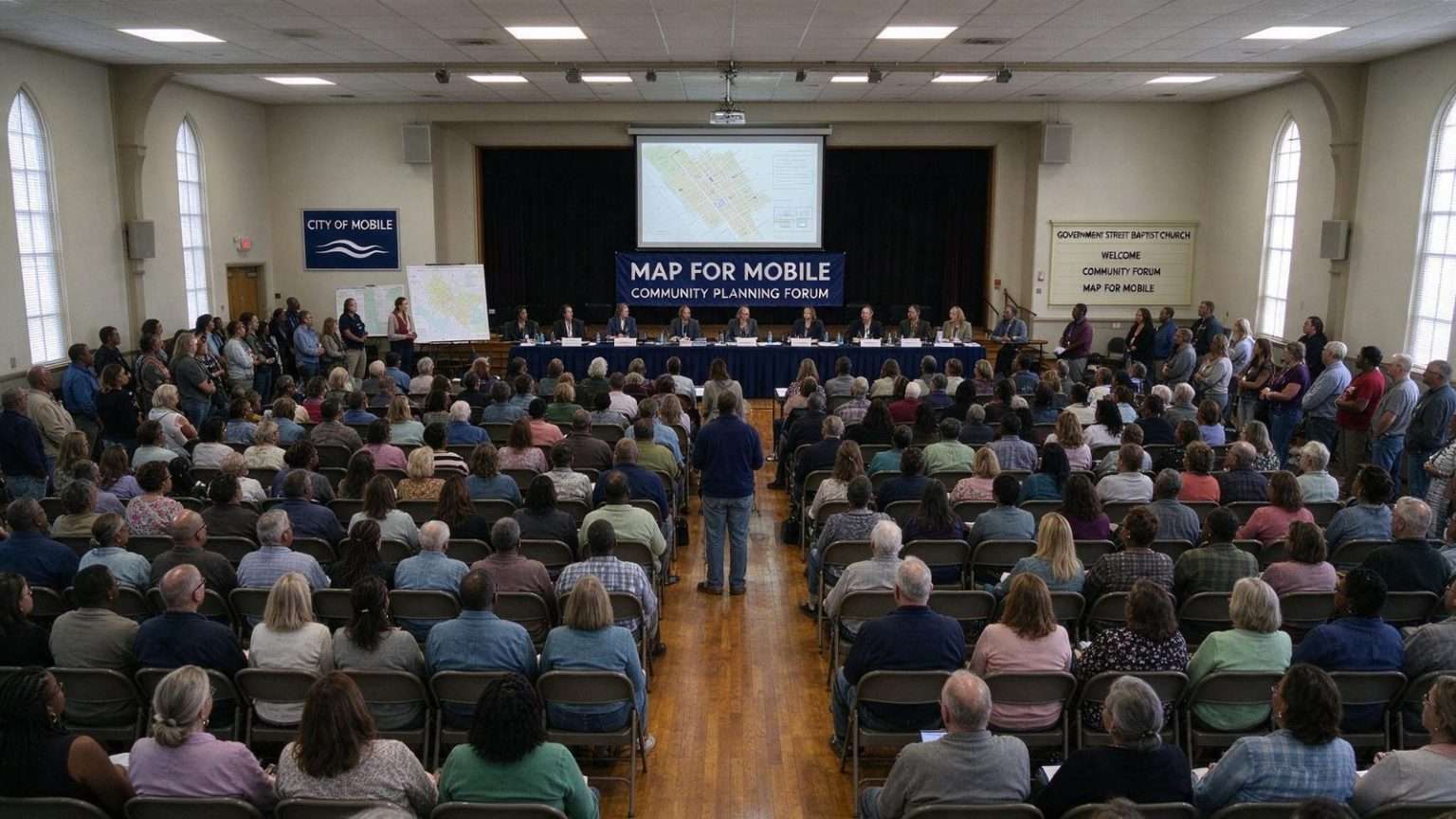
More than 400 Mobile residents packed a church gymnasium this week for the first in a series of public forums aimed at shaping the city’s long-range comprehensive plan, an initiative city officials are calling Map for Mobile.
The turnout at Government Street Baptist Church far exceeded what organizers had anticipated, with the standing-room-only crowd growing throughout the evening as attendees continued filing in after the session began. A spokesman for Mayor Sandy Stimpson’s office said an exact headcount proved difficult, but described the response as a clear signal of public interest.
City officials say it is Mobile’s first comprehensive planning effort in more than two decades, and the forum was designed to accomplish two goals: informing residents about demographic and development trends researchers have gathered so far, and gathering ideas directly from the public about how the city should grow while preserving what makes it distinct.
Comprehensive plans are the foundational policy documents of American city government. They map out land use, transportation, housing, parks, infrastructure and economic development priorities over a twenty-year horizon, and they become the reference point for zoning decisions, capital budgets and development incentives. Cities without a current plan — as Mobile has been for most of the past two decades — make those decisions one at a time, often without an agreed-upon vision to test them against.
Don’t copy another city’s playbook
A planning consultant working on the project urged residents not to model Mobile’s future too closely on other Southern cities frequently cited as comparisons, such as Charleston, Nashville or Chattanooga. Instead, he encouraged participants to focus on identifying and building upon Mobile’s own authentic community assets rather than trying to replicate another city’s transformation.
The advice reflects a familiar pattern in Southern urban planning. Charleston’s historic preservation economy, Nashville’s entertainment districts and Chattanooga’s riverfront revitalization each grew out of local circumstances and decades of specific public investment, and consultants have repeatedly seen cities attempt to transplant those successes with disappointing results. Mobile’s own assets — its 300-year-old historic districts, its working port, its live oak canopies, its Mardi Gras traditions that predate New Orleans, and its growing aerospace and maritime industries — form a different foundation that the plan is meant to build upon.
What the research showed
Consultants shared early findings from their research, noting that Mobile has strong, distinct neighborhood identities organized along corridors throughout the city. That structure, they said, raises a central planning question: how to better connect those neighborhoods and corridors without diluting their individual character.
Mobile’s geography explains much of that pattern. The city stretches north to south along the west bank of Mobile Bay, threaded by historic corridors like Government Street, Spring Hill Avenue, Dauphin Street, Broad Street and Old Shell Road, each lined with its own mix of businesses, churches and housing stock. Neighborhoods from Oakleigh to Toulminville, from Midtown to Tillman’s Corner, developed largely along these spines, and residents’ attachment to them showed in the forum discussion.
Researchers also pointed to strong business recruitment and manufacturing activity in the city currently, while asking residents to weigh in on how Mobile can cultivate more place-based businesses that reflect the kind of growth residents want to see. The distinction matters to planners: large industrial recruitment — most prominently the Airbus final assembly line at the Brookley Aeroplex — brings jobs and headlines, while locally rooted small businesses shape the street-level character of neighborhoods and keep spending in the community.
Breaking into small groups
Following the presentation, attendees broke into small discussion groups to work through maps and questionnaires, marking up large-format drawings of the city with their observations about what works, what is missing and what should change. The small-group format is standard in comprehensive planning processes because it converts a large public meeting into hundreds of individual conversations, each captured by facilitators who record comments on the maps themselves.
Residents’ comments ranged across the usual themes of a growing port city — traffic congestion, blighted properties, the need for better sidewalks and bicycle facilities, the future of the waterfront — but also included the specific local concerns that give a plan its character. Questions about restoring vacant historic buildings, connecting neighborhoods to the bay, and supporting minority-owned and neighborhood businesses recurred across the groups.
The session at Government Street Baptist Church was the first of what organizers describe as a series of forums to be held across the city, deliberately spread among different council districts so that residents from West Mobile to downtown have a chance to participate without traveling far. Materials from each session feed into the consultants’ analysis, which will eventually be compiled into a draft plan presented for public review before adoption by the city council.
Why Mobile needs a new plan now
The timing of the effort is no accident. Mobile’s last comprehensive plan predates the transformations that have reshaped the city in recent years: the construction of the Montgomery cruise terminal era and its aftermath, the expansion of the State Docks, the recovery from Hurricane Katrina, the arrival of ThyssenKrupp’s steel plant upriver, and above all the Airbus decision that made Mobile a North American aircraft manufacturing center.
Those changes brought population shifts, new employment patterns and development pressure in corridors that the old plan never envisioned. City planners and the Stimpson administration have argued that without an updated framework, the city risks reacting to development proposals piecemeal rather than guiding growth toward outcomes residents actually want.
The demographic research presented at the forum also underlined why the plan matters. Like many Southern cities, Mobile has seen population shift outward to suburbs in Spanish Fort, Daphne and Fairhope across the bay, leaving parts of the older city with vacant housing while outlying annexed areas absorb new growth. A comprehensive plan gives the city a tool for addressing both problems at once — reinvesting in established neighborhoods while planning infrastructure where growth is actually occurring.
The long road to adoption
Map for Mobile is structured as a months-long process, with the consultant team — assembled through a competitive procurement led by the city — conducting research, holding public forums, and drafting plan elements covering land use, transportation, economic development, housing, community facilities and the environment. Between the large public forums, the team holds stakeholder interviews and smaller workshops with neighborhood associations, business groups and institutions.
The result, when finished, will be the city’s first new comprehensive plan in more than twenty years, intended to guide decisions through the mid-2030s. Planners caution that a plan is only as good as its implementation, and the draft is expected to include specific action items and priorities so that the city council and mayor’s office can translate the vision into zoning updates and capital spending.
For the residents who filled the gymnasium this week, the evening was the beginning of that conversation, and the size of the crowd suggested that the public intends to stay in it. Organizers said additional forum dates will be announced as the process moves forward.
Government Street Baptist Church as a gathering place
The choice of venue reflected the practical realities of hosting a citywide conversation. Government Street Baptist Church sits along one of the historic corridors the plan will address, and its gymnasium offers the kind of flexible, high-capacity space that hotels and civic halls in the city rarely provide for free. Churches across Mobile have long served this civic function, hosting neighborhood association meetings, candidate forums and community planning sessions for decades.
The standing-room-only crowd also forced small improvisations from the organizers, with additional chairs brought in as latecomers continued arriving well after the formal presentation began. Residents stood along the walls and filed in behind the seated sections, and the consultants adapted by circulating through the overflow crowd during the question-and-answer portions.
The mayor’s office acknowledged afterward that the turnout exceeded anything the team had projected for the first session. For an initiative that depends entirely on public participation to legitimize its conclusions, the opening night’s energy was the best possible signal that the process will produce a plan with genuine community backing rather than a document assembled in a conference room.
How other Gulf Coast cities have done it
Mobile is not the only Gulf Coast city undertaking such an effort, and the region offers useful recent examples. New Orleans’ post-Hurricane planning process enlisted thousands of residents through neighborhood-level meetings, producing a citywide master plan that has survived multiple administrations. Pensacola, Biloxi and Gulfport have all updated their comprehensive plans in the years since the 2005 hurricane season, each using community forums similar to Mobile’s to gather input.
The consultants working with Mobile bring experience from comparable processes, and their presentation drew on that background to set expectations: a comprehensive plan typically takes twelve to eighteen months from kickoff to adoption, involves several rounds of public review, and only takes effect when the governing body formally adopts it by resolution or ordinance.
What residents produce in the forums does more than fill pages. In zoning disputes and capital budget debates, a documented record of community preferences from the planning process becomes evidence that elected officials can cite when approving or rejecting specific projects. Planners call this the plan’s “political weight,” and heavy early participation is how a plan acquires it.
Neighborhoods and corridors: the central question
The finding that Mobile’s neighborhoods are strong but disconnected along its corridors crystallizes the challenge the plan must answer. Corridors like Government Street and Broad Street were once the commercial arteries binding neighborhoods together, but decades of disinvestment, highway construction and suburban retail flight have left gaps that break the connections.
Residents at the forum pointed to specific examples: stretches where vacant lots interrupt the streetscape, sidewalks that end abruptly, and bus routes that fail to link neighborhoods to the job centers at Brookley and the port. Reconnecting those corridors — through targeted business recruitment, streetscape investment and infill housing — is likely to be a recurring recommendation when the draft plan emerges.
The consultants cautioned that the balance between connection and character is delicate. Corridor revitalization that brings new investment can also bring rising rents that displace the long-time residents who sustained the neighborhood through its lean years, and the plan’s policies will need to address that tension explicitly rather than leaving it to the market.
Future forums will dig into those questions district by district, and residents who missed the opening session will have additional chances to weigh in as the Map for Mobile process continues through the coming months.