University of South Alabama Mobile
Mayor Stimpson Names 60-Plus Leaders to Guide Mobile’s First Long-Range Plan in 20 Years
Mayor Sandy Stimpson appointed more than 60 community leaders to advisory and outreach committees for Mobile's first comprehensive plan in two decades.
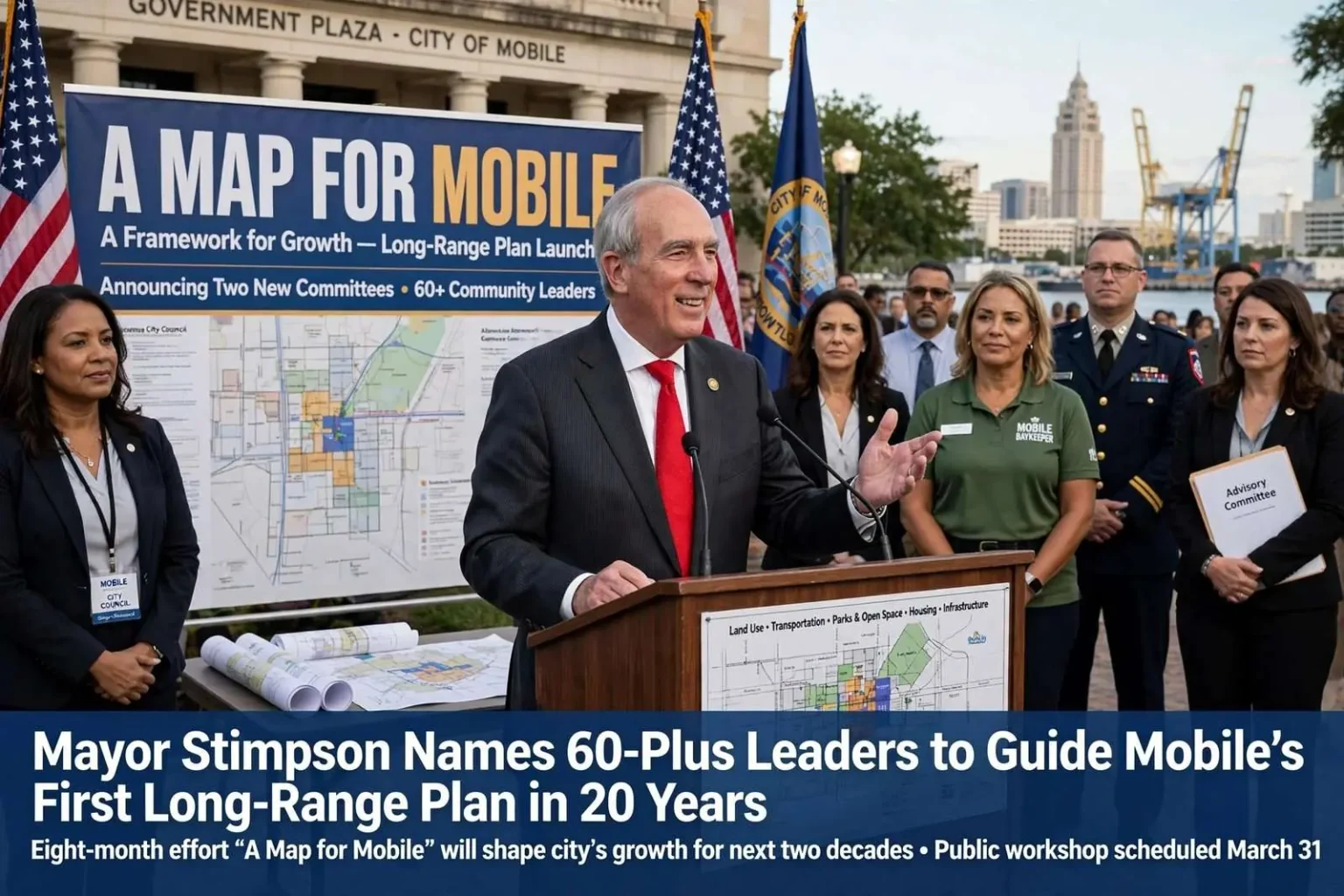
Mobile’s push to draft its first comprehensive, long-range city plan in 20 years took a public step forward Thursday with the announcement of two new committees stacked with more than 60 community leaders.
Mayor Sandy Stimpson said the eight-month planning effort, branded “A Map for Mobile: A Framework for Growth,” is meant to shape the city’s long-term vision and guide development decisions for years to come.
According to the mayor’s office, an Advisory Committee will offer feedback throughout the process and work to ensure the new plan aligns with existing community and economic development efforts already underway in Mobile. A separate Outreach Committee will serve as a sounding board for the planning consultants and is designed to represent a wide cross-section of community stakeholders.
The Advisory Committee includes a mix of civic, business and institutional leaders such as Mobile City Council President Gina Gregory, Mobile County Commission President Connie Hudson, Mobile County Schools Superintendent Martha Peek, University of South Alabama President Tony Waldrop, Alabama State Port Authority director Jimmy Lyons, and Mobile Area Chamber of Commerce president Bill Sisson. Representatives from the U.S. Coast Guard, the U.S. Army Corps of Engineers, Alabama Power, the Downtown Mobile Alliance and several area universities and nonprofits round out the roster.
The Outreach Committee draws from a similarly broad pool, including figures from the Mobile County Health Department, Mobile Baykeeper, the University of South Alabama athletics department, and area law firms, among others.
The city hired Montgomery-based architecture and engineering firm Goodwyn Mills and Cawood roughly six weeks earlier to lead the planning process after the Mobile City Council approved the contract.
The resulting plan is expected to address land use capacity, transportation, natural resources, community facilities, parks and open space, economic development, housing and infrastructure, while identifying gaps left by prior planning efforts.
Stimpson said the initiative is designed to avoid the fate of past city plans that were shelved after completion. He described the new plan as one intended to actually be implemented rather than filed away, pointing to the breadth of community involvement as a key difference from previous efforts.
A public workshop inviting residents to weigh in on ideas for Mobile’s future is scheduled for March 31, though a location had not yet been finalized at the time of the announcement. City officials encouraged residents across Mobile to attend and take part in shaping the plan.
The city’s first full plan in two decades
Comprehensive plans are the documents cities use to make deliberate decisions about what gets built where, and Mobile has been operating without a current one for a generation. In the two decades since the city last undertook a full planning effort, entire neighborhoods have changed, new corridors have filled in with development, and the pressures that come with growth have moved outward from the historic core.
A plan that old cannot guide decisions it never anticipated. Zoning calls, road projects and economic development incentives made without an updated framework tend to be judged one at a time, on their own merits, with no shared vision tying them together. That is the gap “A Map for Mobile” is intended to close.
The eight-month timeline sets an ambitious pace for an effort of this scope. Planning processes that address land use, transportation, housing, parks and infrastructure typically take a year or more, and compressing the work into eight months puts a premium on keeping the committees, consultants and public moving in step.
Who is at the table
The composition of the two committees signals how broadly the city intends to draw input. The Advisory Committee pairs city and county government, with Council President Gina Gregory and County Commission President Connie Hudson both involved, alongside Mobile County Schools Superintendent Martha Peek, whose district’s facility decisions are intertwined with residential growth patterns.
Institutional heavyweights anchor the roster as well. University of South Alabama President Tony Waldrop brings the perspective of one of the region’s largest employers and landowners, while Alabama State Port Authority director Jimmy Lyons represents the maritime economy that has anchored Mobile’s identity and budget for three centuries.
Bill Sisson of the Mobile Area Chamber of Commerce connects the plan to the business recruitment pipeline, and representatives of the U.S. Coast Guard and the U.S. Army Corps of Engineers ensure that federal partners whose facilities and projects shape the waterfront have a seat as the plan takes form.
The Outreach Committee is deliberately different in character. With members drawn from the Mobile County Health Department, the environmental group Mobile Baykeeper, South Alabama athletics, and area law firms, it is built to react to the consultants’ work from a range of community perspectives rather than institutional ones, testing whether what the plan says will actually resonate with the people it affects.
What the plan will cover
The scope of the planning effort touches nearly every function of city government. Land use capacity analysis examines how much development the city’s land can absorb, where vacant parcels remain, and which areas are positioned for growth versus reinvestment.
Transportation planning within a comprehensive framework looks beyond individual road projects to the network as a whole, considering how residents move between neighborhoods, how freight reaches the port, and where gaps in connectivity limit opportunity. Natural resources and open space elements address the waterways, wetlands and green space that define the Gulf Coast, while the community facilities component inventories the fire stations, libraries, parks and public buildings a growing city requires.
Housing and economic development rounds out the picture, examining where people live, what kind of housing exists and what is missing, and how the city can position itself to attract and keep the employers that sustain its tax base. Part of the consultants’ job is identifying gaps left by prior planning efforts, the needs that fell between the plans the city has made piecemeal over the past two decades.
Lessons from plans past
Stimpson’s emphasis on implementation reflects a hard truth about municipal planning: documents that gather dust accomplish nothing, and residents who participate in a planning process only to watch it disappear remember the disappointment the next time they are asked for input.
Past efforts in Mobile and other cities have foundered for predictable reasons. Plans written without political ownership fade when administrations change, plans written without public involvement meet resistance when the zoning map is redrawn, and plans written without funding strategies remain aspiration rather than policy.
The committee structure announced Thursday is designed to counter those failure modes directly, by involving council and county leadership from the start, by keeping a broad cross-section of the community engaged as a sounding board, and by building a constituency that expects to see the finished plan put to work.
The announcement also drew attention to what the committees’ makeup says about the city’s priorities. Health, environment, education, the port, the military presence and the business community are all represented before the drafting has begun, a deliberate hedge against a plan that serves one constituency at the expense of others.
Mobile Baykeeper’s inclusion on the Outreach Committee is notable in a city defined by its water. Stormwater, sanitary sewers and the health of Mobile Bay are recurring public concerns, and a plan that guides growth for the next generation will have to reckon with how development affects the waterways that surround it.
The presence of the health department similarly reflects the growing view among planners that land use decisions are public health decisions, influencing everything from walkability to flood exposure to residents’ access to care.
As the eight-month process advances, the Advisory Committee is expected to review draft materials and keep the plan aligned with the economic development projects already moving in Mobile, while the Outreach Committee’s reaction to each draft will give the consultants a stand-in for the broader community’s response before anything is finalized.
Where residents come in
The committees are only part of the public engagement plan. The workshop scheduled for March 31, once a location is finalized, will be the first structured opportunity for residents at large to contribute, and city officials have been explicit in encouraging participation from every part of the city.
Public workshops in planning processes typically ask residents to map what they value, identify what is missing, and react to early concepts for growth and investment. The input gathered at such events is distilled into the plan’s goals and priorities, which means the residents who show up have a direct hand in what the document says.
For a city of Mobile’s geography, engagement logistics matter. A plan that reflects only downtown’s perspective would shortchange west Mobile’s subdivisions, the port district’s industrial needs and the historic neighborhoods closest to the river, so planners will be watching for participation that represents the whole city rather than the easiest-to-reach corners of it.
Between the advisory and outreach committees, the hired consultants and the public workshops, the architecture of the effort is now in place. What remains is the work itself: eight months of analysis, meetings and drafts aimed at producing a document that Mobile’s leaders will use, not shelve, when the city’s next two decades of decisions arrive.
Residents who want to follow the process can expect updates from the mayor’s office as milestones approach, beginning with the March 31 workshop, where the community’s ideas for Mobile’s future will get their first public airing.