State Democrats Reject Figures Appeal, Sealing Buskey’s Clear Path in District 99
An Alabama Democratic Party panel upheld the disqualification of RaShawn Figures on residency grounds. His attorney called the proceeding a farce of due process and a celebration of the rule of man.
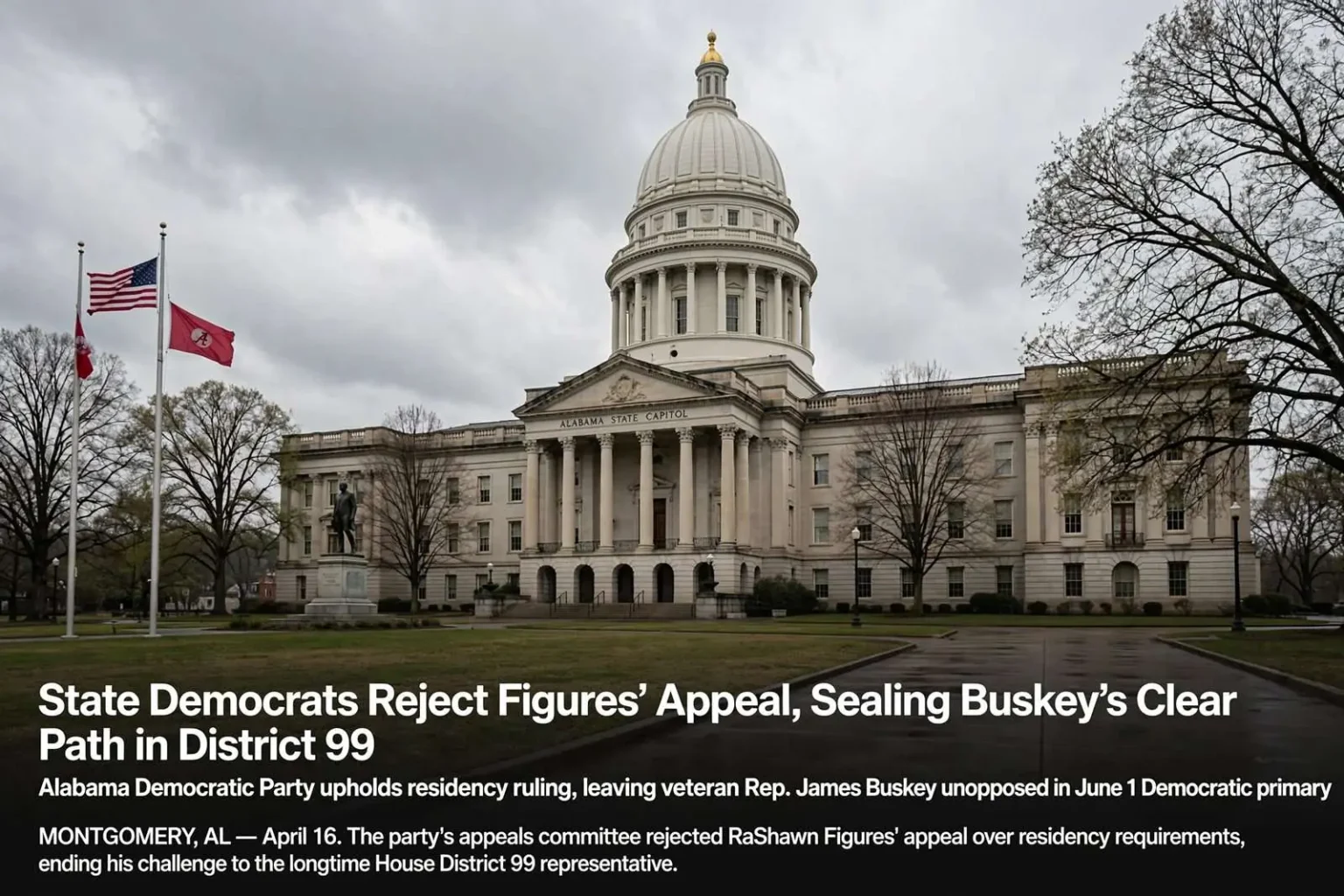
The Alabama Democratic Party has ended RaShawn Figures’ bid to unseat veteran state Rep. James Buskey, rejecting the Mobile real estate investor’s appeal of an earlier party ruling that he did not satisfy residency requirements for House District 99. The decision means Buskey, first elected in 1976, will not face Figures in the June 1 Democratic primary, clearing the veteran lawmaker’s path to another term representing the Mobile district.
The dispute turned on a question that surfaces in Alabama elections from time to time: whether a candidate actually lived in the district he sought to represent in the year before qualifying. The Alabama Constitution requires candidates to reside in a legislative district for one year before running to represent it, and the party treats the requirement as a threshold qualification that can be enforced through its challenge process before ballots are printed.
Figures’ attorney, John Lawler, described the episode in blunt terms, calling it a shameful celebration of the rule of man over the rule of law. There was no evidence to sustain the removal, Lawler argued — only a powerful desire to do so. In his view, the party had reached a conclusion first and assembled the justification afterward, rather than weighing the proof on its merits.
At the heart of the factual dispute was Figures’ property record. Figures owned several properties during the period in question, including one outside the district. But the evidence that he had actually lived outside District 99, Lawler said, simply did not exist. The distinction matters in residency challenges: owning property in more than one place is common, and the operative question is where a candidate actually resided, not where his name appeared on deeds or tax records.
Lawler maintained that the party never confronted that question honestly. A man may hold titles to homes in several neighborhoods at once, but he lives in only one of them, and the record in this case, by the attorney’s account, pointed squarely to District 99 as the place Figures called home.
‘The Rule of Man Over the Rule of Law’
The challenge itself began with a letter. Buskey raised the question of Figures’ residency in an April 1 letter to party officials, setting in motion the internal machinery the Alabama Democratic Party uses to screen candidate qualifications. Under the party’s process, challenges to a candidate’s eligibility are referred to a subcommittee, which reviews the evidence and makes a finding that can then be appealed to the party’s appeals committee.
That is precisely the route this case traveled. A subcommittee chaired by longtime party official Joe Reed found last month that Figures did not meet the residency requirement. The appeals committee confirmed that finding, and the confirmation was transmitted to Figures’ camp as the party’s final word on his eligibility for the June 1 primary ballot.
“Based on the evidence presented, it is the finding of the appointed subcommittee that sufficient evidence was presented to show that RaShawn Figures did not meet the requirements,” the ruling stated. Dated April 16, it was signed by Reed as party vice chairman.
The language of the ruling leaned on the sufficiency of the evidence presented to the subcommittee rather than cataloguing what that evidence was. To Lawler, that phrasing underscored the problem: the finding recited a conclusion about proof that, in his telling, had never been produced in any meaningful sense.
Residency challenges occupy an awkward place in Alabama politics. The constitutional requirement is meant to ensure that a legislator answers to the community where he actually lives, but enforcing it through party committees rather than courts means the outcome often rests on how a panel weighs scattered documents — utility records, property holdings, testimony about comings and goings — under deadline pressure before an election.
For Buskey, the ruling removed the only intra-party obstacle between him and the nomination. First elected to the House seat in 1976, he has represented his Mobile district through more than three decades of change in the city — a span covering roughly nine terms in the State House and a tenure that places him among the longest-serving members of the Alabama Legislature. Challengers from either party have rarely lasted long against him, and the residency challenge was the most direct threat to his re-election in this cycle.
House District 99 takes in a working slice of central Mobile, a district of older neighborhoods where local politics has long been shaped by personal relationships built over decades. In a district like that, an incumbent’s name recognition is a formidable asset, and a challenger’s best hope is usually to make the race about something other than the incumbent’s record. Figures instead found his own qualifications made the issue.
A Lawyer’s Discouragement
Lawler, a lawyer for more than 45 years, said he has rarely been as discouraged by a proceeding that seemed to him pre-ordained. In a career that long, a Mobile attorney accumulates a wide experience of hearings, tribunals and contested matters, and Lawler’s complaint was not simply that his client lost but that the process never felt like a genuine contest of evidence.
“It was just difficult to sit and watch that and know what was happening to you,” he said.
His sharpest words were reserved for the party itself, and for what he saw as the message the episode sent to the kind of candidate parties claim to want.
“I’m on record as quite disappointed in, quote, the democratic process and the Democratic Party,” Lawler said. “Any party that didn’t encourage young people who espoused their ideals and in fact discouraged them — well, it was a pretty sorry thing, to tell them in effect that they have to get permission from the incumbent before they can even run.”
The criticism gets at a tension as old as party politics. Party organizations exist, in part, to protect their nominees and the ballot from frivolous or bad-faith candidacies, and qualification challenges are one of the few tools available for doing that. But the same tool, wielded against a challenger who filed to run against a powerful incumbent, can look to outsiders like an exercise in gatekeeping — the party deciding whose name belongs on the ballot before a single voter has spoken.
Lawler’s account of the proceedings was that the outcome was never really in doubt from the moment the challenge was filed. The subcommittee that heard the case was chaired by Reed, one of the most influential figures in Alabama Democratic circles, and the finding it returned was adopted without difficulty by the appeals committee that reviewed it next.
What Comes Next for the District
With the appeal rejected, Buskey will appear on the June 1 Democratic primary ballot without opposition from within his own party, and the intra-party fight that consumed the spring will end without a single vote being cast. The June primary in Alabama is typically the decisive contest in districts where one party dominates the general election, which made the party’s qualification ruling, in practical terms, the whole ballgame.
For Figures, the decision forecloses the route he had chosen into public life. Whether he would pursue the matter further — in the courts or in a future campaign — was not immediately clear, but his attorney’s public comments left little doubt about how the episode was viewed from his side of the table.
The case is a reminder, meanwhile, of how much weight the one-year residency rule carries in Alabama elections. Candidates who split time between homes, who maintain property in more than one district, or who move shortly before qualifying run a real risk that the question of where they “live” will be litigated by a party committee rather than settled by voters. In this instance, the committee’s answer ended the campaign before it began, and a veteran of the State House since 1976 was left to run for another term unopposed by his own party.
Behind the legal arguments sits a simpler political reality. Challenges to a candidate’s residency are relatively rare, but Alabama has seen them before in legislative races, and they tend to succeed or fail on documentation that ordinary voters never see. A subcommittee weighing such a case is asked to reconstruct where a man slept, received his mail and kept his life during a window of months, often using little more than property records and recollections.
In Figures’ case, the undisputed starting point was his ownership of multiple properties. Real estate investors accumulate holdings as a matter of business, and holding a deed outside District 99 was never itself the problem. The party’s finding instead rested on its judgment that the evidence, taken together, showed he did not meet the district’s residency requirement — a judgment his lawyer insisted rested on desire rather than proof.
The episode also illustrates the particular authority Joe Reed carries within the Alabama Democratic Party. As vice chairman, Reed signed the April 16 ruling, and his chairmanship of the screening subcommittee meant that one of the party’s most senior officials was at the center of both the initial finding and the process that sustained it. For critics of the outcome, that concentration of authority in a single longtime party hand is part of what made the proceeding look predetermined.
For the party, the countervailing consideration is straightforward: someone must decide qualification challenges, and the State Democratic Executive Committee’s structure exists to do so quickly enough that ballots can be printed and absentee voting can begin on schedule. June 1 was approaching, and an unresolved challenge would have left the primary ballot in limbo for the district.
What the dispute leaves behind is a question about process rather than personality. Nobody disputes that Buskey is a fixture of Mobile politics whose service dates to 1976, and nobody disputes that Figures wanted the seat. The contested ground was narrower: whether the party followed its own rules faithfully in deciding which of them would get the chance to ask voters in District 99.
Lawler’s answer, delivered in the language of a 45-year legal career, was that it had not — that a committee had substituted a powerful desire for evidence, and that a young candidate who espoused the party’s own ideals had been turned away for the offense of running without permission. The party’s answer, in the language of its written ruling, was that sufficient evidence was presented and the requirements were not met. The June 1 ballot will reflect only the second answer, and District 99 voters will have no chance to weigh the first.