Baldwin County Commissioners Look for New Ways to Fund Bicentennial Park Upkeep
Baldwin County commissioners are weighing new fees and revenue ideas to help maintain trails at the county's 367-acre Bicentennial Park each year.
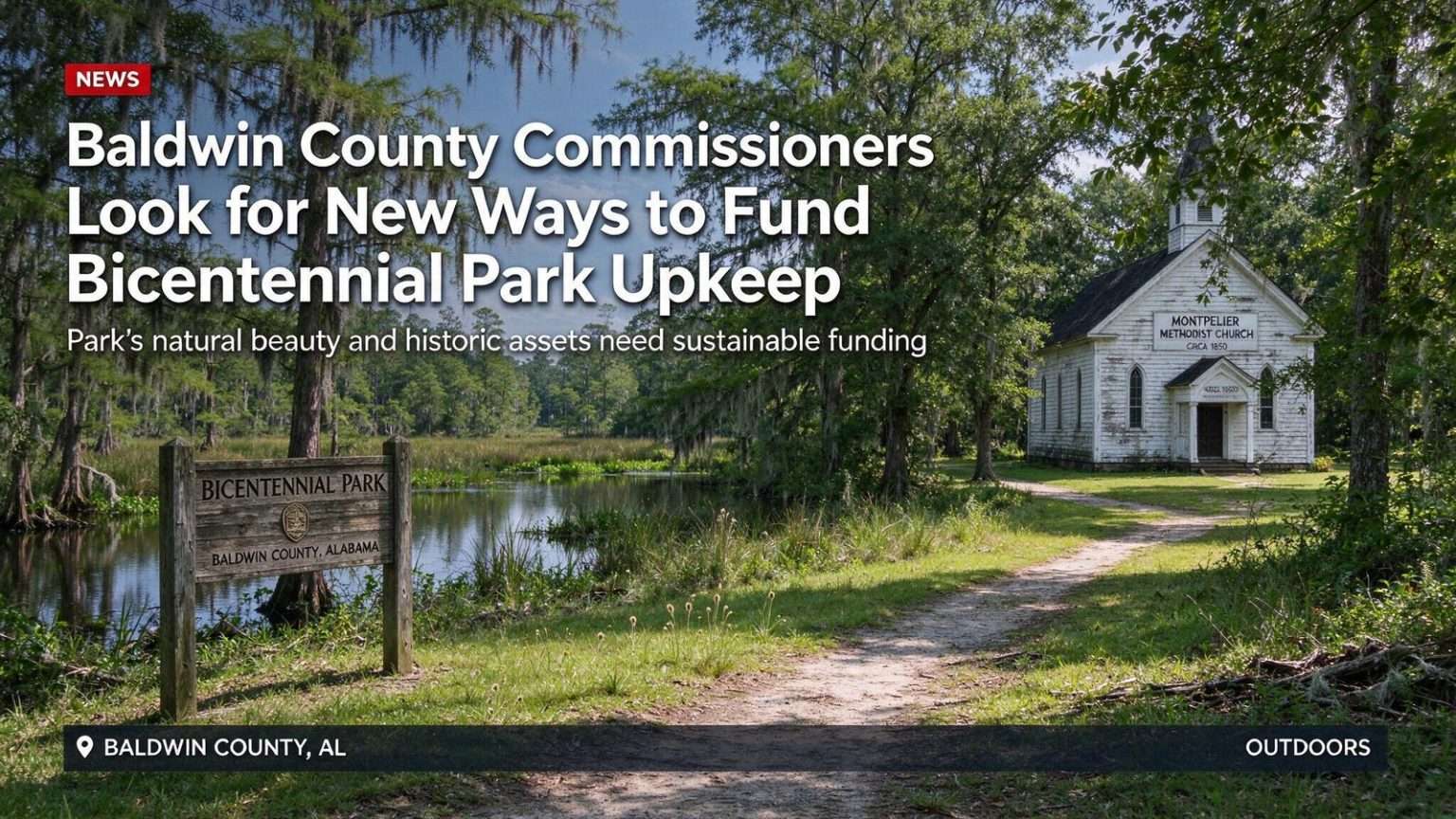
Baldwin County officials are searching for new sources of income to keep up with maintenance at Bicentennial Park, a 367-acre stretch of nature trails off Alabama 225 that has struggled with staffing and upkeep in the decade since it opened.
During a recent work session, commissioners discussed the park’s ongoing maintenance challenges, including overgrown walking trails that have become a haven for snakes near the property’s swampy edges. County horticulturist Madison Steele told commissioners that cutting back vegetation is essential not just for appearance but for public safety, since unmowed grass along the trails creates hiding spots for snakes drawn to the surrounding wetlands.
The park occupies a distinctive slice of Baldwin County’s natural landscape. The land along Alabama 225 sits at the edge of the Mobile-Tensaw Delta, one of the most biologically rich regions in the state, and the wetlands that border the property are part of what makes the park attractive to visitors — and part of what makes neglect there a safety problem. The county created the park as part of its bicentennial observance, and it has since served as a destination for school groups, hikers, photographers and families looking for an inexpensive outdoor outing.
‘Tremendous potential,’ but a funding gap
Commissioner Tucker Dorsey said the park “has tremendous potential” but needs a dedicated revenue stream to keep pace with its upkeep. Ideas floated during the session included charging a fee for weddings held at the historic Montpelier Methodist Church on the property, charging vendors who sell goods there during festivals, and creating new ticketed events to draw more visitors.
The church is one of several historic structures that give the park its character, and officials have long viewed it as a natural venue for weddings and other gatherings. Communities across the region have found that rentable historic buildings can generate meaningful income for parks, and the revenue discussion comes as the county looks for ways to make the property more self-sustaining rather than entirely dependent on annual appropriations.
The park currently has just one maintenance worker assigned to look after the entire property, after a second position was cut last year because of budget constraints. Commissioners are exploring whether temporary or part-time workers could be brought on to help close that gap. For a property of more than 360 acres, a single worker means that routine tasks — mowing miles of trail edges, clearing storm debris, maintaining buildings — must be triaged, and officials acknowledged that the backlog shows in places visitors notice.
Commissioner Chris Elliott said any new spending should be paired with a matching revenue source rather than drawn from the county’s general fund. “We aren’t going to spend general fund money without the revenue to match it,” he said, describing the panel’s approach as a conservative one. His position reflects the budget discipline the commission has applied across county operations, and it effectively turns the maintenance question into a revenue question: the park’s upkeep will improve only when the park generates the money to pay for it.
That framing has guided similar county facilities in recent years. County leaders have pushed to match costs with dedicated income at recreation sites and landings, whether through user fees, event revenue or partnerships with outside organizations. Bicentennial Park, with its mix of natural acreage and historic assets, offers several of those possibilities at once, from church rentals to festival vendor fees to organized runs and other ticketed events that could bring regular crowds to the property.
Fees would also put Baldwin County in line with practices common elsewhere in the region. Parks in neighboring Mobile County and along the Florida Panhandle routinely charge for pavilion rentals, special events and facility use, and many have used that income to fund maintenance positions that general budgets alone could not support. The commission has not settled on specific amounts or approved any fee schedule, and any change would come back before the panel for a vote.
Live Oak Landing offers a model
The discussion also touched on Live Oak Landing, a nearby county-owned boat launch and fishing site along the Tensaw River that received a financial boost last year from BP Deepwater Horizon settlement funds. Commissioner Frank Burt Jr., who represents the area, said the county already approved a master plan for the landing in 2013 that outlined a long-term vision for the property, and the site has since grown into one of the county’s most visible outdoor recreation investments.
The landing sits deep in the delta, giving boaters and anglers access to one of the largest river deltas on the Gulf Coast, and county officials have treated it as proof that investing in outdoor recreation can pay off in tourism dollars. BP settlement money, distributed to Gulf Coast governments to restore and enhance coastal resources after the 2010 oil spill, has funded a series of improvements there, and the experience has shaped how commissioners think about funding other natural assets — including Bicentennial Park.
Unlike the landing, though, Bicentennial Park has not attracted a comparable stream of dedicated funding, and the decade since it opened has exposed the difference. The county’s parks have competed with roads, jails and public safety for general fund dollars, and when budgets tightened last year, the park was among the casualties. The second maintenance position was eliminated, and the remaining staff has worked to keep the most visible areas presentable while less-traveled trails grew wild.
Commissioners left the work session with a clear directive for staff: identify revenue options that could support a realistic maintenance budget and bring them back for consideration. Among the possibilities expected to get further study are the wedding fees at the Montpelier church, vendor charges during the festivals that already draw crowds to the property, and a calendar of ticketed events that could range from concerts to heritage festivals tied to the park’s historic structures.
Officials also discussed whether partnerships could lighten the load. Volunteer groups, civic organizations and school programs have all played roles in supporting county parks before, and a structured volunteer program could supplement the lone maintenance worker while the county works out a longer-term funding plan. Community clean-up days and adopt-a-trail arrangements have proven effective at similar parks across the Southeast.
The delta itself is a selling point the county has only begun to market. The Mobile-Tensaw Delta is a destination for kayakers, birders and anglers from across the region, and Bicentennial Park sits close enough to tap that audience. Nature tourism has grown steadily across the Gulf South, and counties that have invested in trail maintenance, signage and facilities have captured a share of visitors who once drove past on their way to the beaches.
Commissioners also weighed how fees might affect access, a concern that surfaces whenever public property begins charging for what has been free. Walking the trails would remain open to everyone under the ideas discussed; the charges under consideration would fall on weddings, vendors and special events rather than everyday visitors. That distinction, several members noted, keeps the park available to the school groups and families who use it most while asking those who profit from the property to help maintain it.
What is not in dispute is the park’s value to the county. Nearly 370 acres of protected land with trails, wetlands and historic buildings is a rare asset in one of Alabama’s fastest-growing counties, where residential and commercial development continue to consume open land along the Interstate 10 and Highway 98 corridors. As Baldwin County grows, officials say, properties like Bicentennial Park become more valuable, not less — which is exactly why commissioners argue the time has come to fund them properly.
County officials have watched demand for outdoor recreation climb since the pandemic, a trend that has held on the Gulf Coast as new residents continue to arrive. Trails at popular parks across the region have seen heavier use than their maintenance budgets anticipated, and Baldwin County is no exception. More visitors mean more wear on paths, boardwalks and grounds — and a stronger argument, commissioners say, for a funding model that scales with usage.
Any proposal will still face the test of the full commission. Work sessions are for exploration rather than action, and several members cautioned that no dollar figures or fee schedules have been drafted. But the tone of the discussion marked a shift from years past, when the park’s needs were acknowledged and tabled. This time, the question on the table was not whether the park deserves investment, but where the money should come from.
The work session produced no votes, but it set the direction. If the fee and event ideas move forward, the park’s upkeep would rest on a foundation it has never had: money generated on the property itself, spent on the property itself. For the snakes in the grass and the visitors who would rather not meet them, that change cannot come soon enough.