University of South Alabama Mobile
University of South Alabama Trustees to Meet in March, Review Budget and Appointments
USA's board of trustees will convene in March for committee and formal sessions covering hospital credentials, health board nominees and finances.
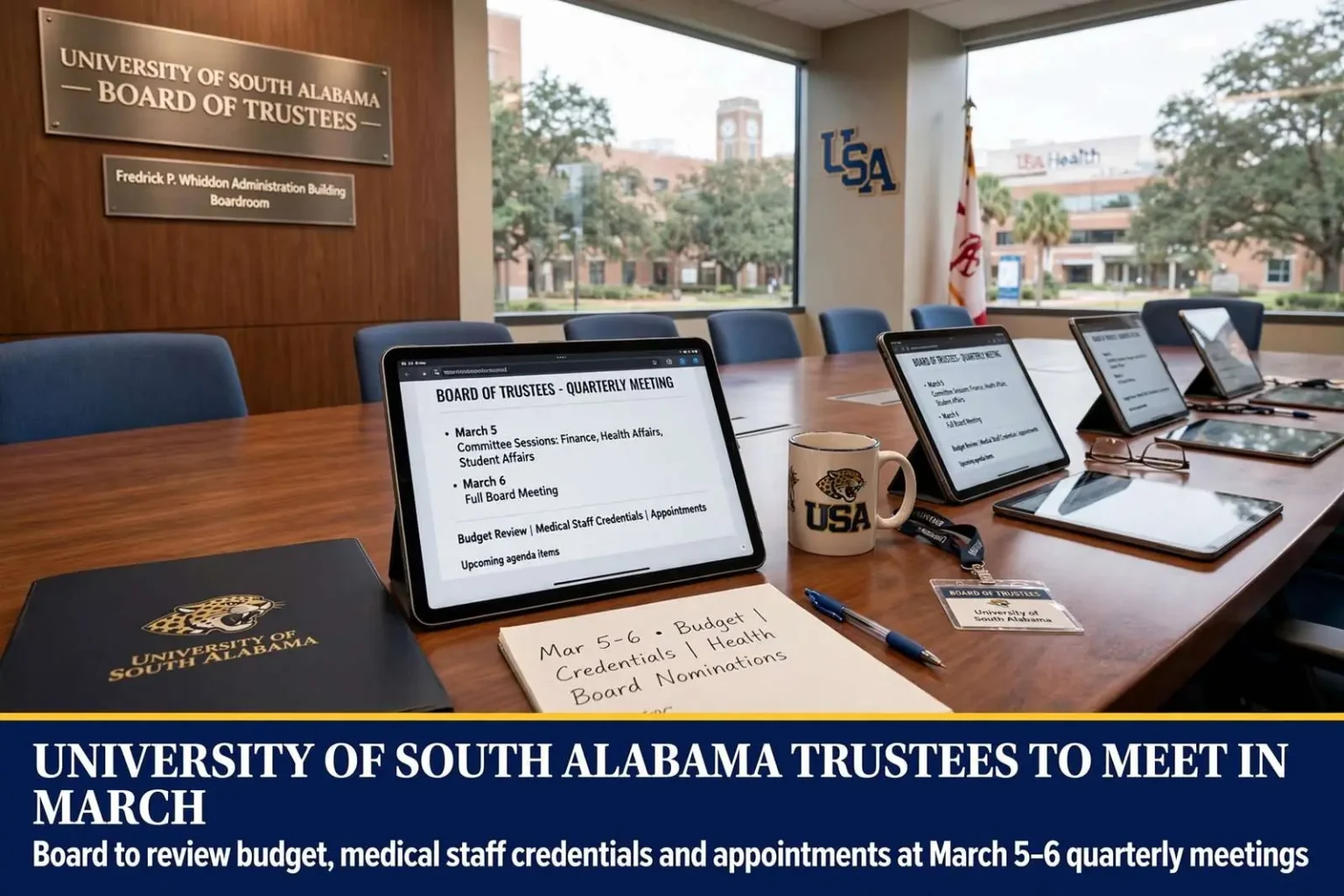
The University of South Alabama’s board of trustees is preparing for its next round of quarterly meetings, with committee sessions scheduled for March 5 followed by the board’s formal meeting on March 6. The board, which oversees university governance on matters ranging from tuition and meal plans to personnel appointments and budgets, meets four times a year.
Its 16 members include a retired sheriff, business owners, attorneys, physicians and Mobile Mayor Sandy Stimpson, reflecting a mix of professional backgrounds drawn largely from the South Alabama region the university serves. The composition is by design: a governing board drawn from the professions and communities that send the university its students, employ its graduates and benefit from its hospital system.
Quarterly meetings of this kind are where the university’s major decisions take shape before they reach the public. Committee sessions on the first day allow trustees to work through agenda items in smaller groups — finance, health affairs, student affairs and the like — with the full board convening the next day to vote on recommendations that survive the committee process.
A Board That Runs on Tablets
Since Tony Waldrop became university president, the board has shifted entirely to digital meeting materials, requiring trustees to bring iPads or other devices to follow along during sessions rather than working from paper binders. University officials have said the change has eliminated the need to print thousands of pages of agendas, minutes and supporting documents for each meeting cycle.
The shift is more than an environmental gesture. A quarterly board packet for a university with a hospital system, a research enterprise and a Division I athletics program can run to hundreds of pages of financial statements, personnel actions and policy documents. Distributing that material digitally lets updates reach trustees between meetings, allows search functions that paper never offered and cuts the printing and courier costs that once accompanied every agenda.
Waldrop, who took over the university’s leadership with a background as a researcher and administrator, has made modernization of university operations a theme of his tenure, and the boardroom transition was among its most visible early symbols. Trustees who once hauled binders to the table now follow along on screens, with the same documents available to the public online.
What’s on the March Agenda
Among the items expected on the board’s March agenda are the approval of USA Hospital medical staff credentials, consideration of nominees for the Mobile County Board of Health, and a review of the university’s financial statements.
The credentialing item may look routine, but it is among the most consequential work the board does. Approval of medical staff credentials determines which physicians may practice within USA Health’s hospitals and clinics, making trustees the final gatekeepers for the medical workforce of one of the Gulf Coast’s largest health systems. Every credentialed specialist added to the staff expands the care available to patients across the region without another public vote.
Consideration of nominees for the Mobile County Board of Health likewise connects the university to the county’s broader public health infrastructure. The county health department depends on board leadership drawn from the medical and civic community, and the university’s role in nominating candidates reflects its position as the area’s largest medical institution.
The financial statements review rounds out the agenda’s core. University trustees routinely handle credentialing and health-related appointments given the university’s role in operating USA Health’s hospital system, which serves as a major regional medical provider for the Mobile area — and the hospital enterprise’s performance weighs heavily in the university’s overall financial picture.
The University’s Footprint in Mobile
University trustees play a significant role in shaping policy at South Alabama, a public research university that has grown into one of the region’s largest employers and a key provider of medical education and health care services through its affiliated hospital system.
Founded in the early 1960s as an upper-division institution serving the Gulf Coast, the university has expanded into a comprehensive campus with colleges of medicine, engineering, nursing, education and business, along with a growing research portfolio. Its main campus sits in west Mobile, with the health system’s hospitals and clinics concentrated closer to the city’s medical district and satellite operations serving Baldwin County and beyond.
USA Health’s hospital system — anchored by University Hospital, the region’s level-one trauma center, along with Children’s & Women’s Hospital and a network of specialty clinics — makes the university inseparable from health care delivery in south Alabama. Patients from across the central Gulf Coast, including the Florida panhandle and south Mississippi, are referred to its trauma, neonatal and cancer services, and the university’s College of Medicine supplies many of the region’s practicing physicians through its residency programs.
That combination — a major employer, a research university and the region’s dominant health system — is why board decisions on budgets and appointments can have ripple effects across the Mobile area, given the university’s size and its integration with local health care and civic institutions. A vote on tuition touches thousands of families; a vote on hospital staffing touches the emergency care available to a multi-county region; a construction approval reshapes a section of the city.
The board’s membership reinforces those connections. Mobile’s mayor sits at the table, as do physicians who practice within the system, attorneys who advise institutions across the region and business owners whose enterprises depend on the university’s payroll and patient flow. Governance of the university is, in practice, a meeting of some of the area’s most institutionally connected citizens.
Public Access and Open Meetings
Meeting materials for the upcoming session are posted online for public access, continuing a shift toward digital transparency that university officials say allows community members, along with trustees, to review agenda items and supporting documentation ahead of each quarterly meeting.
Alabama’s open meetings law requires public boards such as the university’s to conduct their business in the open, and the digital posting of agendas has made that access practical in a way paper packets never were. A resident can now read the same financial statements trustees study, review proposed personnel actions and track health system appointments without leaving home.
The March meetings follow the rhythm of the university’s fiscal calendar, which runs on an October-to-September year. Spring sessions typically carry weight for budget planning ahead of the next fiscal year, making the March cycle a likely venue for early discussions of spending priorities that will be finalized later in the summer.
For the university’s constituencies — students and their families, employees, hospital patients and the Mobile business community — the two days of sessions offer a window into how the institution sets its course. The committee work on March 5 and the full board’s votes on March 6 will produce decisions whose effects, from tuition to trauma care, reach across the Gulf Coast long after the agenda is archived.
Who Sits at the Table
The board’s 16 seats are filled by appointees whose careers span the region’s leading institutions — law firms, medical practices, banks, construction companies and municipal government. Alongside Mayor Stimpson, the roster’s retired sheriff brings a law enforcement perspective rare on university boards, while the physicians on the panel have direct standing in the decisions they make about the hospital system’s medical staff.
That blend matters in the board’s quarterly rhythm. Health affairs committee work lands differently in the hands of trustees who have run hospital departments or treated patients in the system. Budget votes benefit from members who manage payrolls and balance sheets in their day jobs. And the presence of city government keeps the university’s planning tied to the streets, services and economy of the city that surrounds its campus.
Trustee service at a public university is an unpaid, part-time role in the formal sense, but the workload during meeting cycles is substantial: reading financial statements, evaluating construction options, weighing personnel actions and hearing reports from the president’s office and the health system’s leadership. The digital transition under Waldrop trimmed the paper burden of that work without changing its substance.
The Health System’s Board-Level Stakes
Few university boards in Alabama carry the health care weight that South Alabama’s does. USA Health operates as the clinical arm of the university, and its trajectory — patient volumes, staffing, expansion into Baldwin County, specialty service lines — is a standing topic of trustee attention. Credentialing approvals on the March agenda are one visible piece of that oversight.
The system’s role as the region’s safety-net and referral hospital adds another dimension. University Hospital treats trauma cases from across the central Gulf Coast, and Children’s & Women’s Hospital delivers more babies and cares for more critically ill children than any facility in the region. Every appointment the board approves — medical staff credentials, health board nominations — echoes in those wards.
The university’s medical education mission ties the pieces together. Medical residents train in the health system’s wards and clinics, nursing and health professions students rotate through its units, and the College of Medicine’s research enterprise depends on clinical infrastructure the board funds. Decisions made in a committee room on March 5 shape the pipeline of caregivers for decades.
The Mobile County Board of Health nominations extend that influence beyond the university’s walls. County health departments handle everything from restaurant inspections to communicable disease response, and nominees with university medical backing bring clinical expertise to a body that exists largely to protect public health between crises. In a region frequently tested by hurricane season and mosquito-borne illness, that expertise is not abstract.
When the board convenes on March 6 to act on the committees’ work, the votes will span the university’s entire mission — education, research, health care and public service. It is a broad portfolio for 16 people, but it is also the reason the board’s quarterly sessions remain among the more consequential public meetings on Mobile’s calendar.