Mobile County Schools Host Signature Academy Info Session for 8th Graders
Mobile County Public Schools invited 8th graders and parents to a Signature Academy info session as all 12 district high schools now offer the career programs.
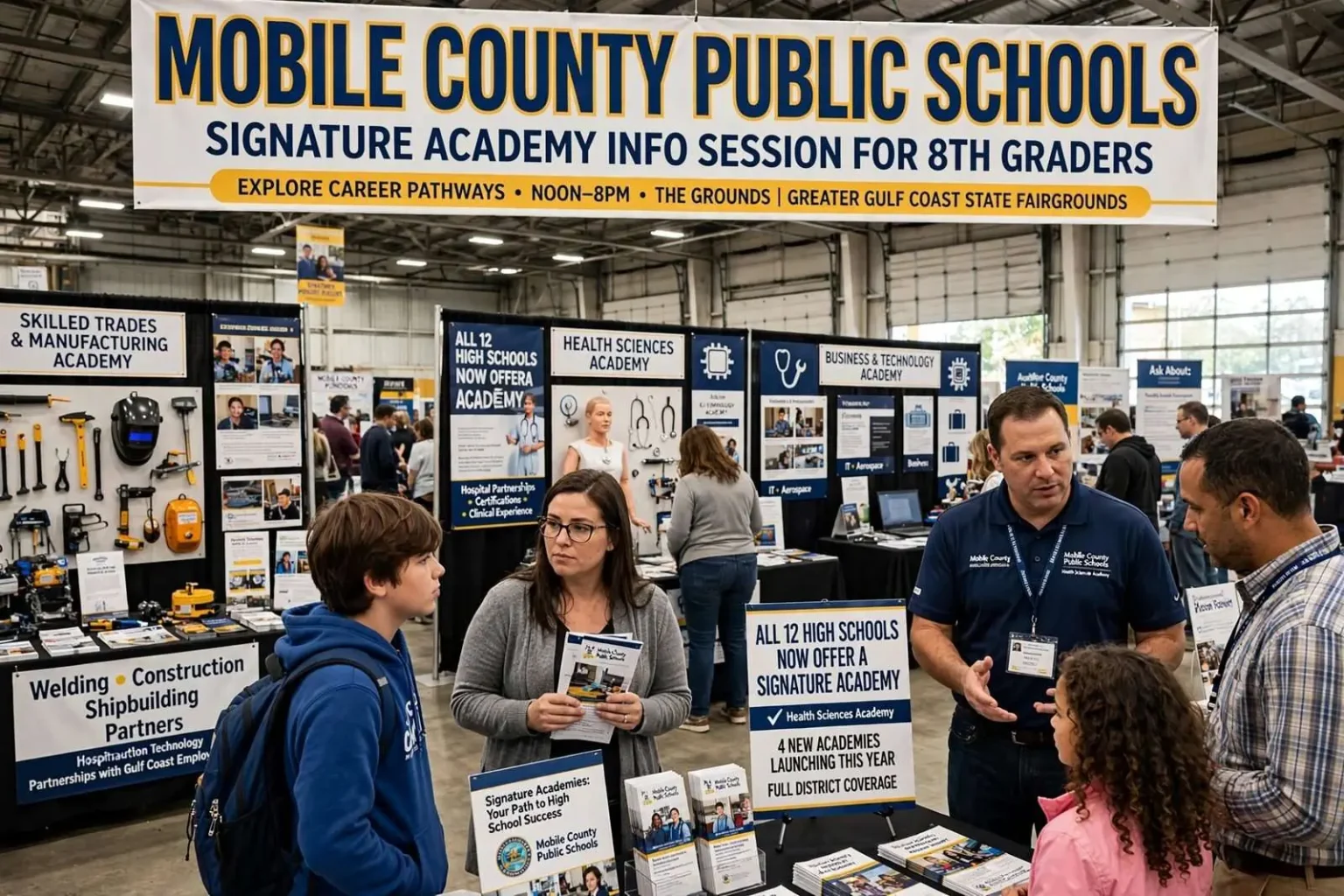
Mobile County Public Schools invited incoming 8th graders and their parents to a districtwide information session designed to introduce families to Signature Academy programs available at the system’s high schools. The session was aimed squarely at the decision point that shapes the start of every student’s high school career — the choice of where to enroll and what pathway to pursue once there — and it gave families a single evening to see the district’s full range of options laid out side by side.
The event, held at the Greater Gulf Coast State Fairgrounds property now known as The Grounds, ran from noon until 8 p.m., giving families a wide window to stop in, meet with program representatives and learn about the academies before making decisions about high school placement for the coming year. The eight-hour format was deliberate: by staying open from lunchtime into the evening, the district accommodated working parents, after-school schedules and families who needed to arrive after the traditional workday ended. The fairgrounds, a sprawling west Mobile property long associated with the annual fair, offered the exhibition space a districtwide showcase requires.
Signature Academies are career-focused programs built into the regular high school experience, allowing students to pursue coursework and hands-on training tied to specific industries or career paths while still working toward a standard diploma. The model borrows from the academy approach used by school systems across the country: rather than separating career-minded students into vocational tracks, the academy program embeds themed coursework — from health sciences to skilled trades to business — inside the comprehensive high school, so academy students take the same core academics as their classmates alongside their specialized classes.
The academies also change what a high school tour looks like. Instead of walking past rows of identical classrooms, visiting families see working labs, simulated hospital rooms, commercial kitchens and workshop floors — the physical footprint of the career pathways inside. District officials have invested in those facilities deliberately, understanding that the hands-on environment is what convinces an uncertain 14-year-old that the coursework will be different from anything middle school offered.
A Milestone Year for the Program
This year marks a milestone for the initiative, with four new academies launching across the district, meaning all 12 Mobile County Public Schools high schools now offer at least one Signature Academy option. That universal coverage is the benchmark the program’s architects set when the initiative began, and reaching it means no student in Mobile County’s public high schools is more than an enrollment choice away from an academy pathway. The four new programs extend the model to campuses that had been waiting for the staffing and resources to launch one.
District officials have described the expansion as a historic moment for Mobile County Public Schools, reflecting a broader push to give students more relevant, career-connected coursework earlier in their education. The framing reflects a district that serves Alabama’s largest student population, spread across a county that runs from downtown Mobile to the Eastern Shore suburbs to the rural communities near the Mississippi line. In a system that size, a program that reaches every high school touches thousands of families — and changes the calculus of which school a student attends.
The academy model has been rolled out gradually since its introduction, with new programs added in phases as individual high schools built out the staffing, equipment and industry partnerships needed to support them. The phased approach meant each academy launched only when its host school could sustain it — teachers trained in the specialty, lab and shop equipment installed, and local employers signed on to provide internships, guest instructors and real-world projects. That groundwork is invisible to families choosing a pathway, but it is what separates a durable academy program from a name on a brochure.
Industry partnerships have been the quiet engine of the program. Gulf Coast employers — in health care, shipbuilding, aerospace, hospitality and the skilled trades — face persistent workforce needs, and the academies give those employers a structured way to connect with the region’s future workers years before graduation. In return, students in academy programs get exposure to workplaces and professionals that a traditional classroom schedule cannot provide, and they graduate with a clearer sense of what the careers they studied actually look like.
What Families Learned at the Session
The partnerships also feed curriculum. Employers sit on advisory committees that review what academies teach, updating course content as the industries change — a feedback loop that keeps classroom material from drifting out of date the way traditional textbook cycles can. When a regional hospital changes its intake procedures or a shipyard adopts new welding standards, the academies hear about it from the people doing the work and adjust what students learn. That responsiveness is a core promise of the career-academy model and one of the reasons districts statewide have watched Mobile County’s rollout closely.
For 8th graders preparing to choose a high school pathway, the info session offered a chance to explore multiple academy options in one place rather than researching each high school’s offerings separately. Representatives from each program were positioned to answer the practical questions families bring to these decisions: what a typical academy schedule looks like, how the specialized coursework fits around athletics and band, and what the pathway leads to after graduation. For families comparing two or three schools, the one-stop format compressed weeks of campus visits into an afternoon.
Parents were encouraged to attend alongside their children, since academy selection can shape a student’s course schedule and elective options for much of their high school career. The choice is consequential in both directions: an academy pathway locks in a sequence of specialized courses across four years, and stepping out of one mid-way through high school can mean giving up credits or restructuring a schedule. District counselors advise families to treat the decision the way they would treat any four-year commitment — with an honest look at the student’s interests and a clear sense of where each pathway ends.
The 8th-grade timing matters because Mobile County students make high school placement decisions while still in middle school, and the application window for academy programs falls in the fall and winter before freshman year. Families who miss the information cycle can find themselves choosing from the remaining seats in a program rather than the full range of options. Sessions like the one at The Grounds are the district’s effort to get every family into the conversation before the deadlines arrive.
The timing of the session — a single day stretched across the daylight and evening hours — reflected the district’s experience with family schedules. Parents who work shifts, juggle multiple children or travel for a living cannot always attend weeknight events at a specific school, so the district set up the showcase at a central property and kept it open all day. Booths were staffed continuously, and families could move at their own pace, lingering where a program caught a student’s interest and skipping past what did not.
Mobile County Public Schools has continued to expand career and technical offerings in recent years as part of a broader statewide emphasis on workforce readiness, with district leaders framing the Signature Academy program as a way to give graduates a head start on industry certifications, college credit or direct entry into local career fields after graduation. The state’s education leaders have pushed for years to align high school coursework with the credentials Alabama employers actually require, and the academy model is the most visible local expression of that push.
The certifications at issue are more than classroom trophies. Industry-recognized credentials in fields like health care, manufacturing and information technology carry real hiring weight on the Gulf Coast, where employers screen for them directly. Students who leave high school with a certification in hand can step into higher-paying entry jobs, reduce the time and tuition required for postsecondary credentials, or arrive at community college with credits already banked — outcomes that translate into the kind of head start district officials describe.
How the Choice Gets Made
For the district, the information session doubles as enrollment strategy. School systems across Alabama have watched enrollment patterns shift as families move within the county and between public, private and homeschool options, and programs like the academies are part of what keeps families engaged with the public schools. A 12th grader who chose a health sciences academy as an 8th grader is a senior with a credential, a portfolio and often a job offer — the kind of outcome that markets itself to the next year’s cohort of 8th-grade families.
The four new academies that brought the district to full coverage will spend their first year proving the model at their host schools, while the established programs continue to mature into the district’s signature offerings. District officials say the next phase of the work is deepening the partnerships and pathway data that show families what each academy delivers — and, for the 8th graders who spent an afternoon at The Grounds exploring their options, the choice they made there will follow them from their first day of high school to the credential they carry out of it.